8 Min Read
Could the daily supplements meant to keep you healthy actually harm your kidneys? Multivitamins are widely used, but the multivitamin side effects on the kidneys are a real concern for some people. Kidneys filter blood and remove excess substances; taking large or inappropriate doses of certain vitamins and minerals can increase the kidneys’ filtering load, change urine chemistry, or even contribute to stone formation.
In this blog a top urologist in Mysore explains which are some of the supplements that pose risk, how often problems occur, who is most vulnerable, and practical steps to use multivitamins safely.
Synopsis
- What are Multivitamins?
- How Kidneys Handle Vitamins and Supplements
- Can Multivitamins Cause Kidney Problems?
- Nutrients Commonly Associated with Concern
- Herbal Additions and Unregulated Formulations
- Factors that may increase risk
- Who is Most at Risk?
- Early Signs of Kidney Diseases
- Diagnosis and Surveillance
- How are Supplement-Related Kidney Problems Treated?
- How to Lower Risk When Using Multivitamins
- Conclusion
What are Multivitamins?
Multivitamins are supplements that include a blend of important vitamins and sometimes minerals necessary for normal growth, metabolism, and overall health. People often take them when their regular diet does not supply enough nutrients.
-
Help support immune function, energy production, bone strength, and tissue repair.
-
Available in formulations tailored to age, gender, lifestyle, or medical conditions.
-
Intended to supplement dietary intake rather than replace healthy, balanced nutrition.
The answer to the question "Do multivitamins affect kidneys?" is yes. depends on dose, formulation, and individual kidney function.
How Kidneys Handle Vitamins and Supplements
Kidneys filter water-soluble substances and help excrete excess. Two simple points matter:
-
Water-soluble vitamins (B vitamins, vitamin C): excess is usually excreted in urine, but very high doses can still create problems (for example, vitamin C converting to oxalate).
-
Fat-soluble vitamins (A, D, E, K) and minerals (calcium, iron) can accumulate in the body and cause toxicity if taken in excess; the kidneys and liver remove some of these byproducts but cannot prevent all harm when doses are very high.
Understanding these pathways clarifies why some multivitamin ingredients carry higher multivitamin side effects on kidney risk than others.
Can Multivitamins Cause Kidney Problems?
Multivitamins are commonly used to support nutrition and prevent deficiencies. When taken in the suggested amounts, they are usually safe for people with healthy kidneys. However, excessive intake, prolonged unsupervised use, or consumption by people with underlying kidney conditions can increase the likelihood of complications.
Nutrients Commonly Associated with Concern
Vitamin C (Ascorbic Acid)
-
High doses (usually >2 g daily) increase urinary oxalate, a building block for calcium oxalate stones.
-
The question, "Can multivitamins cause kidney stones?” often centres on vitamin C concentration. For most people, modest vitamin C in multivitamins is safe, but high-dose supplements raise risk, especially if urine is concentrated.
Vitamin D and Calcium
-
Excess vitamin D increases calcium absorption; combined with high calcium intake, this may raise blood calcium and urine calcium (hypercalciuria), increasing stone or calcification risk.
-
Long-term high-dose vitamin D without monitoring can stress the kidneys in susceptible individuals.
Vitamin A and Other Fat-Soluble Vitamins
-
Chronic, very high vitamin A can be toxic to the liver and indirectly affect kidney function, though direct kidney failure from vitamin A alone is rare.
-
Fat-soluble vitamins accumulate; cautious dosing matters.
Minerals: Calcium, Phosphorus, Iron
-
Excess calcium supplements can contribute to stones in susceptible people.
-
High phosphorus intakes (from some formulations or additives) can affect mineral balance if kidney function is already reduced.
Iron supplementation rarely harms the kidneys directly but requires monitoring.
Herbal Additions and Unregulated Formulations
-
Some herbal ingredients and unregulated products contain nephrotoxic compounds or contaminants.
-
Combining multiple supplements raises the risk of exceeding safe levels.
These ingredient-specific concerns explain how and why multivitamin side effects on the kidneys occur in particular situations.
Factors that may increase risk
-
Use of high-dose or therapeutic-strength vitamin preparations.
-
Taking multiple products with overlapping ingredients.
-
History of kidney stones or chronic kidney disease.
-
Inadequate hydration during supplementation.
Appropriate dosing, awareness of personal risk factors, and professional guidance help ensure that multivitamins provide benefit without unintended harm.
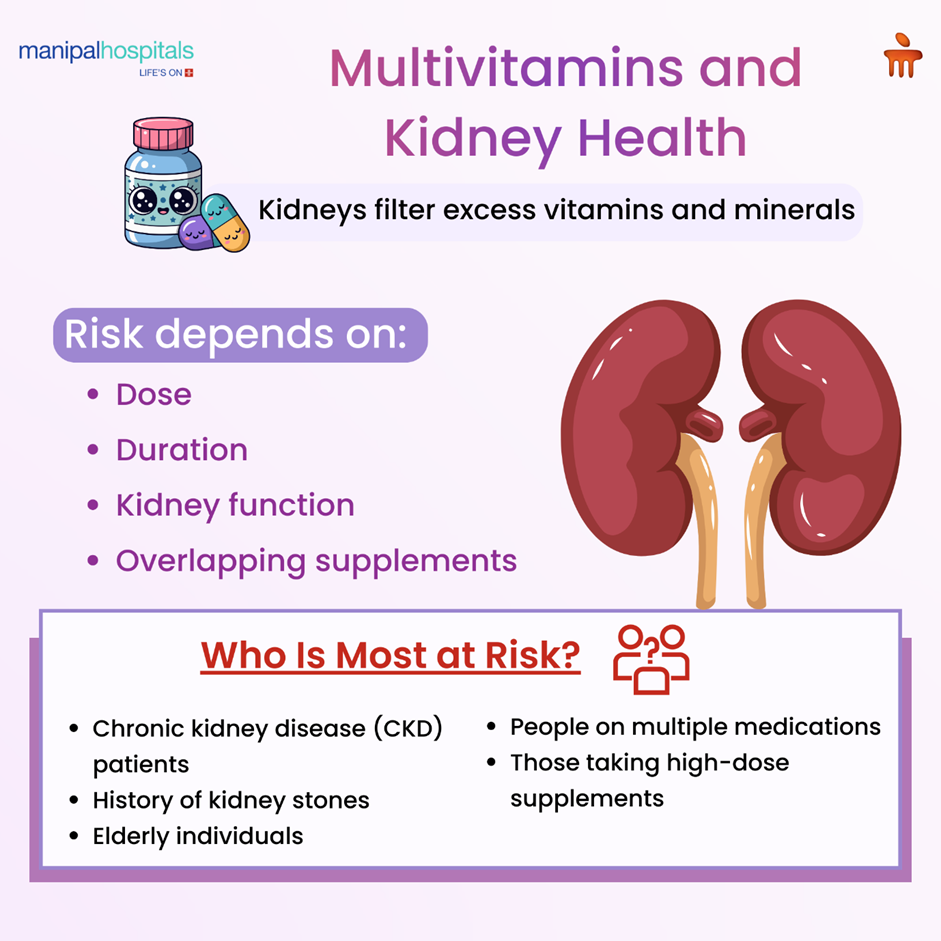
Who is Most at Risk?
-
Not everyone is equally vulnerable. Groups at higher risk of adverse kidney effects include:
-
People with chronic kidney disease (CKD) or reduced kidney function. The kidney’s reduced ability to excrete excess makes dose control essential.
-
Individuals with a history of kidney stones, especially calcium oxalate stones or recurrent stones.
-
People taking high-dose single-nutrient supplements in addition to a multivitamin.
-
Those on medications that affect kidney function (certain blood pressure drugs, NSAIDs, and some antibiotics).
-
Older adults with altered metabolism or polypharmacy.
-
Pregnant people should follow the clinician's guidance. Some multivitamin formulations are intended for pregnancy, while others are not suitable.
Early Signs of Kidney Diseases
Recognising early signs of renal strain can help avoid long-term damage. Even though symptoms may not be obvious at first, some clinical signs need to be looked into.
Some signs that something might be wrong are:
-
Frequent fatigue and weakness.
-
Swollen feet or ankles.
-
Nausea and vomiting.
-
Loss of appetite.
-
Recurrent pain in the back or side.
These symptoms do not always mean there is kidney damage, but they show why it is important to see a doctor to rule out side effects from multivitamins.
Diagnosis and Surveillance
When someone has possible kidney problems related to supplements, kidney specialists do a full check-up. Some common tests for diagnosis are:
|
Procedure |
What Is It Called |
What it Does |
|
Blood Tests |
Serum creatinine, eGFR, BUN |
Measures the kidney’s function. |
|
Urine Tests |
Urinalysis, Albumin-to-Creatinine Ratio (ACR) |
Detects kidney damage. |
|
Imaging Studies |
Ultrasound, CT, MRI |
Identifies structural abnormalities, cysts, or urinary tract obstructions. |
|
Kidney Biopsy |
Histopathology of renal tissue |
Identifies glomerular or interstitial diseases. |
|
Electrolyte Monitoring |
Sodium, potassium, and bicarbonate levels |
Detects kidney imbalances. |
|
Specialised Tests |
Renal scintigraphy, genetic testing |
Identifies hereditary kidney conditions. |
How are Supplement-Related Kidney Problems Treated?
If multivitamins are suspected to impair kidney function, early measures can often stabilise or reverse the changes. Treatment focuses on eliminating the cause, restoring balance, and preventing progression.
-
Stop or reduce the suspected supplement.
-
Encourage adequate hydration to improve clearance.
-
Correct elevated calcium, oxalate, or other electrolyte abnormalities.
-
Monitor kidney function through repeated blood and urine tests.
-
Review other medicines that may contribute to renal stress.
-
Refer to a nephrologist if abnormalities are severe or persistent.
How to Lower Risk When Using Multivitamins
Follow these practical steps:
-
Check doses—choose multivitamins that provide close to recommended daily allowances, not mega-doses.
-
Read labels—note vitamin C, vitamin D, and calcium amounts; avoid overlapping products that push totals too high.
-
Stay hydrated—dilute urine to reduce crystal concentration and stone risk.
-
Discuss with a clinician—especially if there is CKD, prior stones, pregnancy, or multiple medications.
-
Prefer food first—dietary sources reduce the need for high-dose supplements.
-
Use tested brands—choose reputable, regulated manufacturers to avoid contaminants.
-
Monitor labs—if you take high-dose supplements, check renal function and serum minerals periodically.
Conclusion
Multivitamins are important for keeping your health in excellent shape, but taking them incorrectly can cause kidney problems, especially in people who are already at risk. Using supplements in moderation and under a doctor’s guidance is the safest approach. Watch for symptoms, schedule regular checkups, and seek kidney health and supplements advice in Mysuru from specialist at Manipal Hospital to ensure safe use. With informed choices and expert supervision, supplements can support well-being without placing unnecessary strain on the kidneys.
FAQ's
Excess intake or long-term unsupervised supplementation can increase kidney stress and disrupt fluid and electrolyte balance, particularly in individuals with pre-existing risk factors or reduced renal reserve.
People with diabetes, high blood pressure, or chronic kidney disease should not consume them without a prescription. Consult your doctor and inform them about your underlying conditions for the best outcome.
People at risk for kidney stones may be affected by high vitamin C, calcium, or vitamin D intake. Adequate hydration, correct dosing, and regular monitoring help reduce complications.
Some warning signs include less urine, swelling, ongoing tiredness, nausea, or repeated pain in your side. If you notice these symptoms, see a doctor immediately.
People can speak with nephrology specialists at Manipal Hospital. Mysuru about kidney health and supplements. They offer advanced diagnostic facilities and personalised advice for a healthy kidney.
Share this article on: