
When your doctor recommends surgery, the first emotion that comes to your mind is apprehension. In the past, surgery meant large incisions, pain, and a long road to recovery. However, with advancements in medical science, minimally invasive surgeries are becoming increasingly common. These are surgeries with smaller incisions, quicker recovery times, and less physical stress. In current times, the debate is largely between two advanced medical procedures: laparoscopy and robotic-assisted surgery. Which procedure is better is not only dependent upon which procedure is better in itself but also upon how it works in tandem with your doctor’s skill to provide you with the best possible outcome for your condition.
On an initial assessment, both these medical procedures are almost similar. They involve smaller incisions, quicker recovery times, and less physical stress. However, if we look closer into these medical procedures, we can see that the difference between laparoscopic and robotic-assisted surgery is larger than it may seem. These are medical procedures that may have the same end objective but are performed with different tools and skill sets. Understanding robotic versus laparoscopic surgery is not only about understanding which procedure is better in itself. It is also about understanding how these medical procedures can benefit your condition and provide you with an optimal outcome. In this blog, we will explore these aspects in detail.

Understanding the Fundamentals of Minimally Invasive Surgery
Before comparing robotic versus laparoscopic surgery, it helps to understand what both approaches aim to achieve. Minimally invasive surgery is designed to reduce physical stress on the body while still allowing surgeons to perform complex procedures safely.
In traditional open surgery, a large incision is made to access the affected area. In contrast, minimally invasive techniques rely on small incisions through which specialised instruments and a camera are inserted.
Laparoscopic surgery
In laparoscopic surgery, the surgeon makes a few small cuts and uses a thin camera along with long surgical instruments to carry out the procedure. The camera sends a magnified view of the inside of the body to a screen, allowing the surgeon to operate with precision without making a large incision.
This approach has been used for many years and is widely trusted for procedures involving the gallbladder, appendix, hernia repair, gynecologic surgery, and several abdominal operations.
Robotic surgery
In robotic laparoscopic surgery, the surgeon still controls the operation, but the instruments are attached to robotic arms. The surgeon sits at a console and directs the movements through a high-definition system. The robotic platform translates the surgeon’s hand movements into more controlled, highly refined instrument actions.
This does not mean a robot performs surgery on its own. Rather, it is a surgeon-guided system that can offer enhanced dexterity and visualisation in certain cases.
Robotic Surgery vs Laparoscopic Surgery
Both techniques belong to the same family of minimally invasive surgery, so the basic recovery advantages overlap. The real distinction is in dexterity, visualisation, setup, and how much control the surgeon wants from the instruments during the operation.
Where Laparoscopic Surgery Continues to Excel
Even with newer technology available, laparoscopic surgery remains one of the most trusted forms of modern surgery. That is largely because it works well in a wide range of procedures and has a long record of dependable outcomes.
Another major advantage is familiarity. Many surgeons have extensive experience with laparoscopic techniques, and that experience often translates into efficiency, confidence, and consistency during surgery.
Some of the main benefits include:
-
Shorter recovery time: Smaller incisions usually heal faster
-
Reduced post-operative discomfort: Less tissue handling often means less pain
-
Lower risk of complications: Especially when performed by experienced surgeons
-
Cost-effectiveness: Usually more accessible than robotic surgery
For many routine procedures, laparoscopic surgery remains the most practical choice. In the discussion of robotic surgery vs laparoscopic surgery, it is important to remember that the older technique is still highly effective and widely used for good reason.
Situations Where Robotic Surgery Offers an Advantage
There are also cases where robotic systems bring real advantages. This tends to matter most in operations that require fine movement, detailed visualisation, or work in tight anatomical spaces.
Robotic systems can offer:
-
Greater precision in delicate areas
-
Better visualisation through 3D imaging
-
Easier access to hard-to-reach regions
-
Less physical strain for the surgeon during long procedures
These strengths can be especially useful in surgeries involving complex anatomy. In such cases, the benefits of robotic surgery vs laparoscopic surgery may become more noticeable.
Still, it is important not to overstate the difference. Robotic surgery is not automatically the better option in every setting. Its value depends on the procedure, the patient, and the surgeon’s level of experience with the system.
Key Factors That Influence the Choice of Surgical Method
When doctors consider robotic versus laparoscopic surgery, they do not base the decision on technology alone. Several practical and medical factors shape the final recommendation.
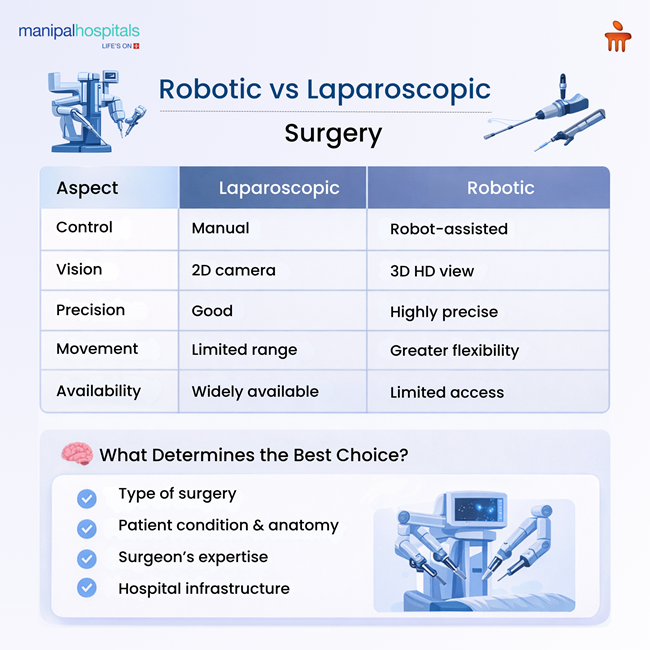
1. Nature of the Procedure
Some operations are straightforward and can be done very effectively using laparoscopy. Others involve more delicate work and may benefit from robotic precision.
2. Patient-Specific Considerations
Previous surgeries, body type, underlying health issues, and anatomical differences can all influence which method is safer or more suitable.
3. Surgeon’s Experience
A skilled laparoscopic surgeon may achieve excellent results without robotic assistance. In many cases, a surgeon's expertise matters more than the machine itself.
4. Infrastructure Availability
Robotic systems are not available in every hospital. Access, cost, and local surgical setup can all affect the final choice.
Understanding these points provides a clearer picture of the difference between laparoscopic and robotic surgery beyond the technology alone.
Recovery Experience and What Patients Can Expect
For most patients, the recovery period is one of the biggest concerns. The good news is that both methods are designed to support easier recovery than open surgery.
Typical recovery advantages include:
-
Smaller scars
-
Shorter hospital stay
-
Faster return to daily activities
-
Lower risk of infection
That said, recovery is still influenced by the type of surgery, the person’s overall health, and how complex the condition was in the first place. In many situations, robotic surgery vs laparoscopic surgery offers similar recovery benefits, with differences becoming more relevant in specific procedures rather than in every case.
Risks and Considerations That Should Not Be Overlooked
No surgery is completely without risk. Even minimally invasive procedures need careful planning, proper execution, and close monitoring after the operation.
Some of the common risks include:
-
Bleeding
-
Infection
-
Reactions to anaesthesia
-
Injury to nearby tissues
In rare situations, a minimally invasive surgery may need to be changed into an open procedure for safety reasons. That can happen with both laparoscopic and robotic methods. Being aware of this possibility helps set realistic expectations and supports better decision-making.
Conclusion
When it comes to robotic surgery and laparoscopic surgery, the choice between the two is not necessarily about which is more effective. It is about choosing the best option according to the condition, the anatomy involved, and the surgeon’s opinion. If you are considering the best option between the two, talk to spine specialists at Manipal Hospitals. This would enable you to proceed with more confidence and the option that is best for your condition.