


 6 Min Read
When someone has a stubborn or unusual lung infection, deciding what is causing it can feel urgent and uncertain. Transbronchial lung cryobiopsy offers a way to collect larger, higher-quality lung tissue samples than many older methods, which helps doctors reach a clear diagnosis faster in difficult cases of pneumonia. For you as a patient or caregiver, this means fewer repeated tests, more accurate treatment, and a shorter time to the right antibiotics or other therapies. This blog explains how the procedure works, why it matters for diagnosing pneumonia, what to expect before and after, and how the benefits weigh against the risks in everyday clinical practice.
Synopsis
- What is Transbronchial Lung Cryobiopsy
- Why Cryobiopsy Matters in Diagnosing Pneumonia
- How the Procedure is Done
- Cryobiopsy Advantages CTransbronchial Lung Cryobiopsy: A Game-Changing Tool in Diagnosing Pneumoniaompared with Traditional Biopsies
- Risks and Safety Considerations
- Who is a Candidate for Cryobiopsy
- What Results Mean and What to Expect After the Procedure
- Practical Tips for Patients
- Conclusion
What is Transbronchial Lung Cryobiopsy
Transbronchial lung cryobiopsy is a minimally invasive procedure that uses a bronchoscope and a specialised freezing probe to obtain lung tissue. Unlike conventional forceps biopsies, the cryoprobe freezes a small area of lung and extracts a larger, well-preserved tissue sample for pathological and microbiological examination. The technique is performed by a specialist in interventional pulmonology who navigates the bronchoscope into the airways, selects the biopsy site under imaging guidance, and briefly applies freezing to capture a sample.
Why Cryobiopsy Matters in Diagnosing Pneumonia
When pneumonia does not respond to standard treatment or when imaging shows an unusual pattern, a simple sputum test or chest X-ray may not give enough information. In such cases, a targeted tissue diagnosis can identify uncommon infections, inflammatory diseases, or alternative causes that mimic infection. Transbronchial lung cryobiopsy yields larger samples suitable for culture, histology, and advanced tests such as polymerase chain reaction and special stains. That broader diagnostic yield improves the chance of identifying the exact cause of illness and tailoring treatment.
How the Procedure is Done
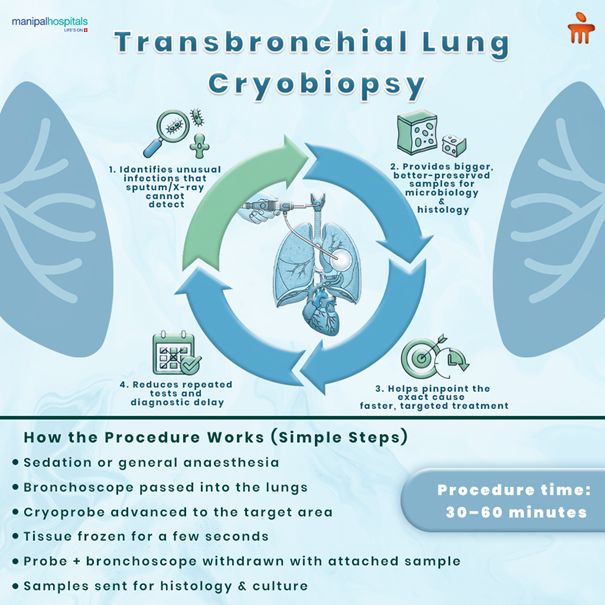
Before the procedure, your doctor reviews your history, medicines, and any bleeding risk. You will usually have blood tests and imaging, such as a CT scan, to plan the biopsy. The procedure is commonly performed under general anaesthesia or deep sedation to keep you comfortable and still.
-
A bronchoscope is passed through the mouth or nose into the airways to reach the target zone.
-
The cryoprobe is advanced through the bronchoscope to the chosen area.
-
The probe is activated for a few seconds to freeze the tissue, which adheres to the probe.
-
The probe and bronchoscope are withdrawn together with the attached tissue sample.
-
The sample is placed in fixative for histology and in sterile media if culture is needed.
-
A small number of samples are taken to reduce risk while obtaining adequate tissue.
Most centres monitor oxygen levels and have immediate access to chest imaging if needed after the biopsy.
Cryobiopsy Advantages CTransbronchial Lung Cryobiopsy: A Game-Changing Tool in Diagnosing Pneumoniaompared with Traditional Biopsies
Cryobiopsy provides several significant practical benefits that make it attractive for complex cases of pneumonia.
-
A larger sample size that preserves tissue architecture, improving tissue diagnosis accuracy.
-
Better yield for microbiology because samples are less crushed than forceps biopsies.
-
Reduced need for repeat biopsies, so you face fewer procedures overall.
-
Can be done through flexible bronchoscopy, avoiding the higher invasiveness of surgical lung biopsy in many cases.
-
Faster path to the right treatment when uncommon organisms or interstitial changes are suspected.
These advantages explain why many centres now include cryobiopsy as part of their diagnostic pathway for difficult lung infections.
Risks and Safety Considerations
No procedure is risk-free, and it is important that you understand the main potential complications before consenting. Specialists use careful technique and monitoring to reduce these risks.
-
Bleeding at the biopsy site. Most bleeding is controllable with local measures during bronchoscopy, but rarely a larger bleed may need further intervention.
-
Pneumothorax, where air leaks into the chest cavity and may require a temporary chest drain. The complication rate is variable across studies and is linked to biopsy location and the number of samples.
-
Transient oxygen desaturation during the procedure, which is managed immediately.
-
Infection risk is low because samples are taken under sterile conditions, but an existing severe infection can complicate recovery.
-
For people with bleeding disorders or very poor lung function, the procedure may be unsuitable.
Your doctor will explain how these risks apply to your specific health and what precautions will be taken.
Who is a Candidate for Cryobiopsy
Cryobiopsy is not for every case of pneumonia. It is most useful when standard tests are inconclusive, when imaging suggests atypical or diffuse lung disease, or when the infection is not responding to treatment.
-
Patients with persistent or atypical pneumonia despite appropriate antibiotics.
-
Cases where imaging shows diffuse or interstitial lung changes that need histological clarification.
-
Patients in whom less invasive tests such as sputum culture, bronchoalveolar lavage, and imaging have not yielded a diagnosis.
-
People fit enough to undergo bronchoscopy under sedation or anaesthesia and without prohibitive bleeding risk.
Your interventional pulmonologist will weigh the likely diagnostic benefit against the procedural risk in a personalised discussion.
What Results Mean and What to Expect After the Procedure
A cryobiopsy sample goes to pathology and microbiology. Results commonly appear within a few days for microbiology and within one to two weeks for histology, depending on the tests ordered.
-
Microbiology results may identify bacteria, fungi, or atypical organisms, guiding specific antimicrobial therapy.
-
Histology can show patterns of inflammation, granulomas, vasculitis, or other changes that point to noninfectious causes.
-
If results are definitive, you and your doctor can change or stop empirical treatments and start targeted therapy.
-
If results are non-diagnostic, your team may still use the tissue findings to narrow probable causes or consider surgical biopsy in selected cases.
After the procedure, you will be monitored for a few hours, have a chest X-ray if indicated, and receive clear instructions about activity and warning signs to watch for.
Practical Tips for Patients
Knowing practical steps helps you prepare and recover smoothly.
-
Tell your doctor about all medicines, especially blood thinners, which may need temporary adjustment.
-
Arrange transport home and a short period of rest after the procedure.
-
Report any new or worsening breathlessness, chest pain, or heavy bleeding immediately.
-
Keep follow-up appointments to review results and plan further treatment.
-
Ask your doctor which tests will be run on the tissue and when you can expect results.
Conclusion
Transbronchial lung cryobiopsy is a powerful tool in diagnosing pneumonia when routine tests are not enough. For you as a patient, it can shorten the path to a precise diagnosis, reduce repeated procedures, and allow treatment that is tailored to the specific cause. The technique carries some risk, but when performed by an experienced interventional pulmonology team, the balance of benefit to risk is often favourable in complex lung infections. If you are facing persistent or unusual pneumonia, discuss cryobiopsy as one of the options with a specialist such as Dr. Jagadeesh Kumar P at Manipal Hospitals Malleshwaram.
FAQ's
You will be sedated or under general anaesthesia and feel no pain during the procedure. Mild throat soreness or chest discomfort is common afterwards.
The bronchoscopy and biopsy typically take 30 to 60 minutes, plus recovery time.
Many patients go home the same day after monitoring, but some may need an overnight stay if precautions are required.
Cryobiopsy often provides diagnostic tissue comparable to surgical biopsy for many conditions, while being less invasive. Surgical biopsy may still be needed in selected cases.
Discuss with your pulmonologist or an interventional pulmonology specialist to see if transbronchial lung cryobiopsy is appropriate for your situation.
Share this article on:


