6 Min Read
Leprosy, also called Hansen’s disease, is an infectious bacterial disease that mainly affects the skin, upper respiratory tract, eyes and nervous system. This disease is seen worldwide, but is more commonly in countries like India, Brazil and Indonesia. Leprosy is characterized by skin lesions, numbness and also nerve damage, but in extreme cases. Despite being infectious, leprosy is fully curable. Despite this, people affected by leprosy face discrimination, isolation and stigma. World Leprosy Day aims to bring awareness about this disease and treatments, eradicate stigma and work towards eradication of this disease.
Synopsis
What is World Leprosy Day?
World Leprosy Day was first observed in 1954. Since then, it is observed internationally every year on the last Sunday of January. The idea was initiated by Raoul Follereau, a French humanitarian. He did this to pay tribute to Mahatma Gandhi, who was compassionate towards people affected by leprosy. In India, the day is observed as World Leprosy Eradication Day on 30 January, marking Gandhi’s death anniversary and reinforcing the country’s commitment to eliminating the disease.
What is Leprosy?
Leprosy is a chronic bacterial disease caused by mycobacterium leprae or mycobacterium leprematosis. It primarily affects the skin, mucosa layer of the upper respiratory tract and nervous system. Leprosy can cause skin lesions, numbness in the affected areas and, in severe cases, nerve damage. Lesions from leprosy usually do not heal without proper treatment. This can cause them to spread and affect healthy tissue. In cases where lesions become severe, the affected part needs to be amputated.
Myths Surrounding Leprosy
Leprosy is one of the oldest recorded diseases in the world, but it is surrounded by myths. These myths create stigma, due to which affected people face isolation and discrimination. World Leprosy Day, or World Leprosy Prevention Day, aims at eradicating these stigmas and help affected individuals live a normal life.
Some common myths surrounding leprosy include:
1. Myth: Leprosy is a highly contagious disease.
Fact: Leprosy spreads very slowly, and only through prolonged contact with an affected person. Almost 95% of people exposed to the bacteria do not develop leprosy. Once treatment begins, an affected person can no longer infect others.
2. Myth: Leprosy makes body parts fall off.
Fact: Body parts do not fall off due to leprosy. Extensive nerve damage and loss of sensation get complicated with injuries, infections, muscle atrophy, and bone resorption, which leads to deformity and disability.
3. Myth: Leprosy cannot be cured.
Fact: Leprosy is fully curable with Multi-Drug Therapy (MDT). Treatment is free worldwide, and within 6-12 months, the affected person can achieve full recovery.
4. Myth: People in impoverished conditions get leprosy.
Fact: Leprosy can affect anybody irrespective of their socioeconomic conditions. It is not strictly limited to any specific group of people.
5. Myth: Leprosy is a curse/punishment
Fact: Leprosy is a bacterial infection with no spiritual connection whatsoever. It can affect anybody, irrespective of age, gender or racial background.
6. Myth: Leprosy spreads through touch.
Fact: Leprosy is contagious but has a slow infection rate. It does not spread through hugs, handshakes or sharing food, clothes and utensils.
National Leprosy Elimination Programme
India has seen significant reduction in leprosy cases. As of March 2025, infection rate is 0.57 per 10,000 population. The Indian Council of Medical Research (ICMR) leads the National Leprosy Eradication Programme (NLEP) in the country which aims to achieve complete elimination of this disease.
Launched in 1955, NLEP is a government-sponsored scheme aimed at making treatment accessible for all sections of the society, bringing down new infection cases and ensuring zero disability in new cases for children and adult patients. NLEP also aims at eradicating stigmas and discrimination faced by people affected by leprosy. Some of its strategies include:
-
Providing treatment through an integrated healthcare system
-
Early detection and complete treatment of new cases by involving social service organisations like ASHA
-
House-to-house surveys for more efficient detection
-
Strengthened disability prevention and medical rehabilitation
-
Education against myths and misinformation
-
Awareness sessions on treatment and prevention.
-
Consistent monitoring across hospitals and healthcare centres.
World Leprosy Day Participation
The theme for World Leprosy Day 2026 is, “Beat Leprosy, End Stigma and Advocate for Inclusion”.
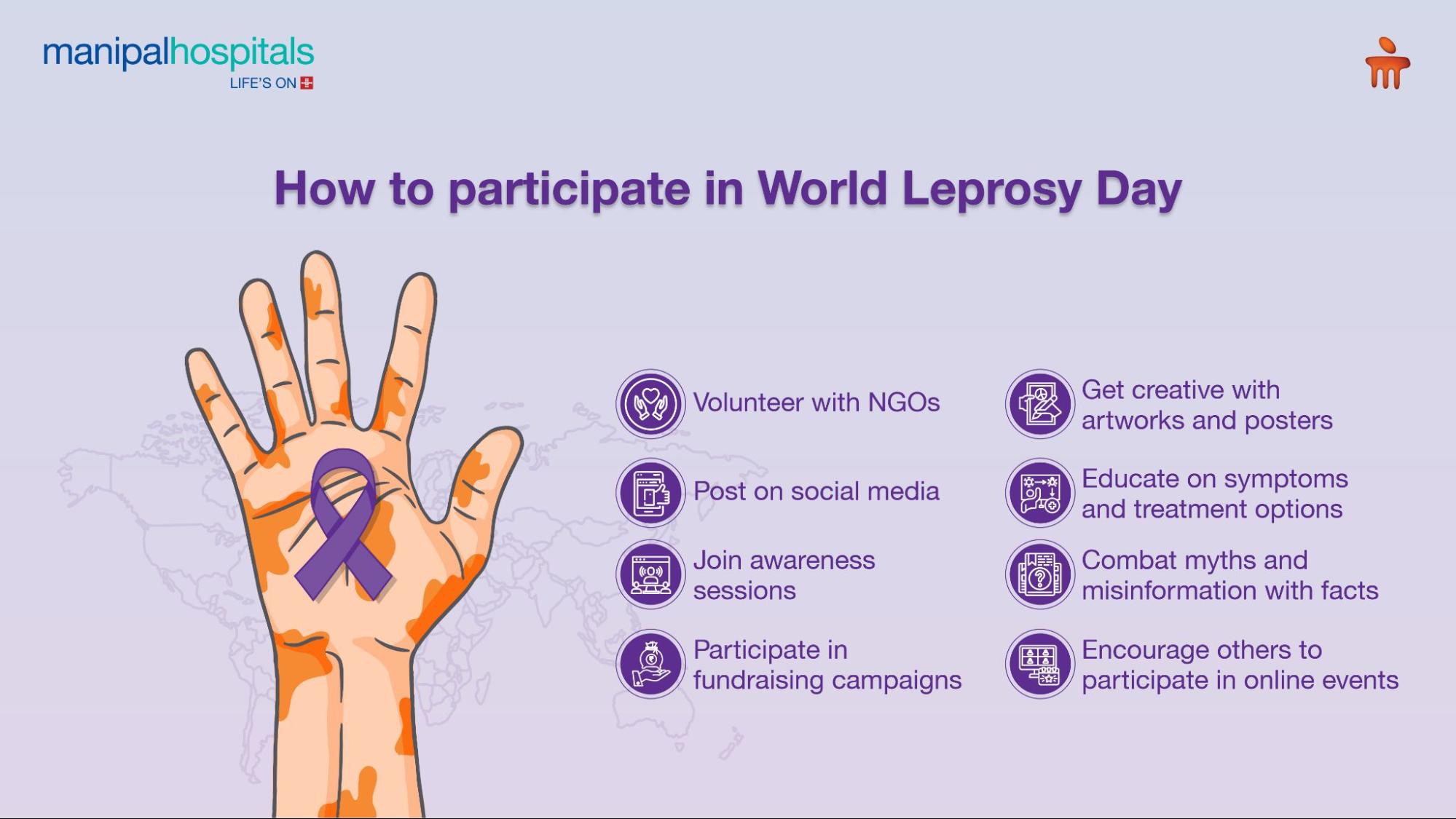
Here are some ways by which you can participate in World Leprosy Day:
-
Leprosy awareness: Participate in awareness sessions, health talks, and other events to know more about leprosy.
-
Combatting misinformation: Observe World Leprosy Day by educating others about leprosy, its symptoms, prevention and treatments.
-
Creative outlets: Creating posters, crafts or artworks to commemorate World Leprosy Day encourages participation.
-
Use social media: Use social media platforms to spread awareness about leprosy through posts, carousels and reels.
-
Fundraising campaigns: Participate in World Leprosy Day events like talks, debates, contests, concerts, runs and more. These events often help raise funds for research and providing necessities for the affected individuals.
-
Volunteering: Volunteering at NGOs working with leprosy patients is a great way to participate in World Leprosy Day. This way, you get to communicate with people affected by leprosy and hear about their experience with the condition.
-
Online events: Online World Leprosy Day events encourage widespread global participation. You can participate in such events and encourage others to do the same.
Conclusion
Leprosy is a treatable bacterial disease that affects the skin, nerves, and mucous membranes.While initially considered a life-threatening condition, it is completely treatable with proper medication. However, stigma attached with leprosy leads to discrimination against affected people. World Leprosy Day is observed to end this stigma and continue the fight against leprosy until it is completely eradicated. Raise your voice. Join the movement to help raise awareness, eradicate misconceptions and continue the fight against leprosy. If you notice any skin concerns, visit your nearest Manipal Hospital unit. Our expert dermatologists will provide you with tailored treatment plans for your dermatological needs.
FAQ's
Some of the key symptoms of leprosy include light or reddish lesions on skin, numbness in the affected areas, tingling and loss of sensation.
Leprosy mainly affects the skin and peripheral nervous system. Severe cases of leprosy can affect bones. However, leprosy does not affect major organs like heart, brain or liver.
Leprosy can co-exist with other medical conditions or infections, like HIV. Despite this, treatment can be safely administered under the supervision of a doctor.
Leprosy targets the nervous system and causes nerve damage. Residual nerve damage causes persistent neuropathic pain even after healing from infection.
The severity of leprosy depends on stage of detection and immunity. Weakened immune system or detection at a much later stage can increase severity of the condition.
Share this article on: