




 7 Min Read
Road accidents are one of the leading causes of injury and death across India. According to national road safety data, thousands of accidents occur every day, many resulting in serious injuries or fatalities. A significant number of these deaths happen not because the injuries are untreatable, but because timely emergency care is not available.
In a road accident, the first few minutes are critical. Doctors often refer to this period as the golden hour. Proper medical support during this time can prevent severe blood loss, protect vital organs, and save lives. Unfortunately, delays in ambulance arrival, lack of trained medical staff, or limited on-site treatment often reduce survival chances.
This is where MARS (Manipal Ambulance Response Service) plays a vital role. MARS is designed to bring advanced emergency care directly to the accident location, ensuring that life-saving treatment begins even before the patient reaches the hospital.
Synopsis
- Understanding Road Accident Emergencies
- Why Emergency Care at the Accident Site Is Critical
- What Is MARS and How Does It Work?
- Rapid Response: Reaching the Accident Location Quickly
- Advanced Life Support Ambulances
- Skilled Emergency Medical Professionals on Board
- On-Spot Life-Saving Interventions by MARS
- Continuous Care During Hospital Transfer
- How MARS Improves Survival and Recovery
- When Should MARS Be Contacted?
- What Bystanders Can Do While Medical Help Is on the Way
- Conclusion
Understanding Road Accident Emergencies
Road accident emergencies are sudden and unpredictable. Injuries can range from minor cuts to life-threatening trauma. The condition of the patient can worsen quickly without medical intervention.
Common medical emergencies after road accidents include:
-
Severe bleeding
-
Head and brain injuries
-
Spinal and neck injuries
-
Chest injuries affecting breathing
-
Multiple fractures
-
Shock due to blood loss (Intra-abdominal & pelvic injuries)
Many of these conditions require immediate medical attention. Even a short delay can lead to permanent disability or death. This makes quick access to emergency care essential.
Why Emergency Care at the Accident Site Is Critical
Emergency care is most effective when it begins early. On-site treatment stabilises the patient and prevents further damage during transport.
Early emergency care helps to:
-
Control bleeding and prevent shock
-
Maintain airway and breathing
-
Protect the spine and neck
-
Monitor vital signs
-
Reduce complications before hospital arrival
An advanced emergency ambulance service ensures that these interventions begin as soon as possible, rather than waiting until the patient reaches a hospital.
What Is MARS and How Does It Work?
MARS, or Manipal Ambulance Response Service, is a specialised emergency response system developed by Manipal Hospitals. Its primary focus is to provide advanced, hospital-level emergency care at the scene of accidents and during patient transport.
Unlike basic ambulances that focus mainly on transportation, MARS functions as a mobile emergency unit. It ensures that patients receive continuous medical attention from the moment help arrives until they are handed over to the hospital team.
Rapid Response: Reaching the Accident Location Quickly
In road accident emergencies, time is the most important factor. MARS operates with a rapid dispatch system that ensures ambulances are sent out immediately after receiving an emergency call.
GPS-enabled vehicles and trained response teams help reduce response times, especially on highways and busy roads. For people searching for an emergency ambulance service near me during a crisis, MARS ensures quick and reliable assistance when every minute matters.
Advanced Life Support Ambulances
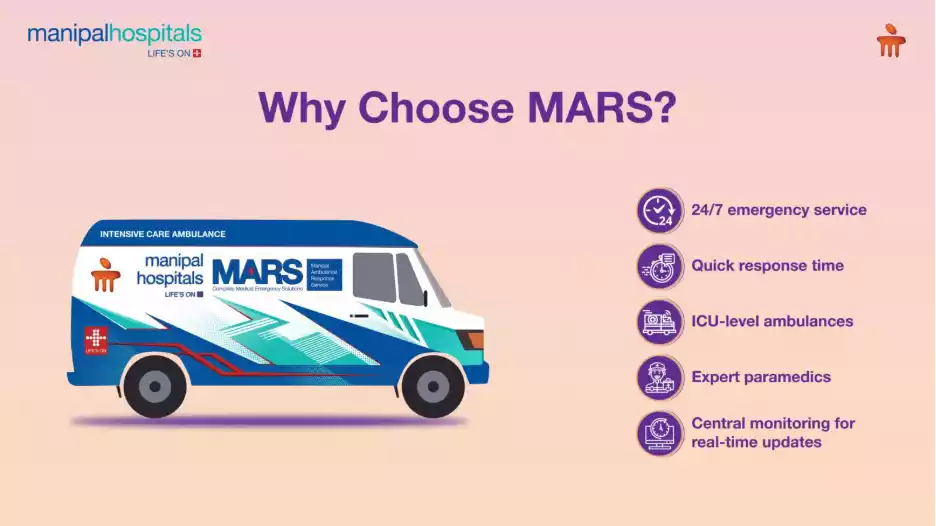
MARS ambulances are equipped with advanced life support (ALS) systems. These ambulances are designed to handle critical trauma cases effectively.
Key features of MARS ambulances include:
-
24/7 dedicated command centre for rapid coordination and response (Call: 033-2222-1111)
-
Fully equipped ambulances with essential emergency drugs and medical equipment to manage critical situations on the spot
-
Well-trained Emergency Medical Technicians (EMTs) experienced in handling trauma and medical emergencies
-
Advanced Cardiac Life Support (ACLS) and Basic Life Support (BLS) ambulances to support patients with varying levels of medical need
-
BLS-trained ambulance drivers focused on safe, timely, and patient-centred transport
-
Live video streaming from the ambulance to Manipal Hospitals, enabling doctors to guide care even before hospital arrival
-
Real-time vehicle tracking through GPRS, ensuring faster response times and better coordination
Skilled Emergency Medical Professionals on Board
One of the strongest aspects of MARS is its medical team. Each ambulance is staffed with trained emergency professionals who can manage critical situations confidently.
The team may include:
-
Emergency doctors or critical care specialists
-
Trained paramedics
-
Emergency medical technicians (EMTs)
They are experienced in trauma management, resuscitation, airway control, and advanced life support. Their expertise ensures that patients receive the right treatment at the right time.
On-Spot Life-Saving Interventions by MARS
MARS teams are trained to deliver more than basic first aid. They provide advanced medical interventions directly at the accident site.
On-spot emergency care includes:
-
Stopping severe bleeding using advanced techniques
-
Securing the airway and supporting breathing
-
Providing oxygen and ventilation support
-
Starting intravenous fluids and medications
-
Continuous monitoring of heart rate, oxygen levels, and blood pressure
These steps help stabilise the patient before transport and reduce the risk of complications.
Continuous Care During Hospital Transfer
Emergency care does not stop once the patient is inside the ambulance. MARS ensures continuous monitoring and treatment during transit.
The medical team closely tracks vital signs and responds to any sudden changes. Communication with the receiving hospital allows emergency departments to prepare in advance. This smooth handover saves valuable time once the patient arrives.
How MARS Improves Survival and Recovery
Early and effective emergency care significantly improves survival rates after road accidents. MARS reduces delays between injury and treatment, which is often the deciding factor in critical cases.
Key benefits of MARS include:
-
Faster medical response
-
Early stabilisation of life-threatening injuries
-
Reduced risk of complications
-
Better outcomes after hospital admission
This makes MARS a dependable emergency ambulance service for road accident victims.
When Should MARS Be Contacted?
MARS should be contacted immediately in any serious road accident situation.
Call MARS if there is:
-
Loss of consciousness
-
Heavy bleeding
-
Suspected head or spinal injury
-
Multiple injured persons
Searching for an emergency ambulance service near me during an emergency can cause delays. Keeping emergency numbers saved can help ensure a faster response.
What Bystanders Can Do While Medical Help Is on the Way
In the moments before an ambulance arrives, bystanders can play a supportive role by acting carefully and responsibly.
Helpful actions:
-
Remain composed and speak calmly to the injured person
-
Ask the person to stay still, especially if there may be neck or back injuries
-
If trained, apply light pressure to visible bleeding to slow blood loss
-
Check that the person is breathing comfortably and nothing is blocking the airway
Actions to avoid:
-
Do not move the injured person unless there is immediate danger
-
Do not offer food, water, or medication
-
Do not remove helmets or safety gear unless breathing is affected
Taking these precautions can reduce the risk of further harm until trained emergency professionals arrive.
Conclusion
Road accidents strike without notice and often leave very little time to react. In such situations, timely emergency care can be the deciding factor between survival and severe outcomes. MARS plays a crucial role by extending hospital-level care to the accident site and maintaining medical support during transport. By reducing delays and ensuring early stabilisation, MARS helps improve survival chances and recovery outcomes. When time is critical, MARS serves as a dependable emergency response on the road.
FAQ's
Medical assistance should arrive as quickly as possible. Even short delays after an accident can result in serious complications such as uncontrolled bleeding, breathing problems, or worsening brain injuries. Early emergency care is essential for stabilisation.
Many patients deteriorate due to the absence of medical care at the scene. Without timely oxygen support, spinal stabilisation bleeding control, or monitoring, injuries can escalate during transit. This highlights the importance of advanced emergency ambulance services.
MARS delivers immediate medical care at the location of the accident. The priority is to assess injuries, stabilise vital functions, and prevent further complications before hospital transfer.
Arterial stiffness reflects how flexible or stiff your arteries are, commonly measured using pulse wave velocity (PWV). Higher stiffness increases the risk of heart disease and stroke. Wearables can track trends, but clinical tests provide more accurate and actionable results.
Early medical intervention helps maintain oxygen supply, manage blood loss, and protect vital organs. This early stabilisation often leads to smoother hospital treatment and better overall recovery.
Yes, MARS communicates with hospital doctors during transit, allowing emergency departments to prepare in advance and minimise treatment delays upon arrival.
Wearable accuracy can be affected by movement, skin tone, device fit, and intense activity. They may overestimate or underestimate readings and generate false alerts. Privacy concerns, lack of standardisation, and over-reliance without medical guidance are additional challenges highlighted by experts.
Yes, MARS operates round the clock to respond to road accident emergencies, ensuring access to emergency care at any hour.
Share this article on:


.webp "Emergency ambulance service in Kolkata during heart attack")





