7 Min Read
Worried about choosing the safest option for your planned surgery?
The choice between laparoscopic surgery and open surgery influences pain levels, recovery time, scarring, hospital stay, and return to routine activities. While laparoscopic procedures are increasingly common, they are not suitable for every condition or every patient. This blog explains how both techniques work, compares their safety profiles, outlines situations where one may be preferred over the other, and helps you understand what factors surgeons consider before recommending a specific approach.
Synopsis
- What is Laparoscopic Surgery?
- What is Open Surgery?
- Key Technical Differences
- Laparoscopic Surgery Vs Open Surgery
- Benefits of Laparoscopic Surgery
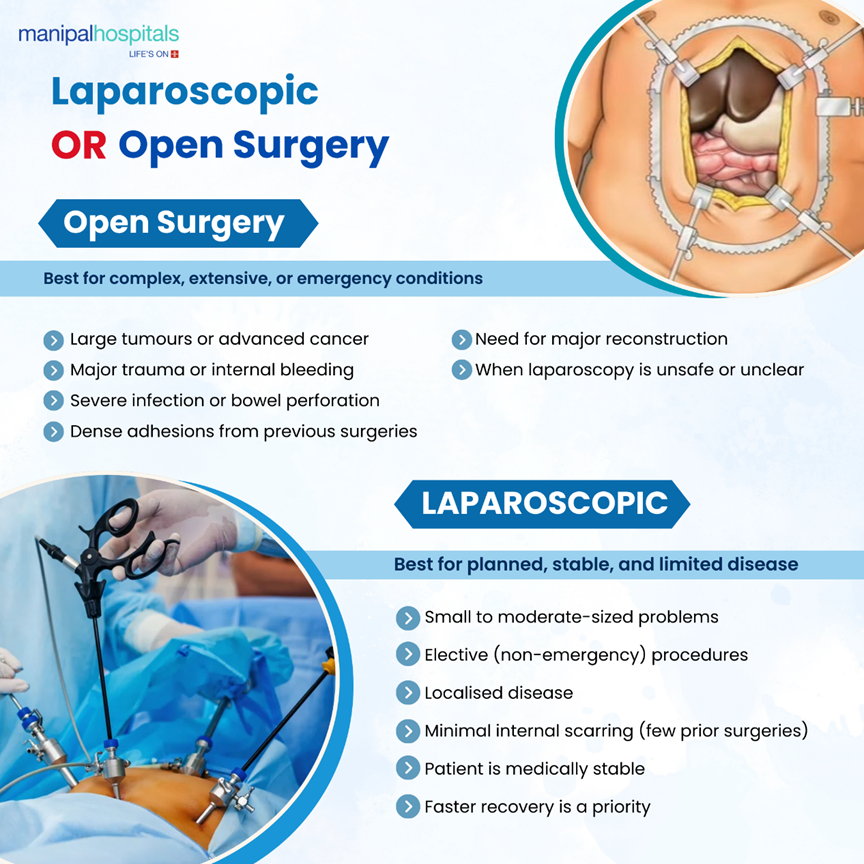
- When is Open Surgery More Preferable?
- Risks and Complications to Consider
- Recovery and Rehabilitation
- Surgeon Skill, Hospital Resource, and Outcomes
- Costs and Practical Considerations
- Preparing for Surgery
- Postoperative Warning Signs
- Conclusion
What is Laparoscopic Surgery?
Laparoscopic surgery is a minimally invasive technique that uses small incisions, a camera, and specialised instruments. The term "laparoscopy" describes this keyhole technique that allows internal viewing without a large incision, which is why it is also called "keyhole surgery." Surgeons insert a laparoscope to view organs on a monitor and perform precise movements. Common procedures performed using the laparoscopic approach include gallbladder removal, appendectomy, hysterectomy, bariatric procedures, and hernia repair. The approach aims to reduce wound size and speed recovery. For many routine abdominal and pelvic problems, laparoscopy is now the preferred option when feasible.
What is Open Surgery?
Open surgery is a conventional approach that uses a single larger incision that gives direct access to organs. Surgeons work with their hands and traditional instruments. Open surgery remains the standard for complex operations, extensive disease, and emergencies. It offers direct tactile feedback and easier access for reconstructions. For conditions that involve large tumours, multiple organ systems, or major trauma, the open surgical approach can provide the safest and most controlled approach.
Key Technical Differences
The following are the key differences between open and laparoscopic surgery.
-
Incision size: Laparoscopy uses small ports, while the open approach requires a larger cut.
-
Visualisation: Laparoscopy relies on camera magnification and bright lighting. Open surgery provides a direct, three-dimensional view.
-
Instrument control: Laparoscopic instruments operate through ports and provide less tactile feedback. Laparoscopy requires insufflation of the abdomen with gas to create working space. Open instruments allow direct hand manoeuvres.
-
Conversion possibility: Surgeons may start with a laparoscopic technique and move to an open approach if visibility or access is inadequate. Conversion is a decision made for safety.
Laparoscopic Surgery Vs Open Surgery
Surgical approach differences give the patient an informed view. The comparison below points out how the techniques of laparoscopic and open approaches differ, as well as their recoveries and suitability, so that clear expectations around healing time, discomfort, and outcomes can be set before surgery.
|
Feature |
Laparoscopy Surgery |
Open Surgery |
|
Incision |
Multiple small ports |
Single larger incision |
|
Visualisation |
Magnified camera view |
Direct line of sight |
|
Recovery |
Shorter hospital stay and quicker return to activity |
Longer hospital stay and slower recovery |
|
Pain |
Generally, lower postoperative pain |
Generally, higher postoperative pain |
|
Scarring |
Small, less visible scars |
A larger scar that is more visible |
|
Blood Loss |
Often less |
Can be more |
|
Infection Risk |
Lower wound infection risk |
Higher wound infection risk |
|
Best Use |
Elective or limited disease |
Complex diseases, emergencies |
Benefits of Laparoscopic Surgery
Patients often choose a laparoscopy or keyhole surgery for smaller scars, reduced pain, and faster return to work. Reduced tissue exposure lowers the risk of wound infections and adhesions.
Many studies show that for specific procedures, keyhole surgery achieves similar long-term outcomes to open approaches while improving short-term recovery. For example, laparoscopic cholecystectomy and laparoscopic colectomy are common standards in many centres. For patients with stable disease and suitable anatomy, laparoscopy typically improves comfort in the early postoperative period.
When is Open Surgery More Preferable?
You will be recommended open surgery when the disease extent is large, prior scarring creates dense adhesions, or when immediate control of bleeding is vital. Surgeons often prefer open surgery in trauma care, extensive cancer operations, and when the planned reconstruction requires a direct manual technique. In some complex abdominal or pelvic surgeries, open access allows the team to perform multiple steps more safely and quickly.
Risks and Complications to Consider
No operation is risk-free. Laparoscopic surgery risks include:
-
Injury to blood vessels or hollow organs,
-
Gas-related shoulder discomfort, and
-
The need to convert to open surgery.
Conversion is a prudent choice when safety requires it.
Open surgery carries a higher risk of:
-
Wound infection
-
Greater blood loss
-
Longer pain control needs.
Both approaches involve anaesthesia risks, such as breathing or cardiac events. Both can result in complications like deep vein thrombosis or postoperative ileus. Your individual risk depends on age, medical history, and the specific procedure.
Recovery and Rehabilitation
After laparoscopic surgery, patients typically have shorter hospital stays and can resume light activity within days. Pain is usually manageable with oral medication. Wound care involves small port sites and simple dressings. After open surgery, recovery includes longer wound healing, more intensive pain control, and a gradual return to daily tasks over weeks. Nutrition, controlled blood sugar, and smoking cessation speed healing in both types of surgery. Physiotherapy is often recommended to support recovery after major operations.
Surgeon Skill, Hospital Resource, and Outcomes
Outcomes depend heavily on surgeon experience and hospital resources. Centres that perform high volumes of laparoscopic surgery demonstrate lower complication rates. Conversely, access to intensive care, blood bank, and multidisciplinary teams in Jayanagar makes open surgery safer when complex management is needed. When choosing a hospital, check the surgical team’s experience with the specific procedure and ask about postoperative support services.
Costs and Practical Considerations
Cost varies with procedure, implants used, and hospital stay length. Laparoscopic surgery may use higher-cost disposables, but shorter inpatient time often offsets these expenses. Open surgery can be less expensive for simple, short procedures, but may incur higher costs due to longer hospitalisation and rehabilitation. Verify coverage with your insurer and discuss expected out-of-pocket costs with the hospital billing team.
Preparing for Surgery
Be prepared by optimising your chronic conditions, finishing pre-op tests, and following medication regimens. Quit smoking and make arrangements for help during home recovery. In preparation for laparoscopic surgery, plan for shorter hospital stays and return to usual activities sooner. In preparation for open surgery, make arrangements for extended leave at work, in addition to help at home. Good communication with your surgical staff can help decrease uncertainties associated with recovery.
Postoperative Warning Signs
After any abdominal operation, report if you experience the following:
-
Fever
-
Increasing pain
-
Redness or drainage at the wound
-
Persistent vomiting
-
Breathing difficulty
After laparoscopic surgery, report severe shoulder pain or sudden swelling at a port site. After open surgery, watch for wound drainage or increased redness. Early reporting allows prompt treatment and prevents complications.
Conclusion
Both laparoscopic and open surgery are established, safe methods when matched to the right patient and condition. Lap surgery offers advantages in recovery and scarring for many elective cases. Open surgery remains essential for complex disease and emergency situations. Discuss options, risks, and the surgeon's experience to make an informed choice.
For expert surgical assessment and both laparoscopic and open surgical approaches, visit Manipal Hospital Jayanagar. Our surgical teams offer personalised surgical planning and comprehensive postoperative care.
FAQ's
Not always. Safety depends on disease type, your overall health, and the surgeon’s experience. For many elective procedures, laparoscopic surgery reduces recovery time, but open surgery may be safer for complex problems.
Conversion rates vary by procedure and patient factors, such as prior surgery and anatomy. Conversion is a judgment call to ensure safety and a good outcome.
In many cases, yes. Laparoscopic surgical approach typically leads to shorter inpatient time and earlier return to activity. The exact length of stay depends on the procedure and your recovery.
Smaller wounds after a laparoscopic operation reduce superficial wound infections. Deep infections depend on the procedure and patient risk factors.
Choose a general surgeon who is equipped to perform both laparoscopic and open surgery based on inidividual patient profile. Ask about outcomes, complication rates, and postoperative support services. A skilled, experienced team improves results.
Share this article on:


--Symptoms-and-Septoplasty-Recovery.webp "Deviated Nasal Septum (DNS): Symptoms and Septoplasty Recovery")