7 Min Read
Have you ever had sudden, sharp pain in your lower back that comes and goes and makes it hard to sit or stand comfortably?
Kidney stones may be the cause of this severe pain for a lot of people. Kidney stones are small, hard deposits that form in the kidneys and can move through the urinary tract, causing severe discomfort.
Small stones may pass on their own, but larger stones usually need medical help to do so. Laser lithotripsy is among the most advanced and effective contemporary kidney stone laser treatments for managing kidney stones. This minimally invasive procedure helps break stones into small pieces that can be removed or passed naturally.
In this blog, we'll talk about how laser treatment for kidney stones works, when it's best to use it, how long it takes to heal, and some common myths about the procedure.
Synopsis
- What Are Kidney Stones?
- Common Types of Kidney Stones
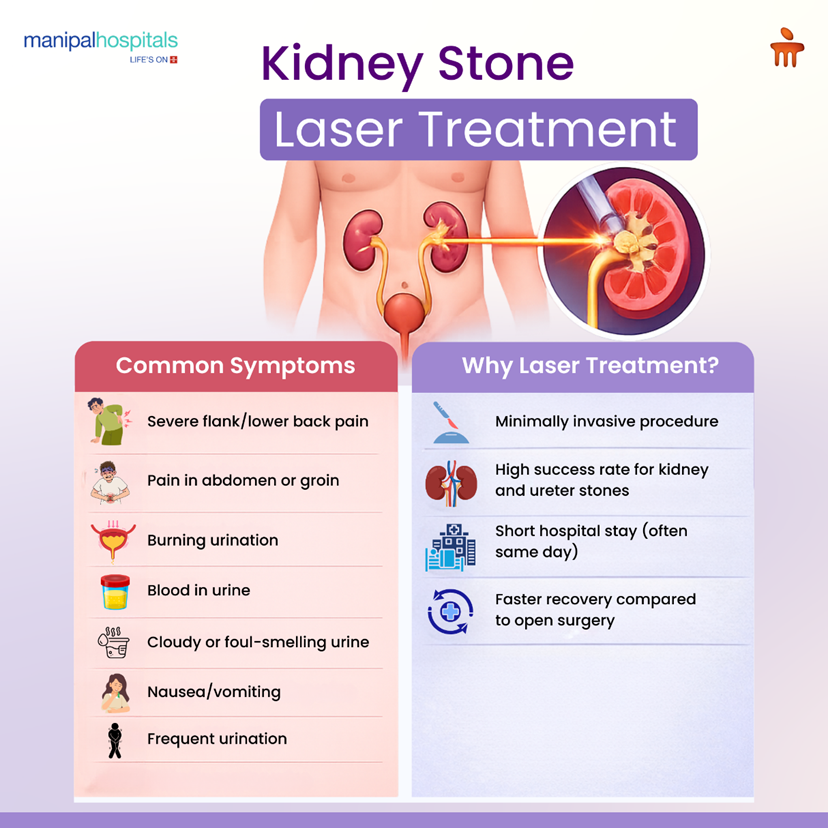
- Symptoms of Kidney Stones
- Kidney Stone Laser Treatment
- When Should You Get Laser Treatment?
- How is Laser Lithotripsy Performed?
- Benefits of Kidney Stone Laser Treatment
- Recovery After Laser Kidney Stone Treatment
- Post-Treatment Care Tips
- Common Myths About Kidney Stone Laser Treatment
- Prevention of Kidney Stones
- When Should You See a Doctor?
- Conclusion
What Are Kidney Stones?
Minerals and salts that build up in the urine form solid crystals called kidney stones. When urine gets concentrated, minerals like calcium, oxalate, or uric acid can form crystals. These crystals can turn into stones that range in size from small grains to stones that are big enough to block the urinary tract.
Common Types of Kidney Stones
|
Type of Stone |
Description |
|
Calcium Stones |
The most common type, usually made of calcium oxalate |
|
Uric Acid Stones |
When urine becomes too acidic |
|
Struvite Stones |
Often associated with urinary infections |
|
Cystine Stones |
Rare stones caused by inherited metabolic disorders |
Understanding the kind of kidney stone a person has helps doctors figure out the best way to treat it.
Symptoms of Kidney Stones
Usually, people do not realise they have kidney stones until the stones begin to move through the urinary tract. Common symptoms include:
-
Severe flank pain (renal colic)
-
Hematuria (blood in urine)
-
Pain radiating to the abdomen or groin
-
Dysuria (burning sensation during urination)
-
Blood in the pee
-
Nausea or vomiting
-
Urine that is cloudy or smells bad
If a stone blocks urine flow, symptoms can get worse, and you may need medical attention right away.
Kidney Stone Laser Treatment
Ureteroscopic Laser Lithotripsy (URS-LL), also known as kidney stone laser treatment, is a minimally invasive procedure that uses a high-energy laser to break kidney stones into small pieces. A thin tool called a ureteroscope is used to find the stone during the procedure. Then, a laser fibre is used to break the stone into smaller pieces. The surgeon may remove the fragments with small instruments or allow them to pass naturally in urine.
When Should You Get Laser Treatment?
Doctors usually suggest a laser treatment for kidney stones when:
-
The stone is too large to pass
-
Stones cause severe pain
-
Stones cause urinary obstruction
-
Kidney stones are recurrent
-
When shock wave therapy has failed
Laser treatment works especially well for stones located in the kidney or ureter.
How is Laser Lithotripsy Performed?
A urologist usually performs the procedure while you are asleep under anaesthesia. The step-by-step procedure is as follows:
-
The patient is given a general or spinal anaesthesia, depending on their condition.
-
A thin ureteroscope is put into the bladder and ureter through the urethra.
-
The surgeon uses a camera on the ureteroscope to locate the kidney stone.
-
A laser fibre breaks the stone into smaller pieces.
-
The fragments are either removed by the doctor or allowed to pass naturally.
-
A temporary ureteral stent may be placed to help urine flow smoothly after the procedure.
The procedure usually takes 30 to 90 minutes, depending on the size and location of the stone.
Benefits of Kidney Stone Laser Treatment
Laser lithotripsy is a popular treatment because it is effective and does not require major surgery. Key benefits include:
-
Minimally invasive procedure
-
High success rate
-
Quicker recovery
-
Minimal pain after the procedure
-
Reduced risk of complications
-
Good for stones in different locations
Most patients go home the same day or after a short hospital stay.
Recovery After Laser Kidney Stone Treatment
Most people recover quickly from laser treatment for kidney stones. The following is the usual recovery timeline you can expect:
|
Recovery Stage |
Expected Time |
|
Hospital discharge |
Same day or next day |
|
Mild discomfort |
2 - 3 days |
|
Return to normal activities |
3 - 7 days |
|
Complete recovery |
1 - 2 weeks |
You may notice some burning when you urinate or a small amount of blood in your urine for a few days. Doctors usually recommend drinking plenty of water to help flush out any remaining stone fragments.
Post-Treatment Care Tips
Following your Jayanagar doctor's advice after the procedure will help you recover quickly. Helpful tips include:
-
Drink 2 to 3 litres of water every day.
-
Avoid heavy physical activity for a few days.
-
Take medicines that your doctor prescribes.
-
Attend follow-up appointments.
-
Follow the dietary recommendations.
These steps can help prevent new stones from forming.
Common Myths About Kidney Stone Laser Treatment
Many patients feel nervous about medical procedures because they are unsure of the facts. The following are the most common myths:
|
Myth |
Fact |
|
Laser treatment is very painful |
The procedure is performed under anaesthesia |
|
Surgery always requires large cuts |
Laser lithotripsy is minimally invasive |
|
Stones always return after treatment |
Lifestyle changes reduce recurrence |
|
A long hospital stay is needed |
Most patients get discharged within 24 hours |
|
Recovery takes months |
Most people recover within a week |
Sharing accurate information can help patients feel more confident about the treatment.
Prevention of Kidney Stones
Not all kidney stones can be prevented, but certain habits can greatly lower your risk. Follow the tips below to reduce your risk:
-
Drink a lot of water every day.
-
Cut back on your salt intake.
-
Limit high-oxalate foods, like spinach and nuts.
-
Maintain a balanced diet.
-
Avoid too much animal protein.
-
Maintain a healthy body weight.
Depending on the type of stone, doctors may also suggest certain changes to your diet.
When Should You See a Doctor?
Seek medical attention if you experience:
-
Severe pain that lasts for a long time
-
Urine with blood
-
Chills or fever
-
Having trouble peeing
-
Having repeated kidney stones
Doctor can pick the best treatment and avoid problems by doing an early evaluation.
Conclusion
Untreated kidney stones can cause significant discomfort and interfere with daily activities. Modern medical advances, such as laser treatment for kidney stones, provide safe and effective options for stone removal with minimal pain. This improves the rate of recovery and improves results.
At Manipal Hospital Jayanagar, experienced urologists utilise advanced technology to diagnose and treat kidney stones. For comprehensive support, including personalised care, modern surgical techniques, and expert guidance, contact us now.
FAQ's
Kidney stone laser treatment is a minimally invasive procedure where a laser breaks kidney stones into smaller pieces using a ureteroscope, allowing fragments to pass naturally.
The procedure itself is not painful because it is performed under anaesthesia. Patients may experience mild discomfort or burning during urination for a few days afterwards.
Most patients recover within one to two weeks. Light activities can usually resume within a few days, depending on the patient’s overall health.
Yes, kidney stones may recur if risk factors remain. Drinking enough water, maintaining a healthy diet, and following medical advice can significantly reduce recurrence risk.
You should consult a doctor if you experience severe back pain, blood in urine, fever, nausea, vomiting, or difficulty passing urine. Early diagnosis improves treatment outcomes.
Share this article on: