5 Min Read
Parkinson’s disease is a progressive neurological condition that significantly affects movement, independence, and quality of life. Over time, symptoms such as tremors, stiffness, slowness of movement, and balance problems can become difficult to control with medications alone. This is where DBS Parkinson’s therapy has emerged as a game-changing solution. As one of the most advanced neuroscience innovations, deep brain stimulation offers long-term symptom control for selected patients with Parkinson’s disease.
This comprehensive guide explains how DBS Parkinson’s treatment works, who can benefit, how it fits into modern movement disorder treatment, and why it is considered a cornerstone of advanced neuromodulation therapy.
Synopsis
- Understanding Parkinson’s Disease and Symptom Progression
- What Is Deep Brain Stimulation (DBS)?
- How DBS Parkinson’s Therapy Works
- Benefits of DBS Parkinson’s Treatment
- DBS vs Medication: A Comparative Overview
- The DBS Procedure: Step-by-Step
- Safety and Risks of DBS Parkinson’s
- Life After DBS: What Patients Can Expect
- DBS Parkinson’s and Future Neuroscience Innovations
- Why Multidisciplinary Care Matters
- Key Takeaways: DBS Parkinson’s at a Glance
- Conclusion
Understanding Parkinson’s Disease and Symptom Progression
Parkinson’s disease occurs due to the gradual loss of dopamine-producing nerve cells in the brain. Dopamine plays a critical role in smooth and coordinated movement.
Common Parkinson’s Symptoms
-
Resting tremors
-
Muscle stiffness (rigidity)
-
Slowness of movement (bradykinesia)
-
Balance and posture problems
-
Fluctuations in medication response
As symptoms progress, patients may experience “on-off” periods, where medications work inconsistently. At this stage, DBS Parkinson’s therapy becomes a valuable option in advanced movement disorder treatment.
What Is Deep Brain Stimulation (DBS)?
DBS Parkinson’s treatment is a surgical procedure that uses electrical stimulation to regulate abnormal brain signals responsible for movement symptoms. It is a form of advanced neuromodulation therapy that does not destroy brain tissue.
Key Components of DBS
-
Thin electrodes are placed in specific brain areas
-
A pulse generator implanted under the skin
-
Electrical signals that modulate abnormal neural activity
Unlike medications, DBS Parkinson’s therapy provides continuous symptom control and reduces motor fluctuations.
How DBS Parkinson’s Therapy Works
DBS targets specific brain regions involved in movement control, such as the subthalamic nucleus or globus pallidus interna.
Mechanism of Action
-
Modulates abnormal neural circuits
-
Restores balance in motor pathways
-
Reduces excessive or irregular brain signals
This targeted stimulation makes DBS Parkinson’s treatment a powerful movement disorder treatment supported by cutting-edge neuroscience innovations.
Benefits of DBS Parkinson’s Treatment
Key Advantages
-
Significant reduction in tremors and stiffness
-
Improved mobility and daily function
-
Reduced medication dosage and side effects
-
Better quality of life
As a form of neuromodulation therapy, DBS Parkinson’s treatment offers long-term stability in symptoms and is among the most impactful neuroscience innovations in Parkinson’s care.
DBS vs Medication: A Comparative Overview
|
Aspect |
Medication Therapy |
DBS Parkinson’s Therapy |
|
Symptom control |
Variable over time |
Consistent and adjustable |
|
Side effects |
Dyskinesia, nausea |
Minimal, device-related |
|
Disease stage |
Early to moderate |
Advanced Parkinson’s |
|
Long-term benefit |
Often limited |
Sustained improvement |
This comparison highlights why DBS Parkinson’s treatment is an essential option in advanced movement disorder treatment.
The DBS Procedure: Step-by-Step
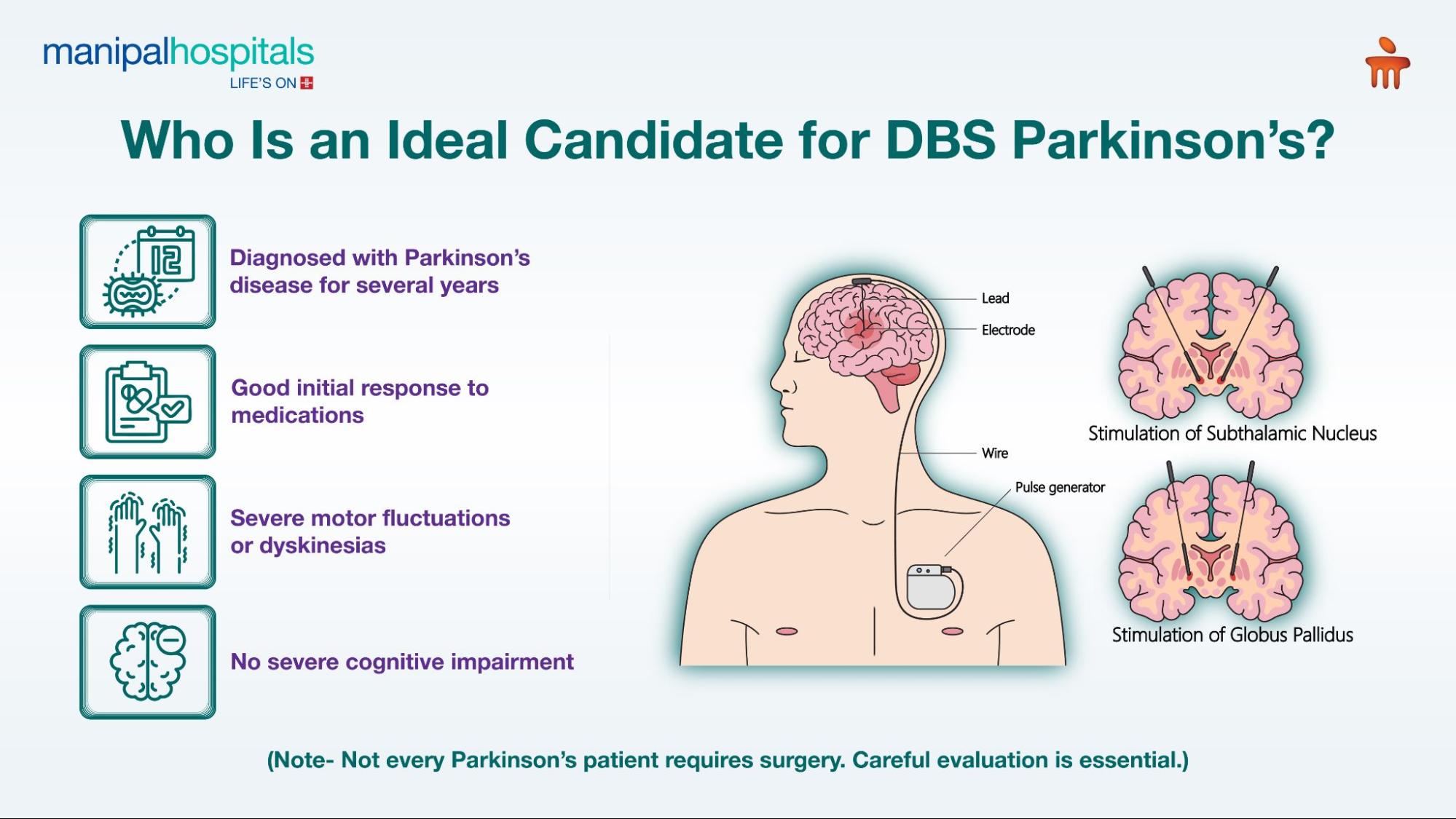
Pre-Surgical Evaluation
-
Brain imaging - Advanced brain imaging helps precisely identify target areas, assess brain anatomy, rule out abnormalities, and ensure safe, accurate electrode placement planning.
-
Motor symptom assessment - Detailed motor symptom assessment evaluates tremors, stiffness, mobility fluctuations, and medication response to determine suitability for DBS therapy.
-
Cognitive and psychological evaluation - A comprehensive cognitive and psychological evaluation ensures mental readiness, identifies mood concerns, and confirms that the patient can benefit safely from surgery.
Surgical Process
-
Electrode placement using precision guidance - Electrodes are placed using high-precision imaging and navigation systems to accurately target brain regions controlling abnormal movement signals.
-
Pulse generator implantation - A small pulse generator is implanted under the skin, usually near the chest, to deliver controlled electrical impulses to the brain.
-
Programming and stimulation adjustment - Post-implantation programming fine-tunes stimulation parameters gradually to maximise symptom control while minimising side effects.
Post-Surgical Care
-
Gradual optimisation of stimulation settings - Stimulation settings are adjusted over multiple sessions to achieve balanced symptom relief and long-term functional improvement.
-
Medication adjustments - Medications are carefully modified following DBS to reduce side effects while maintaining effective control of Parkinson’s symptoms.
-
Regular follow-ups - Regular follow-up visits monitor device performance, symptom progression, and overall well-being, ensuring sustained therapeutic benefits.
Our neurosurgeons in Delhi-NCR follow globally accepted protocols to ensure safety and optimal outcomes with DBS Parkinson’s therapy.
Safety and Risks of DBS Parkinson’s
While DBS Parkinson’s treatment is considered safe, like any surgery, it carries potential risks.
Possible Risks
-
Infection
-
Temporary speech or balance changes
-
Device-related complications
Advances in neuroscience innovations and surgical precision have significantly reduced complication rates, making neuromodulation therapy safer than ever.
Life After DBS: What Patients Can Expect
Most patients notice gradual improvement over weeks to months.
Post-DBS Improvements
-
Reduced tremor severity
-
Better walking and posture
-
Improved independence
-
Enhanced confidence
With proper follow-up, DBS Parkinson’s therapy allows patients to regain control over daily activities and remain socially active.
DBS Parkinson’s and Future Neuroscience Innovations
The field of neuroscience innovations continues to evolve rapidly.
Emerging Advances
-
Adaptive DBS systems
-
Improved targeting techniques
-
Longer-lasting devices
These innovations further strengthen the role of DBS Parkinson’s treatment in modern movement disorder treatment and advanced neuromodulation therapy.
Why Multidisciplinary Care Matters
Successful outcomes depend on teamwork.
Integrated Care Approach
-
Neurologists
-
Neurosurgeons
-
Rehabilitation specialists
Our neurosurgeons in Delhi-NCR work closely with multidisciplinary teams to deliver personalised DBS Parkinson’s therapy plans.
Key Takeaways: DBS Parkinson’s at a Glance
-
Advanced surgical option for Parkinson’s disease
-
Effective neuromodulation therapy
-
Reduces medication dependence
-
Improves long-term quality of life
-
Backed by strong neuroscience innovations
Conclusion
DBS Parkinson’s therapy has revolutionised the way advanced Parkinson’s disease is managed. As a leading movement disorder treatment, it offers sustained symptom control when medications are no longer sufficient. Supported by ongoing neuroscience innovations, Deep Brain Stimulation represents a safe, effective, and life-changing form of neuromodulation therapy. With expert evaluation and long-term care, patients can experience renewed independence and improved daily functioning. Our neurosurgeons in Delhi-NCR continue to play a vital role in delivering evidence-based DBS care.
FAQ's
DBS Parkinson’s therapy is a surgical neuromodulation therapy that uses electrical stimulation to control movement symptoms.
No, DBS Parkinson’s treatment does not cure Parkinson’s, but significantly improves symptom control and quality of life.
With proper programming and follow-up, DBS Parkinson’s therapy can provide long-term symptom relief for many years.
Yes, DBS is considered safe when performed by experienced teams using modern neuroscience innovations.
DBS Parkinson’s treatment is usually considered when medications no longer provide consistent symptom control.
Share this article on: