8 Min Read
Do you hesitate before getting out of a chair because of a sharp twinge on the inner side of your knee? Inner knee pain often starts subtly. At first, it feels like a minor strain, but over time, that discomfort can turn into stiffness, reduced mobility, and pain that refuses to go away, even at rest.
For many people, especially those over 50, persistent knee pain, especially on the inner side of the knee, can signal advancing joint damage. While not every case requires surgery, some warning signs suggest that conservative treatments may no longer be enough.
In this blog, we will help you understand when inside knee pain is manageable and when it may be time to consider knee replacement surgery.
Synopsis
Understanding Knee Pain
The knee is a complex hinge: bones meet cartilage, menisci cushion, ligaments stabilise, and muscles control motion. The medial (inner) compartment bears more load with normal alignment. Over the years, that load can wear out cartilage, stress meniscus tissue, or strain ligaments, producing pain inside your knee without swelling.
Pain without swelling is especially common in early or moderate osteoarthritis and in chronic wear patterns. Identifying the exact structure that hurts (cartilage, meniscus, ligament, or alignment) guides treatment and the decision about replacement.
Common Causes of Inner Knee Pain
The most common cause of pain inside your knee without swelling is age-related wear and tear. Understanding what is causing your knee pain can help you know if surgery might be needed later on.
|
Cause |
What It Is |
Typical History / Key Clues |
|
Medial Osteoarthritis |
Cartilage wear in the medial compartment |
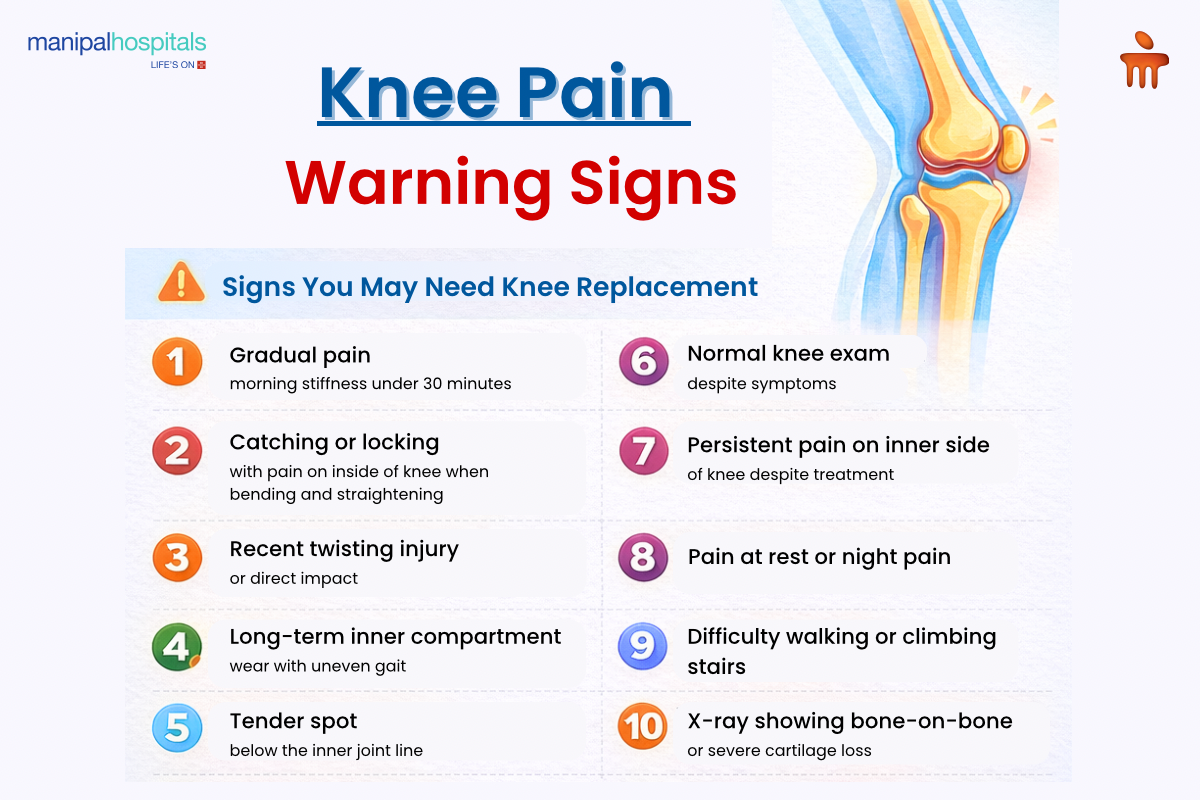
Gradual pain, morning stiffness (<30 mins), worse with walking, joint space, narrowing on X-ray |
|
Medial Meniscus Tear |
Tear of the inner meniscus from twist/degeneration |
Catching, locking, pain with bending/straightening; MRI shows a tear |
|
Medial Collateral Ligament (MCL) Strain |
Overstretch or partial tear of the inner ligament |
Recent twist or direct blow; pain on medial stress test, local tenderness |
|
Alignment Problems (Varus / Bow-Leg) |
Mechanical overload of the inner compartment | Long history of inner-side pain, uneven wear on X-ray, altered gait |
|
Pes Anserine Bursitis/Tendinopathy |
Irritation of tendons/bursa just below the inner joint line |
Localised tenderness below the joint, worse with inclined walking |
|
Referred Pain (Hip/Back) |
Pain felt at knee from other joints |
Knee exam normal; investigate hip or lumbar spine if suspected |
Key Signs Your Inner Knee Pain May Need Surgery
Mild discomfort after activity is common. However, the following signs suggest more advanced joint damage:
-
Persistent pain despite a course of medication and physiotherapy
-
Pain with bending and full extension (catching or grinding)
-
Increasing morning stiffness or stiffness lasting more than 30 minutes
-
Progressive difficulty walking longer distances or climbing stairs
-
Pain at rest or pain that wakes you at night
-
Imaging reveals joint-space narrowing, osteophytes (bone spurs), or bone-on-bone contact.
-
Taking analgesics to get rid of pain 4/5 times a week.
If conservative care fails for months and imaging confirms advanced wear, a surgical consultation for partial or total knee replacement is reasonable.
Evaluating Inner Knee Pain
Getting the right diagnosis can show whether you need knee replacement or if non-surgical treatments might still help.
Clinical Checkup
-
Orthopaedic specialists check your knee’s alignment, range of motion, and tenderness.
-
They observe your walk to check the severity of pain and joint stability.
-
Physical exams help find ligament strain, arthritis signs, and meniscus injury.
Imaging Tests
-
Standing X-rays: first-line to assess joint space, alignment, and arthritis severity.
-
MRI: used when meniscus, ligament, or cartilage detail is needed.
-
Ultrasound: helpful for soft-tissue pain (bursitis, tendons).
-
Weight-bearing long-leg films: for alignment planning if surgery is considered.
Right detection and prompt recovery methods can prevent worsening of the symptoms or delay surgery.
Non-Surgical Treatment for Inner Side Knee Pain
Doctors usually try less invasive inner-side knee pain treatment first to relieve symptoms and improve how your knee works before considering surgery.
Medication
-
Short-term NSAIDs (ibuprofen/naproxen) or topical NSAID gels reduce pain and inflammation. Use under advice if there are stomach or kidney issues.
-
Short courses of acetaminophen may help with milder pain.
-
Oral steroid courses are rarely used long-term when inflammatory causes are suspected.
Injections
-
Corticosteroid injections: useful for short-term relief when inflammation flares.
-
Hyaluronic acid (viscosupplementation): may help some patients with moderate osteoarthritis.
-
PRP (platelet-rich plasma): an emerging option with mixed evidence; considered in selected cases.
Physiotherapy And Exercise
-
Strengthen quadriceps (including VMO), hip abductors, and hamstrings to unload the medial compartment.
-
Low-impact aerobic exercise (cycling, walking, pool therapy) maintains fitness without harsh joint stress.
-
Gait retraining and balance work reduce abnormal loading.
-
Home exercise programs: consistent daily practice matters more than intensity.
Bracing And Orthotics
-
Medial off-loading braces can shift the load away from the inner compartment and reduce pain while walking.
-
Shoe orthotics or lateral wedge insoles may alter knee mechanics for some people.
Weight Management And Lifestyle
-
Losing 5–10% of body weight significantly reduces knee load and pain. Generally 1 kg–6 kg.
-
Avoid high-impact activities (running on rough surfaces) while maintaining fitness via cycling or swimming.
Activity Modification
-
Shorten walks, use stair alternatives, and pace daily tasks during flare-ups.
When is Knee Replacement Surgery Recommended?
If joint damage becomes severe and symptoms make daily life difficult, doctors may suggest knee replacement surgery.
Reasons for Surgery
-
Severe pain on the inside of the knee that makes it hard to do everyday things.
-
Knee pain that won't go away, even with conservative treatment.
-
When bending and straightening, there is pain on the inside of the knee and limited movement.
-
Imaging shows a lot of cartilage loss.
-
Deformity that gets worse over time or stiffness in the joints.
In these cases, a full or partial knee replacement can improve how your joint works, reduce pain, and help you move more easily.
Benefits of Knee Replacement for Inner Knee Pain
Getting timely inner-side knee pain treatment ensures that the surgery is planned correctly and that the recovery goes as well as possible. Other key benefits include:
-
Significant pain relief and restoration of function.
-
Improved walking ability, stair climbing, and daily activities.
-
Correction of deformity and more even load distribution.
Conclusion
You should never ignore pain on the inside of your knee, especially if it doesn't go away or gets worse over time. Conservative inner-side knee pain treatment can help a lot of people, but if you have chronic inner-side knee pain that is stiff, limits your movement, and makes it hard to walk, it may mean that your joints are getting worse. Knowing the warning signs, such as pain on the inside of the knee without swelling or pain when bending and straightening, helps patients get checked early.
Our team of orthopaedic surgeons at Manipal Hospital Bhubaneswar offers joint replacement surgery for advanced knee pain treatment in Bhubaneswar to relieve pain, restore movement, and improve quality of life when needed.
FAQ's
Osteoarthritis, meniscus injuries, ligament strain, or alignment problems in the medial compartment of the knee are all common causes of pain on the inner side of the knee.
If you feel pain inside the knee when bending and straightening, it could be a sign of cartilage wear, meniscus damage, or advanced arthritis. You should see an orthopaedic doctor to find out for sure.
Yes, pain inside your knee without swelling can still be a sign of early or moderate osteoarthritis, especially if you feel stiff and have trouble moving around.
You can manage pain inside your knee with medications, physical therapy, injections, and changes to your daily life. In severe cases, knee replacement surgery may be needed.
Of course yes, it depends on the presence of healthy cartilage & stages of OA.
HTO, alignment surgery, BMAC injection, and arthroscopic OATS.
Manipal Hospitals in Bhubaneswar offers full knee pain treatment, including robotic knee replacement, advanced diagnostics, personalised care, and expert joint replacement surgery.
Share this article on: