7 Min Read
A hernia may begin as a small bulge or mild discomfort, but over time, it can start interfering with simple daily movements like bending, lifting, or even walking. While it might seem manageable at first, most hernias do not heal on their own and often require medical attention.
One of the most commonly recommended surgical procedures for hernias today is hernia mesh surgery. This form of surgery has revolutionised the way hernias can be treated. The use of a mesh to strengthen weakened tissues and prevent the recurrence of a hernia has been quite effective. While not all hernias may necessarily need a mesh repair, it can be quite useful to understand when it can be the best option.
In this blog, you can find answers to important questions: when hernia mesh surgery is necessary, how it works, what doctors consider before recommending it, what kind of mesh materials are used for hernia repair, and what you can expect from the surgery.
Synopsis
What Happens in a Hernia?
A hernia occurs when an internal organ or fatty tissue pushes through a weak area in the surrounding muscle or connective tissue. The abdominal wall normally acts as a protective barrier, but certain factors can create weak spots that allow tissues to protrude.
Common contributing factors include ageing, repeated strain, heavy lifting, chronic coughing, pregnancy, and obesity, all of which increase pressure within the abdomen.
The most common types of hernias include:
-
Inguinal hernia (groin area)
-
Umbilical hernia (near the navel)
-
Incisional hernia (through a previous surgical scar)
-
Femoral hernia (upper thigh area)
-
Hiatal hernia (upper stomach pushing into the chest cavity)
Small hernias may initially cause mild discomfort, but they usually do not heal on their own and may gradually enlarge over time.
When Do Doctors Recommend Hernia Mesh Surgery?
It is not necessary for everyone who has a hernia to undergo hernia mesh surgery. There are some cases when the doctor recommends that the hernia be monitored for some time if the symptoms are not too serious and the hernia is not too large. However, there are some cases when hernia mesh surgery is recommended.
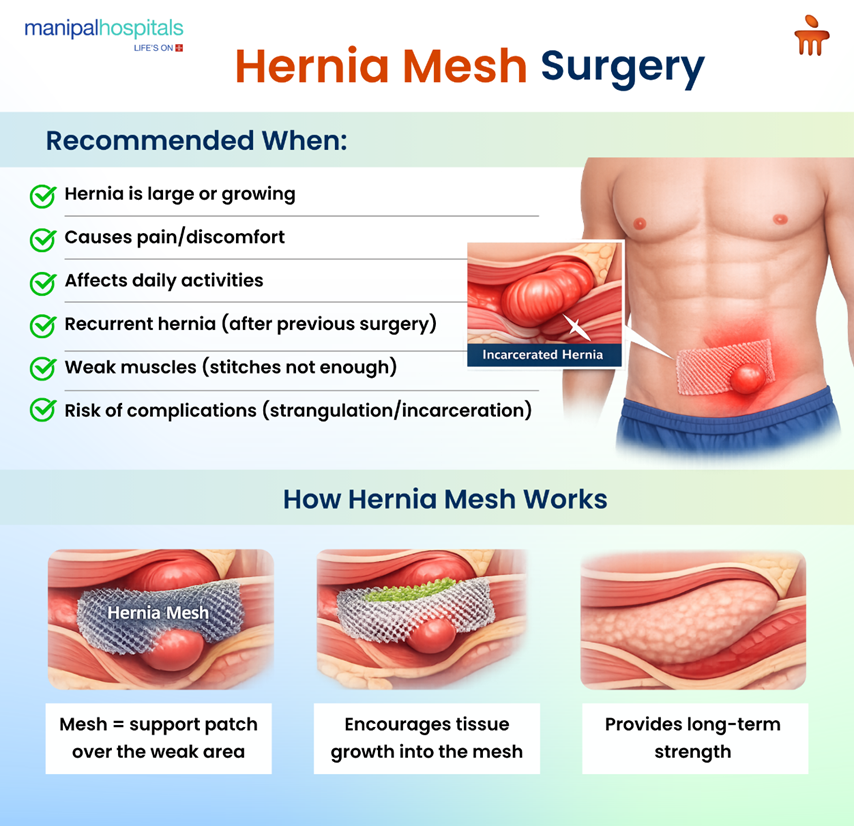
Mesh repair is recommended when there is a need for reinforcement of the weakened part of the abdominal wall so that the hernia cannot recur. Some reasons why hernia mesh surgery is recommended include:
-
Hernia is large or is increasing in size
-
A hernia is causing discomfort or pain
-
A hernia affects physical activities or work
-
Mesh repair is often recommended in recurrent hernias where previous surgery has failed
-
Muscles around the hernia are weak, and the stitches cannot hold
-
There are chances of complications like incarceration or strangulation
The mesh acts like a supporting structure that is sewn over the weakened part of the abdominal wall. Over time, tissue ingrowth into the mesh takes place, and the mesh becomes strong. Especially in procedures such as umbilical hernia surgery with mesh, the reinforcement helps stabilise the abdominal wall near the navel, an area that often experiences repeated pressure from daily movements.
For many abdominal wall hernias, hernia repair with mesh has become the standard surgical approach because it significantly reduces recurrence rates
Types of Mesh Used in Hernia Repair
The choice of mesh is carefully decided based on the type of hernia, its size, and the surgical technique being used. Surgeons consider several factors before selecting the most suitable material:
|
Mesh Type |
Material Composition |
Typical Surgical Use |
Key Advantages |
|
Synthetic Non-Absorbable Mesh |
Usually made from polypropylene or polyester |
The most common option for abdominal wall hernias |
Provides long-term reinforcement as it remains permanently in the body |
|
Partially Absorbable Mesh |
A combination of absorbable and permanent materials |
Used when temporary support is needed along with long-term reinforcement |
Gradually reduces foreign material while maintaining structural strength |
|
Biological Mesh |
Made from processed animal or human tissue |
Often used in contaminated surgical fields or complex reconstructions |
Integrates naturally with body tissues and may reduce infection risk |
|
Composite Mesh |
Multi-layer mesh with protective coating |
Frequently used in laparoscopic procedures |
The coating prevents organs from sticking to the mesh surface |
|
Lightweight Mesh |
Reduced material density |
Used for those who may benefit from less rigid reinforcement |
Offers flexibility while still supporting the abdominal wall |
What Happens During Hernia Mesh Surgery?
It is usually easier to understand what is involved in the surgery, which in turn reduces anxiety. Although the steps in hernia mesh surgery vary depending on the type of hernia, the basic process is similar.
There are various methods used in hernia mesh surgery, including open surgery and minimally invasive techniques like laparoscopy. All these approaches aim at pushing the bulging tissue back into the abdomen, as well as strengthening the weakened abdominal wall.
During hernia mesh surgery, the following steps are usually involved:
-
An incision is made in the abdomen, near the bulging area of the hernia.
-
The bulging tissue is gently pushed into the abdomen.
-
Apply a patch of mesh over or under the weakened area.
-
Close the incision.
Minimally invasive techniques involve making small incisions in the abdomen and using a camera to perform the operation. This might result in quicker recovery in some people.
Recovery After Hernia Mesh Repair
Recovery after hernia mesh repair depends on the hernia size, the surgical technique, and the patient’s general health. Most people return to routine activities within a few weeks. Early gentle movement is usually advised.
General recovery advice may include:
-
Walking within a day or two
-
Avoiding heavy lifting for several weeks
-
Gradually returning to normal activities
-
Keeping the surgical wound clean and protected
-
Attending scheduled follow-up visits
As healing progresses, most patients notice reduced discomfort and an improvement in the bulge caused by the hernia.
Conclusion
Hernia mesh surgery is used to reinforce the abdominal wall and ensure that hernias do not recur. This type of surgery is used to treat various hernias, including umbilical hernia surgery. Understanding when surgery is needed, the available types of mesh for hernia repair, and what to expect from recovery can help you approach treatment with greater clarity and confidence with guidance from general surgery speciality Manipal Hospital, Bhubaneswar.
If you are considering treatment options, consulting specialists experienced in the best hernia surgery with mesh in Bhubaneswar can provide personalised guidance. Comprehensive surgical evaluation and care are available with the best General Surgeons at Manipal Hospital Bhubaneswar, where specialists assess each case carefully and recommend the most appropriate treatment approach.
FAQ's
Most permanent synthetic meshes are designed to remain in the body for life. They gradually integrate with surrounding tissue, reinforcing the abdominal wall and helping reduce the risk of hernia recurrence.
Yes, lifestyle changes may help reduce the risk of hernia recurrence. Maintaining a healthy weight, strengthening abdominal muscles, controlling chronic cough, avoiding heavy lifting, and maintaining proper posture can support recovery.
Yes, hernia mesh surgery is generally safe for older adults. Although age is considered during surgical planning, many elderly patients successfully undergo hernia repair, particularly when the hernia causes pain or complications.
Yes, a hernia can return even after mesh repair. Although mesh repair lowers recurrence compared with stitch-only repair, factors such as strain, poor healing, infection, or large hernias may increase the risk.
Hernia mesh does not trigger airport security alarms or interfere with imaging tests such as X-rays, CT scans, or MRI scans. The materials used are stable and widely considered safe.
Share this article on: