8 Min Read
A sudden pull in the back of the thigh during a sprint, jump, or quick change of direction can stop the athlete suddenly during activity. A hamstring injury is frustrating because of the pain and the uncertainty of the recovery period. Understanding hamstring strain recovery time helps you approach healing with clarity instead of guesswork. Recovery depends on several factors, including the severity of the strain, how early treatment begins, and how carefully rehabilitation is followed. While some mild strains improve in a few weeks, more serious injuries can take considerably longer and require structured rehabilitation.
In this blog, you will learn how long it takes to recover from the injury, what affects the rate of healing of the hamstring strain, how doctors treat hamstring strains, and what athletes can do to help the healing process.
Synopsis
Hamstring Strain Injury: What Actually Happens in the Body?
The hamstrings are a group of 3 muscles located at the back of the thigh. The injury happens when these muscles are subjected to overstretching. The hamstring muscles are essential for bending the knee and extending the hips, thus crucial for sprinting, jumping, and other explosive activities.
A hamstring strain occurs when muscle fibres are stretched beyond their capacity, leading to microscopic tears or, in severe cases, larger disruptions in the muscle tissue. Athletes often describe the moment of injury as a sharp pull, followed by tightness, difficulty running, or pain when straightening the leg.
Medical experts categorise hamstring strains into different grades. The injury grade determines the hamstring strain recovery time. The injury grade is thus a very essential factor that must be determined before the start of the healing process.
Hamstring Strain Recovery Time
Hamstring strain healing time differs from one person to another, mainly because the injury grade differs. The healing process takes an extended period and should not be rushed to avoid any risk of complications.
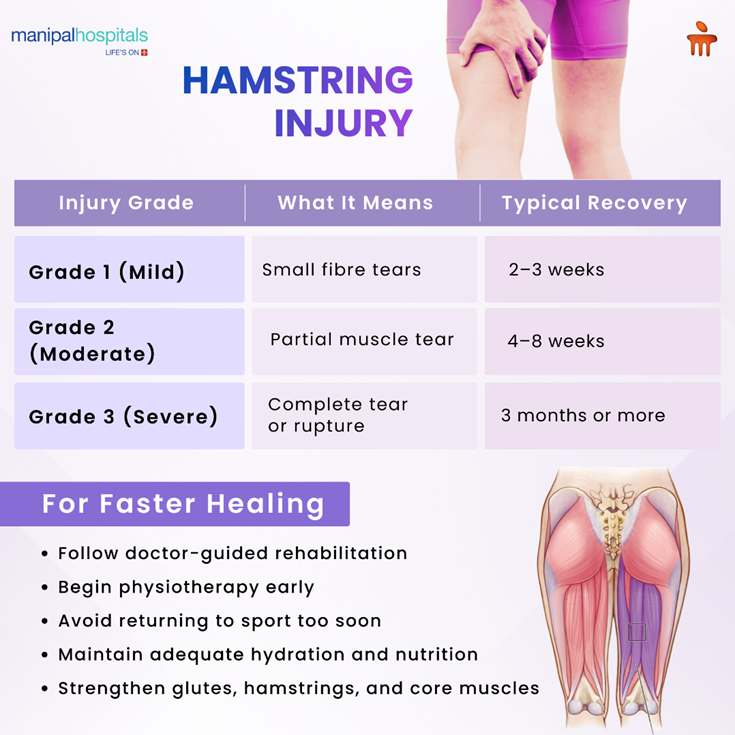
Below is a general overview of how recovery timelines tend to differ:
-
Grade 1 strain (mild): Small muscle fibre tears with minimal strength loss.
-
Grade 2 strain (moderate): Partial tearing of muscle fibres with noticeable weakness.
-
Grade 3 strain (severe): Extensive tear or rupture of the muscle.
Standard mild hamstring strain recovery time is between 2 and 3 weeks if the athlete is given the right recovery and rehabilitation. Moderate hamstring strains have a recovery time of 4 to 8 weeks, while severe hamstring tears have a recovery time of as long as three months or even more if surgery is required.
It is also important to note that if an athlete returns to practice too early and strains the hamstring further, this could result in an even longer recovery time from hamstring strains.
Stages of Healing After a Hamstring Injury
Muscle healing does not occur all at once. The body progresses through several phases, each playing a role in restoring strength and flexibility. Recognising the following stages helps athletes understand why patience during recovery matters:
|
Healing Stage |
Typical Timeframe |
What Happens in the Muscle |
Common Signs |
Recommended Approach |
|
Inflammatory Phase |
2-5 days |
Blood flow increases, and damaged tissue begins to clear to start healing |
Pain, swelling, tenderness |
Rest, cold packs, and avoid strain |
|
Repair Phase |
1-3 weeks |
New muscle fibres and connective tissue begin rebuilding the injured area |
Tightness and mild discomfort with movement |
Gentle physiotherapy and controlled mobility |
|
Remodelling Phase |
3-8 weeks or longer |
Muscle fibres strengthen and regain flexibility |
Minimal pain but possible weakness |
Progressive strengthening and sport-specific training |
Key Factors That Influence Recovery Speed
Not all athletes heal at the same rate. There are a number of factors that can speed up or slow down the hamstring strain recovery time, despite the fact that the injuries may be similar in nature.
Some of the most significant factors include:
-
The degree of strain: Muscle injuries that are more severe will need more time for the body to heal.
-
Age and condition: Younger and more conditioned athletes will have faster recovery times.
-
Previous injuries: Athletes who have repeatedly injured their hamstrings may have a weaker hamstring, which will make the recovery period longer.
-
Early medical care: Athletes who are provided with the right guidance in the rehabilitation of the injured hamstring will have faster recovery times.
-
Adherence to rehabilitation exercises: Regular physiotherapy helps build strength in the hamstrings.
Understanding these influences helps athletes set realistic expectations and avoid unnecessary frustration during recovery.
Effective Hamstring Strain Treatment
Treatment aims to reduce pain, restore mobility, and rebuild strength in a gradual and structured way. Early care plays a major role in preventing further damage, especially when athletes look into how to heal a hamstring strain fast.
Initial hamstring strain treatment often includes:
-
Rest from intense activity to allow muscle fibres to begin healing.
-
Cold therapy during the early phase to reduce inflammation.
-
Compression and elevation to control swelling.
-
Guided physiotherapy exercises that restore movement and flexibility.
-
Progressive strengthening programmes targeting the hamstrings and surrounding muscles.
Medical professionals may also recommend imaging tests when symptoms suggest a more severe injury. A tailored rehabilitation programme ensures the athlete returns to practice only when the muscle is strong enough to handle athletic demands.
Returning to Sport Safely
Athletes are always eager to return to training as soon as the pain in the hamstrings diminishes. However, the absence of pain in the hamstring does not mean that the hamstring is completely cured. A safe return to sport involves:
-
Full range of motion in the injured hamstring.
-
Strength in the injured hamstring is similar to that of the unaffected hamstring.
-
Ability to sprint, accelerate, and decelerate without any discomfort in the hamstrings.
-
Ability to perform sport-specific drills without any instability in the hamstrings.
Conclusion
Recovering from a hamstring injury requires patience, structured rehabilitation, and careful attention to the body’s signals. The typical recovery time varies from a few weeks for mild injuries to several months for more severe muscle tears. Understanding the stages of healing, following appropriate hamstring strain treatment, and practising good rehabilitation habits can improve the outcome. If pain persists or recovery feels unusually slow, professional evaluation becomes crucial. Athletes seeking expert guidance for hamstring pain treatment in Bhubaneswar can consult orthopaedic specialists at Manipal Hospital Bhubaneswar.
FAQ's
Many athletes can still walk after a mild hamstring strain, though it may feel tight. Walking becomes difficult in moderate or severe injuries. Running or explosive movements should be avoided until healing improves.
Hamstring injuries have a high recurrence rate because the muscle group experiences strong forces during sprinting and jumping. If rehabilitation ends too early, the muscle may regain flexibility but not full strength. Residual weakness or scar tissue can then increase vulnerability during high-speed movements.
Not always. Most minor injuries can even be diagnosed just by physical examination. The use of other diagnostic procedures, such as ultrasound or MRI, is usually required if the injury is considered severe, if the exact location of the tear is not well understood, or if there is no expected progress in recovery.
Stretching should be avoided in the early phase of a hamstring injury. Gentle, controlled stretching may be introduced later in rehabilitation as the muscle heals and pain begins to improve.
Strengthening exercises are often introduced during rehabilitation to reduce the risk of reinjury. Eccentric hamstring training, along with strengthening the glutes and core muscles, helps improve stability and prepares the body for powerful sports movements.
Share this article on:


_need_Surgery__Expert_Guide_.webp "Expert guide on gallbladder polyps and treatment options")