




 8 Min Read
The Whipple procedure, also known as pancreaticoduodenectomy, is a complex and potentially life-saving surgery primarily used to remove cancerous tumors from the head of the pancreas, as well as tumors in the duodenum, bile duct, and Ampulla of Vater. This major operation comes in two primary forms: the standard Whipple and the pylorus-preserving Whipple (PPPD). While both procedures share the same curative goal, their differences in technique can impact aspects like patient recovery, digestion, and long-term outcomes. For patients and families facing this surgery, understanding these variations, along with potential complications, signs to watch for, and when to seek urgent care, is essential for a smoother recovery journey.
In this detailed guide, we'll break down the key differences between the two procedures, explore digestive challenges (including common issues like diarrhoea after Whipple and the role of pancreatic enzyme therapy), discuss Whipple surgery recovery time and hospital stay, and provide practical advice on recognizing and responding to major complications.
Synopsis
Standard vs. Pylorus-Preserving Whipple: A Detailed Comparison
The core difference between the standard Whipple and PPPD revolves around the pylorus, the muscular valve that regulates food flow from the stomach to the small intestine. Preserving or removing this valve affects how the digestive tract is reconstructed post-surgery.
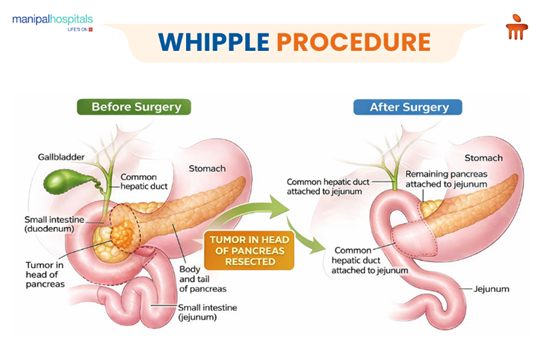
To visualize the standard Whipple procedure, here's a diagram showing the anatomy before and after surgery:
|
Feature |
Standard Whipple Procedure |
Pylorus-Preserving Whipple Procedure (PPPD) |
|
Surgical Technique |
Removes the head of the pancreas, gallbladder, duodenum, a portion of the stomach (including the pylorus and antrum), and surrounding lymph nodes. The remaining pancreas, bile duct, and stomach are reconnected to the small intestine (jejunum) to restore continuity. |
Removes the head of the pancreas, gallbladder, duodenum, and lymph nodes, but preserves the entire stomach and pylorus. The duodenum is divided 1-3 cm past the pylorus, and the remaining structures are reconnected to the jejunum. |
|
Patient Recovery |
Often associated with slightly longer operative time, higher blood loss, and longer hospital stays in some studies. Whipple surgery recovery time typically involves 1-2 weeks in the hospital, with full recovery taking several months. Most patients resume normal activities in 4-6 weeks. |
May involve shorter operation time and less blood loss. Hospital stay after Whipple is comparable (1-2 weeks), with similar overall recovery timelines. Randomized studies show no major differences in mortality or stay length. |
|
Digestion |
Removal of the pylorus can cause dumping syndrome, leading to rapid stomach emptying and symptoms like nausea, cramping, diarrhea after Whipple, and feeling full quickly. Patients may need pancreatic enzyme therapy for fat absorption issues, causing bloating, gas, and weight loss. |
Aims to maintain natural digestion by preserving the pylorus, potentially reducing dumping syndrome and improving nutrition after pancreatic surgery. However, delayed gastric emptying (gastroparesis) is common in both, with conflicting study results on incidence. Post-Whipple digestion often requires enzyme supplements and dietary changes like small, frequent meals. |
|
Potential Outcomes |
Long-term survival and cancer recurrence rates are equivalent to PPPD. Some studies note more postoperative weight loss, but overall effectiveness in cancer removal is the same. Choice depends on tumor location and surgeon experience. |
Comparable survival and recurrence rates. May offer better long-term weight recovery, BMI, nutritional status, and quality of life in some research. Delayed gastric emptying remains a shared risk. |
Studies confirm both procedures are equally effective for treating pancreatic and periampullary cancers, with no significant differences in long-term survival. The decision often hinges on individual factors, such as the tumor's position and the surgeon's expertise.
Managing Digestive Problems After Whipple Surgery
Post-Whipple digestion can be challenging due to the removal of pancreatic tissue, which affects enzyme production for breaking down fats and nutrients. Common digestive problems after Whipple surgery include:
-
Diarrhea after Whipple: Often linked to dumping syndrome in the standard procedure or fat malabsorption in both. Symptoms may include loose stools, urgency, and cramping shortly after eating.
-
Nutrition after Pancreatic Surgery: Weight loss, bloating, and gas are frequent. Patients should focus on high-calorie, low-fat diets with small meals to aid absorption.
-
Pancreatic Enzyme Therapy: Essential for most patients. Supplements like pancrelipase help digest fats and proteins, reducing symptoms like steatorrhea (oily stools). Consult a dietitian for personalized plans.
-
Other Adjustments: Avoid high-fat foods, eat slowly, and monitor for deficiencies in vitamins (e.g., A, D, E, K). Long-term, many patients adapt well with these strategies.
Incorporating these into your routine can significantly improve quality of life during recovery.
Recognizing and Responding to Major Complications
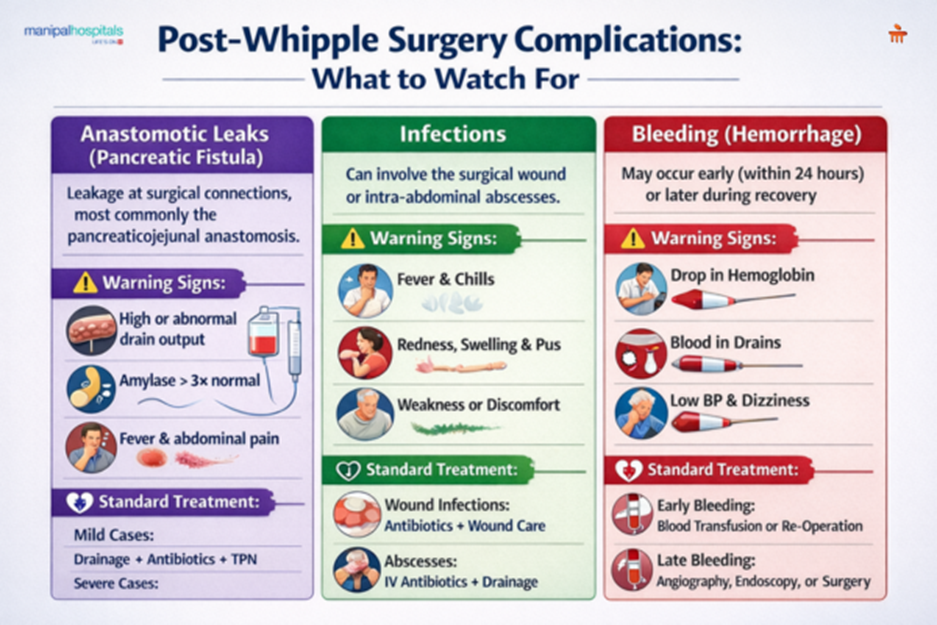
The Whipple procedure carries risks of serious complications, including anastomotic leaks, infections, and bleeding. Early detection is critical.
When to Seek Immediate Medical Attention
Recovering from a Whipple procedure is a gradual and often challenging process that extends well beyond the hospital walls. While most patients experience steady improvement with proper care, the risk of serious postoperative complications, such as leaks, infections, bleeding, or blood clots, can persist for weeks or even months after discharge. The expert team at Manipal Hospitals advices that being able to recognize warning signs early and knowing exactly when to act can make a critical difference in preventing minor issues from becoming life-threatening emergencies.
The following list outlines the most important red-flag symptoms that require immediate medical attention, empowering patients and caregivers to respond quickly and confidently.
|
Symptom |
Description |
|
Severe or worsening abdominal pain |
Intense or progressively increasing pain in the abdomen that does not improve. |
|
High fever with shivering |
Elevated temperature accompanied by chills or rigors. |
|
Persistent vomiting, especially if it contains blood |
Repeated vomiting that continues or includes red blood or coffee-ground material. |
|
Signs of shock |
Weakness, rapid heartbeat (tachycardia), light-headedness, dizziness, mottled/pale skin. |
|
Significant bleeding |
Visible blood in surgical drains, vomit (hematemesis), stools (melena or bright red), or large amounts from any site. |
|
Wound changes |
Increased swelling, redness, warmth, opening of the incision, or pus/discharge from the surgical wound or drain sites. |
|
Leg swelling/pain |
Unilateral or bilateral leg swelling, pain, redness, or warmth (possible deep vein thrombosis/blood clot). |
|
Symptoms of new-onset diabetes |
Excessive thirst, frequent urination, unexplained weight loss, or fatigue suggesting pancreatic insufficiency. |
|
Sudden changes in drain output or color |
Abrupt increase in volume or change to milky, bloody, dark brown, greenish, or foul-smelling fluid from any surgical drain. |
Vigilance is one of the most powerful tools in the months following a Whipple procedure. By closely monitoring your body and acting promptly on the signs listed above, you can significantly reduce the risk of severe complications such as sepsis, uncontrolled bleeding, or organ damage. Never hesitate to contact the best gastro doctors in Old Airport Road, or go to the emergency room when something feels wrong, even if you’re unsure whether it’s “serious enough.” Trusting your instincts and seeking help without delay is not overreacting; it is an essential part of protecting the life-saving benefits this complex surgery provides. Your recovery is a partnership between you, your loved ones, and your medical team. Stay proactive, stay informed, and prioritize your safety every step of the way.
Final Thought
While the standard and pylorus-preserving Whipple procedures differ in technique, their effectiveness in combating pancreatic cancer is comparable, withchoices tailored to patient needs. Recovery is demanding, but understanding Whipple surgery recovery time, managing post-Whipple digestion through pancreatic enzyme therapy and nutrition, and staying vigilant for complications empower patients to navigate this path successfully. Always communicate concerns with your medical team; knowledge and proactive care are your best allies in recovery.
For those seeking expert care, Manipal Hospitals Old Airport Road, the best hospital in Old Airport Road for Whipple procedures, stands out as a leading choice in India, with high-volume experience in Whipple procedures (pancreaticoduodenectomy) across locations like Bangalore. They offer advanced options, including open, laparoscopic, and robotic-assisted techniques; multidisciplinary hepatobiliary teams; and enhanced recovery protocols for better precision, reduced complications, and improved outcomes in pancreatic and periampullary cancer treatment.
FAQ's
Whipple (PPPD)? The standard Whipple removes part of the stomach, including the pylorus, while PPPD preserves the entire stomach and pylorus. Both remove the pancreatic head, duodenum, gallbladder, and bile duct, with similar long-term cancer outcomes but potential variations in digestion.
Hospital stay is usually 1-2 weeks. Full recovery takes several months, with most patients resuming normal activities in 4–6 weeks, though a complete adjustment to digestion may take longer depending on individual health.
Issues include diarrhea, bloating, gas, weight loss, and malabsorption due to reduced pancreatic enzymes. Management involves pancreatic enzyme therapy, small frequent meals, low-fat diets, and vitamin supplements to improve nutrient absorption and quality of life.
Major risks include anastomotic leaks, infections, bleeding, delayed gastric emptying, and blood clots. Seek immediate care for severe abdominal pain, high fever, persistent vomiting, signs of shock, significant bleeding, or unusual drain output changes.
Yes, Manipal Hospitals carries out Whipple procedures (pancreaticoduodenectomy) in places like Bangalore, with many surgeries done, skilled hepatobiliary surgeons, and choices for open, laparoscopic, or robotic methods to enhance accuracy, shorten recovery time
Share this article on:




