




 8 Min Read
When someone hears the word “brain surgery,” it can immediately bring a sense of fear. Many people imagine a major operation, long hospital stays, and a difficult recovery. But not all brain treatments involve exposing the skull. This is where gamma knife surgery often comes as a relief. Despite the name, it is not a “knife” in the usual sense. There are no cuts or stitches. Instead, it is a highly focused form of treatment that uses radiation to target specific areas in the brain with outstanding precision.
If you’ve been advised of this procedure, it’s completely natural to have questions. What exactly is it? Is it safe? Will it hurt? This blog walks you through everything so you feel informed, not overwhelmed.
Synopsis
- What is Gamma Knife Surgery?
- When Do Doctors Recommend Gamma Knife Surgery?
- How Does Gamma Knife Surgery Work?
- Benefits of Gamma Knife Surgery
- Who is an Ideal Candidate?
- Possible Risks and Side Effects
- What Results Can Be Expected?
- Recovery After Gamma Knife Surgery
- When to Seek Medical Help?
- Conclusion
What is Gamma Knife Surgery?
Gamma knife surgery is a very precise type of stereotactic radiosurgery. Unlike conventional surgical procedures, there are no incisions or stitches, and general anaesthesia is rarely required. Instead, it uses many carefully directed beams of gamma radiation that meet at one target point in the brain. Because each beam is low in intensity on its own, the surrounding brain tissue receives very little exposure. But where all the beams meet, the treatment becomes strong enough to affect the targeted lesion or abnormal tissue. Because it is non-invasive and accurate, gamma knife surgery is often chosen for certain brain conditions.
When Do Doctors Recommend Gamma Knife Surgery?
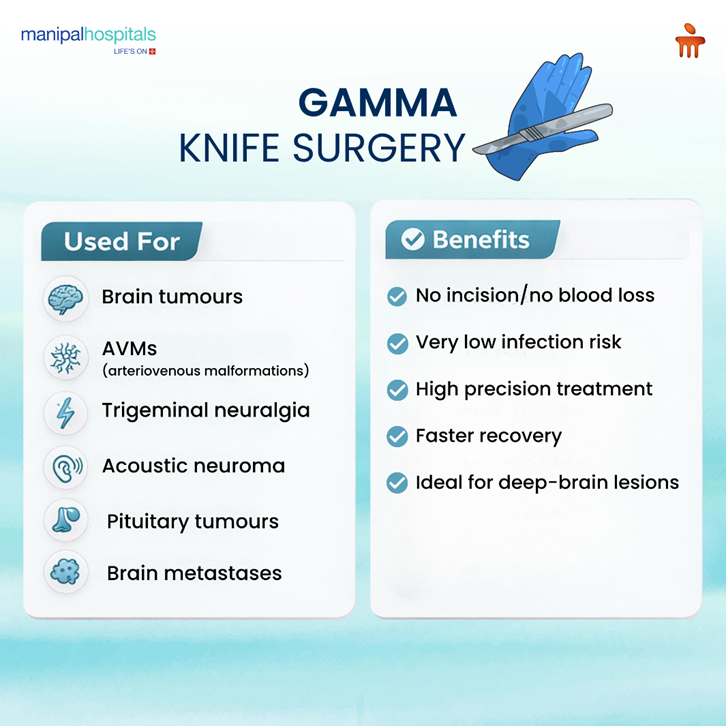
Doctors recommend gamma knife surgery as a suitable option for conditions where accuracy is crucial, and nearby brain tissue needs to be kept safe. Common indications for this procedure include the following:
-
Brain tumours (benign and malignant)
-
Arteriovenous malformations (AVMs)
-
Trigeminal neuralgia (severe facial pain)
-
Acoustic neuroma
-
Pituitary tumours
-
Brain metastases
How Does Gamma Knife Surgery Work?
Gamma knife surgery treats brain conditions by using highly focused beams of radiation. Key features include:
-
Multiple radiation beams converge at a precise target point.
-
The tissues around the area get very little radiation.
-
Targeted cells lose the ability to grow and gradually shrink over time
Gamma knife surgery is especially useful for treating delicate brain areas where regular surgery could be riskier.
Step-by-Step Procedure
Understanding what will happen can help you feel calmer and better prepared.
1. Preparation and Imaging
Before gamma knife surgery, the medical team usually performs a careful assessment. This helps ensure that the treatment is safe and well planned.
The preparation may include:
-
A detailed consultation with the neurosurgeon
-
MRI or CT scans for planning
-
A review of your medical history and current medicines
-
Discussion about the condition being treated and expected results
On the day of treatment, a head frame or a custom mask may be used to keep the head in a fixed position. This helps the team deliver treatment with very high accuracy. The process may sound intimidating at first, but most patients are surprised by how organised and controlled it feels.
2. Treatment Planning
After preparing the images, a team of experts carefully maps out the treatment area, based on its size and location. They then determine the right dose of radiation to address the problem while safeguarding the healthy brain tissue.
3. Sending Radiation
When it is time for treatment:
-
The head is positioned securely
-
Imaging is reviewed, and treatment planning is finalised
-
You are moved into the machine for radiation delivery
-
The machine sends focused beams of radiation directly to the area that needs care
-
The treatment is delivered over a set period of time
-
You are monitored throughout the process
The session may last a few hours, depending on the condition being treated and the size or shape of the target. Some patients are able to go home the same day, while others may stay for observation depending on their situation.
4. Post-Procedure Care
Most patients go home the same day after treatment. Recovery is usually quick. Most people return to their normal activities within a day or two. Good follow-up care helps monitor safety and effectiveness, allowing you to resume your daily routine.
Benefits of Gamma Knife Surgery
There are several reasons why doctors and patients prefer this approach. The benefits go beyond just avoiding surgery:
-
No incision, no stitches, no blood loss
-
Very low risk of infection
-
Short recovery time, faster return to daily activities
-
High-precision targeting for maximum effectiveness
-
Safe option for high-risk or inoperable cases
Due to these benefits, gamma knife surgery is becoming a more popular choice for treatment.
Who is an Ideal Candidate?
This procedure is not needed for everyone, but it can be very helpful in certain situations. Suitable candidates include:
-
Patients with small to medium-sized brain lesions or conditions
-
Individuals unfit for open surgery
-
Patients with lesions in critical or deep brain areas
-
People seeking minimally invasive treatment options
Doctors review each case individually before recommending this treatment.
Possible Risks and Side Effects
At Manipal Hospitals Bangalore, gamma knife surgery is usually safe, but some short-term side effects may occur, such as the following:
-
Mild headache
-
Fatigue
-
Temporary swelling in the brain
-
Nausea (in some cases)
-
Rarely, radiation necrosis (damage to brain tissue)
What Results Can Be Expected?
The results of gamma knife surgery vary depending on the condition being treated. Some patients notice improvement quickly, while others need several weeks or months before the full effect appears.
For example:
-
Pain relief in trigeminal neuralgia may develop gradually
-
Tumours may stop growing or shrink over time
-
AVMs may take time to respond after treatment
-
Symptoms may improve step by step rather than all at once
It is important to understand that gamma knife surgery does not always produce immediate results. In many cases, the purpose is to control the condition safely and effectively over time.
Recovery After Gamma Knife Surgery
Recovery after gamma knife surgery is usually simpler than after open brain surgery. Most patients can return to normal routines sooner, although rest is still important on the day of treatment.
After the procedure, your doctor may advise you to:
-
Rest for the day
-
Keep the head frame or bandage area clean, if applicable
-
Watch for headaches or unusual symptoms
-
Attend follow-up scans and appointments
-
Take prescribed medicines as directed
The recovery period depends on the underlying condition, not just the procedure itself. Some people feel back to normal quickly, while others need ongoing observation and staged follow-up.
When to Seek Medical Help?
After gamma knife surgery, it is important to stay in touch with your care team. You should contact a doctor if you develop:
-
Severe or worsening headache
-
Vomiting
-
New weakness or numbness
-
Vision changes
-
Seizures
-
Fever or signs of infection
-
Symptoms that feel different from what you were told to expect
Most patients do well, but prompt review helps address anything unexpected early.
Conclusion
When it comes to brain treatment, understanding treatment options can reduce uncertainty. Knowing that options like gamma knife surgery are available can make the journey feel far less overwhelming. This precise, non-invasive procedure works well for many neurological conditions and has little impact on daily life. This procedure is a safe and reliable choice for patients looking for modern treatment. Advanced technology and skilled professionals provide expert care, accurate diagnosis, and personalised treatment.
To learn more or book a consultation, visit Manipal Hospitals Bangalore and connect with our expert neurosurgery team.
FAQ's
Gamma knife surgery is commonly used to treat small brain tumours, AVMs, and nerve conditions like trigeminal neuralgia. It helps control or shrink problem areas without needing open brain surgery.
It’s called surgery, but there are no cuts or stitches involved. Instead, it uses focused radiation to treat the problem area, making it far less invasive than traditional brain surgery.
The procedure usually takes a few hours in total, including preparation and planning. The actual radiation treatment may be shorter, depending on the size and location of the condition.
Yes, in most cases, recovery is much quicker. Many patients go home the same day and return to normal activities within a day or two, with minimal discomfort.
The best way is to speak with our neurosurgeons at Manipal Hospitals Bangalore, who understand your condition. They can review your scans, explain your options clearly, and guide you toward the most suitable treatment.
Share this article on:




