7 Min Read
Being told that you may need a Whipple’s procedure can raise many questions at once. The name alone sounds complicated, and when terms like "open surgery," "laparoscopic surgery," or "robotic techniques" enter the conversation, it can quickly feel overwhelming. For most patients, the concern goes far beyond the operation itself. People want to understand what recovery will look like, how long they may stay in the hospital, and when life might begin to feel normal again.
The Whipple procedure is one of the most intricate abdominal surgeries performed today. The approach your surgical team recommends matters. In this blog, you will understand the difference between open and minimally invasive Whipple procedure options. This information can help you feel more prepared and confident in the decisions ahead.
Synopsis
- What is a Whipple’s Procedure?
- The Traditional Open Whipple’s Procedure
- Understanding the Minimally Invasive Whipple Procedure
- Laparoscopic Whipple’s Procedure
- Robotic-Assisted Whipple’s Procedure
- Comparing Open and Minimally Invasive Approaches
- Recovery: What Truly Matters
- Is One Approach Better Than the Other?
- Questions to Discuss With Your Surgeon
- The Bigger Picture: Beyond the Operating Room
- Conclusion
What is a Whipple’s Procedure?
The Whipple’s procedure, also known as pancreaticoduodenectomy, is a major surgery performed to treat conditions affecting the pancreas, bile duct, or small intestine. It is most commonly done for pancreatic head cancer but may also be required for certain benign or precancerous conditions.
During the procedure, the surgeon removes:
-
The head of the pancreas
-
A portion of the small intestine (duodenum)
-
The gallbladder
-
Part of the bile duct
-
Sometimes a small portion of the stomach
After removal, the digestive tract is carefully reconstructed so that food, bile, and pancreatic enzymes can continue to flow properly. This reconstruction is as critical as the removal itself.
Because of its complexity, surgical precision and planning are essential, regardless of the approach used.
The Traditional Open Whipple’s Procedure
The open approach has been the standard for decades. It involves a larger incision in the abdomen, allowing the surgeon direct access to the pancreas and surrounding structures.
This method provides excellent visibility and tactile feedback. Surgeons can directly feel tissues, assess the involvement of blood vessels, and manage unexpected findings during the operation.
Open surgery remains a reliable and effective technique, especially in complex cases where the tumour involves nearby vessels or when prior abdominal surgeries make minimally invasive access difficult.
However, because of the larger incision, recovery may involve:
-
More postoperative discomfort
-
A longer hospital stay
-
A more visible scar
-
Slightly slower return to full physical activity
Despite these factors, outcomes in experienced centres are strong, and many patients recover well with appropriate post-operative care.
Understanding the Minimally Invasive Whipple Procedure
A minimally invasive Whipple procedure uses smaller incisions and specialised instruments to perform the same operation. Instead of one large incision, several small cuts are made through which a camera and instruments are inserted.
There are two main types:
-
Laparoscopic Whipple’s procedure
-
Robotic-assisted Whipple’s procedure
Both aim to reduce surgical trauma while maintaining the same oncological principles as open surgery. The goal is not simply to make the surgery “smaller.” The aim is to reduce the physical stress of surgery while still performing the same complex operation safely.
The internal steps of removing and reconstructing the digestive tract remain just as detailed and complex.
Laparoscopic Whipple’s Procedure
In a laparoscopic approach, the surgeon operates using long, slender instruments guided by a high-definition camera. The image is displayed on a screen, magnified to allow careful dissection.
Some of the commonly discussed laparoscopic Whipple’s benefits include:
-
Smaller incisions
-
Reduced blood loss in selected cases
-
Potentially shorter hospital stay
-
Faster initial recovery
However, laparoscopic surgery requires advanced skill and significant experience. Not every patient is a candidate. Tumour size, location, and involvement of blood vessels play a major role in deciding suitability.
It is also important to note that while recovery from the incision may be quicker, the internal healing time remains substantial. This is still a major abdominal surgery.
Robotic-Assisted Whipple’s Procedure
Robotic surgery builds upon laparoscopy but adds enhanced precision. The surgeon controls robotic arms from a console. The system provides 3D magnified vision and wristed instruments that allow greater flexibility than standard laparoscopic tools.
Some recognised Robotic Whipple’s benefits include:
-
Greater precision in delicate reconstruction
-
Improved visual clarity
-
Enhanced instrument control in confined spaces
-
Potential reduction in postoperative pain
Robotic platforms can be especially helpful in complex reconstructions. However, the surgeon remains fully in control at all times. The robot does not operate independently. As with laparoscopy, not all patients qualify. Careful selection is essential.
Comparing Open and Minimally Invasive Approaches
Before deciding which approach is right for you, it helps to see how the two techniques differ in practical terms. Below compares each approach to help understand the differences:
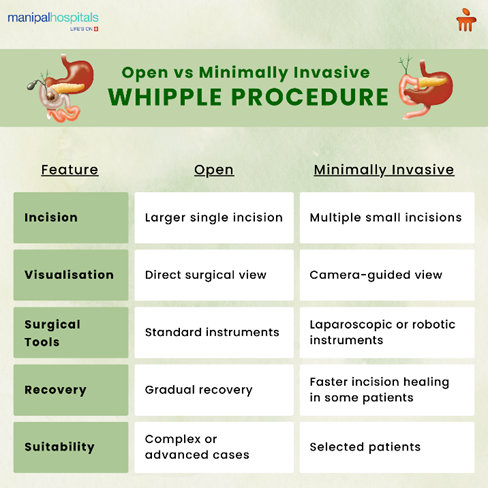
|
Feature |
Open Whipple’s |
Minimally Invasive Approach (Robotic/Laparoscopic) |
|
Incision Size |
Larger single incision |
Multiple small incisions |
|
Visualisation |
Direct view |
2D magnified camera |
|
Instrument Flexibility |
Standard surgical instruments |
Straight laparoscopic tools and Wristed robotic instruments |
|
Postoperative Pain |
Moderate |
Often reduced |
|
Hospital Stay |
Slightly longer |
Potentially shorter |
|
Suitability |
Complex or advanced cases |
Selected patients |
|
Recovery |
Gradual; larger incision healing may take longer
|
Smaller incision healing may be quicker |
The internal surgical steps are equally extensive across all approaches. The difference lies mainly in access technique and recovery experience.
Recovery: What Truly Matters
Regardless of whether surgery is open or minimally invasive, recovery depends on several factors:
-
Your overall health before surgery
-
The complexity of reconstruction
-
Nutritional status
-
Presence of complications
Most patients stay in the hospital for about one to two weeks. Early mobilisation, breathing exercises, and gradual reintroduction of food are key components of recovery. Even with a minimally invasive Whipple procedure, fatigue can last several weeks. Digestive adjustments take time. Appetite may fluctuate. These are normal parts of healing.
Long-term recovery is often more influenced by the disease itself and the need for additional treatments like chemotherapy than by incision size alone.
Is One Approach Better Than the Other?
There is no universal “best” approach. The ideal choice depends on:
-
Tumour size and location
-
Involvement of blood vessels
-
Previous abdominal surgeries
-
Surgeon expertise
-
Hospital infrastructure
Minimally invasive techniques are promising and continue to evolve. The reported Robotic Whipple’s benefits and laparoscopic Whipple’s benefits are encouraging, particularly in experienced hands. However, open surgery remains indispensable in certain complex scenarios.
The most important factor is not the size of the incision but the experience of the surgical team. in Bangalore
Questions to Discuss With Your Surgeon
Before deciding, it is reasonable to ask:
-
Am I a candidate for a minimally invasive approach?
-
How many Whipple procedures have you performed?
-
What are the expected risks in my case?
-
What will recovery look like realistically?
An open and detailed discussion builds trust. This is not a procedure where shortcuts are taken. It requires careful planning and clear communication.
The Bigger Picture: Beyond the Operating Room
Surgery is one part of treatment. Nutrition support, pain management, emotional resilience, and sometimes chemotherapy are equally important.
Some patients focus heavily on the technique, open versus robotic, while overlooking preparation. Strengthening your body before surgery, managing diabetes if present, and improving protein intake can significantly influence outcomes.
Choosing between open and minimally invasive Whipple procedure options are important, but preparation and aftercare often shape the overall experience just as much.
Conclusion
The Whipple procedure is a complex but life-saving operation for many patients. Whether performed through an open incision or using minimally invasive techniques, the core goal remains the same: complete and safe removal of disease followed by precise reconstruction. What matters most is individualised care. If you are considering the Whipple procedure, consult Manipal Hospital Bangalore for tailored advice and a personalised surgical plan. A thoughtful surgical plan, guided by experience and patient-specific factors, leads to the best outcomes.
FAQ's
It’s a complex operation, removing the head of the pancreas and nearby organs, with reconnections to restore digestion. It treats tumours in the pancreas head, bile duct, or duodenum.
Qualification depends on tumour size, vessel involvement, prior surgeries, and overall health. Your multidisciplinary team evaluates scans and medical history to decide if minimally invasive options are safe.
When used appropriately, cancer-control outcomes are similar. The priority is complete tumour removal; technique choice should never compromise oncological safety.
Some patients do have shorter initial stays after minimally invasive procedures, but this varies by centre, patient health, and perioperative recovery. Recovery speed isn’t guaranteed.
Ask how many Whipple procedures (open and minimally invasive) the surgeon has performed, complication rates, and whether they work within a high-volume centre with multidisciplinary support.
Share this article on: