




 7 Min Read
Have you ever felt a slight change, a lump, a patch of skin that looks different, or a new pain, and told yourself it will pass? For many young women, those small changes are exactly what eventually lead to a critical diagnosis. In recent years, doctors and public health experts have noticed a worrying trend: rising rates of breast cancer in India, often in younger women than before. This blog explains the likely reasons behind that shift, what early breast cancer symptoms look like, which breast cancer risk factors matter most in today’s lifestyle, and practical steps you can take to protect yourself and the women you care about.
Synopsis
- Rise in Breast Cancer Among Young Women
- Early Breast Cancer Symptoms
- What Explains this Rise? Causes of Breast Cancer in Young Women
- Risk Factors: Which Ones You Can Change and Which You Can’t
- Screening, Detection, and Considerations for Younger Women
- How to Act When You Notice Signs: A Simple Roadmap
- Prevention: Practical Steps for You and Your Community
- Conclusion
Rise in Breast Cancer Among Young Women
The rise in breast cancer in India among younger age groups changes how we think about screening and awareness. Historically, breast cancer was most common in women over 50. Now, more women in their 20s, 30s, and 40s are being diagnosed. Younger people often have denser breast tissue, which can hide tumours on mammograms, and cancers can be biologically more aggressive. Also, Indian women often present at a more advanced stage compared with high-income countries. This is mainly due to limited access to screening, social stigma, and low awareness of breast cancer symptoms.
Early Breast Cancer Symptoms
Many early signs are subtle. Learn these common breast cancer symptoms so you can act fast if you notice them.
|
Symptom |
Why It Matters |
What To Do |
|
A new lump or thickening in the breast |
Most classic sign; not all lumps are cancer, but they need checking |
See a clinician for a clinical exam and imaging |
|
Change in breast shape or size |
May indicate an underlying lesion |
Clinical assessment and imaging |
|
Skin changes over the breast (dimpling, puckering, redness) |
Can signal tumour pulling on tissue or inflammatory cancer |
Urgent review and imaging |
|
Nipple discharge, especially bloody |
It could be a sign of ductal involvement |
Specialist referral for imaging and possible biopsy |
|
New nipple inversion or ulceration |
Concerning for underlying pathology |
Urgent evaluation |
|
Localised breast pain that is persistent |
Most breast pain is benign, but persistent focal pain needs assessment |
Check with your doctor |
Note: lumps can be benign cysts or fibroadenomas, especially in younger women, but the rule is simple: any persistent change merits prompt evaluation.
What Explains this Rise? Causes of Breast Cancer in Young Women
No single explanation fits every case. Instead, several interacting trends and exposures seem to be pushing numbers up. Below are the major causes of breast cancer and why they matter today.
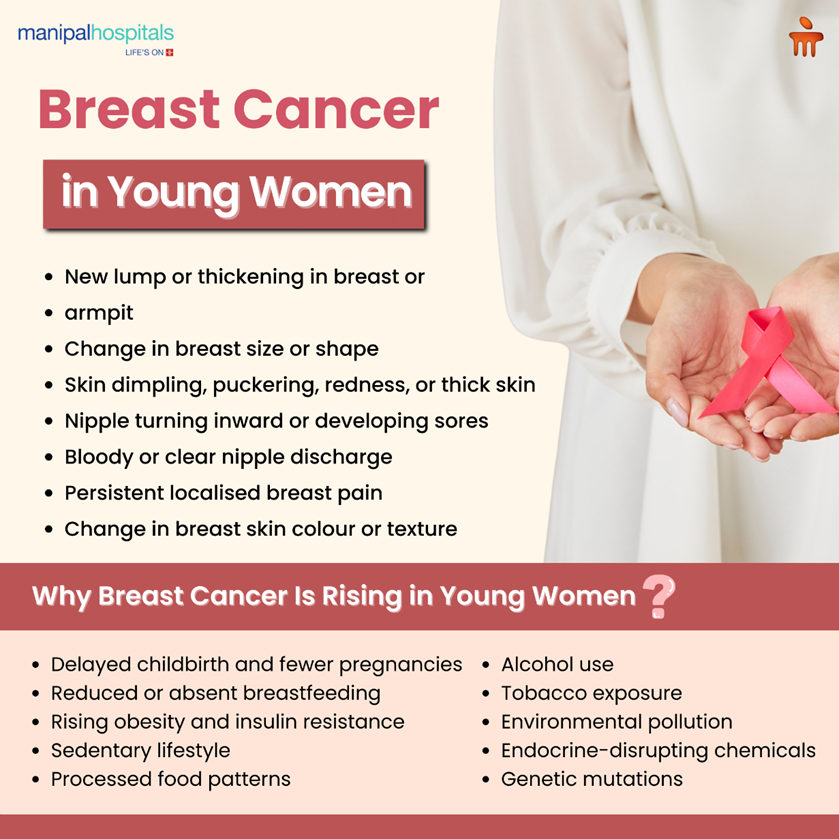
1. Lifestyle changes and reproductive patterns
Delayed childbearing, fewer pregnancies, and shorter or absent breastfeeding periods all increase lifetime exposure to oestrogen. In India, career pressures, urban living, and changing social norms mean many women have children later or fewer children than earlier generations. These shifts are recognised breast cancer risk factors.
2. Obesity and metabolic health
Rising obesity and metabolic syndrome contribute to higher levels of inflammatory markers and hormones that encourage some breast cancers. Excess weight, particularly after menopause, is a clear breast cancer risk factor that is now more common in urban India.
3. Diet and inactivity
A shift from traditional diets toward processed foods, sugary drinks, and sedentary lifestyles raises cancer risk. Regular physical activity reduces risk.
4. Environmental exposures and pollution
Air pollution, endocrine-disrupting chemicals in plastics, and some occupational exposures are under investigation as contributors. These are possible causes of breast cancer that interact with genetic susceptibility.
5. Genetic and family history
A minority of cases are driven by inherited gene mutations such as BRCA1 and BRCA2. If you have a strong family history of early breast or ovarian cancer, genetic testing and earlier surveillance make sense.
6. Increased detection and awareness
Part of the rise reflects better detection and more awareness, but the rising incidence cannot be explained by detection alone. This makes prevention and early action crucial.
Risk Factors: Which Ones You Can Change and Which You Can’t
Understanding breast cancer risk factors helps you prioritise what to act on.
-
Family history and genetics: Strong for individuals with BRCA mutations
-
Age at first childbirth, number of pregnancies: Modifiable only at a life-choice level
-
Breastfeeding duration: Increasing breastfeeding reduces risk
-
Body weight and physical activity: High, modifiable risk5. Alcohol intake: Dose-dependent increase in risk
-
Tobacco use: Contributes to many cancers, including some breast cancers
-
Diet quality: Healthier diets lower risk
-
Exposure to radiation or certain chemicals: Occupational and medical exposures can be minimised
-
Dense breast tissue: Increases the difficulty of detection and may raise the risk
Focusing on the modifiable items, maintaining a healthy weight, limiting alcohol, avoiding tobacco, staying active, and breastfeeding where possible, gives you practical control.
Screening, Detection, and Considerations for Younger Women
Traditional screening with mammography targets older women. For younger women, dense breast tissue reduces mammogram sensitivity and makes lumps harder to spot on routine screens. If you are young and have breast cancer risk factors or a strong family history, your doctor may recommend:
-
Earlier clinical breast exams,
-
Targeted ultrasound when lumps or changes are felt,
-
MRI in high-risk women,
-
Genetic counselling and testing if family history suggests inherited risk.
Awareness campaigns focused on self-awareness and prompt clinical evaluation help identify cancers that would otherwise be found late.
How to Act When You Notice Signs: A Simple Roadmap
-
Don’t ignore a new lump or persistent change. The 2-week rule for persistent symptoms is a proper local standard.
-
Get a clinical breast exam from a doctor experienced in breast health.
-
Imaging choices depend on age and examination: ultrasound is often first-line in women under 40; mammography is standard for older women.
-
If imaging is suspicious, a needle biopsy will confirm the diagnosis.
-
If cancer is confirmed, ask about receptor tests (oestrogen, progesterone, HER2) that guide treatment.
Prompt diagnosis not only improves survival but also often allows less aggressive treatment.
Prevention: Practical Steps for You and Your Community
Prevention is realistic. Here are evidence-based moves that reduce personal and population risk:
-
Stop tobacco and avoid secondhand smoke. The tobacco cancer risk is high for many cancers; quitting helps overall cancer prevention.
-
Limit alcohol; every unit increases alcohol and cancer risk. Keeping consumption low reduces breast cancer risk.
-
Stay active and maintain a healthy weight. Exercise lowers hormone levels that drive some cancers.
-
Favour a whole-food diet rich in vegetables, pulses, and whole grains. Reduce processed and high-sugar foods.
-
Breastfeed when possible; it gives protective benefits.
-
Participate in breast cancer awareness India programmes and encourage screening in your community.
If you have a family history, seek genetic counselling and consider earlier surveillance options.
Conclusion
The rise of breast cancer in Bangalore, India among younger women is a call to action, not panic. By learning breast cancer symptoms, understanding breast cancer risk factors, addressing lifestyle risks such as tobacco cancer and alcohol and cancer risk, and improving breast cancer awareness in Bangalore, India, you and your community can detect the disease earlier and reduce incidence over time. Small changes, less alcohol, no tobacco, more activity, and timely medical checks make a measurable difference. If you notice any persistent change in your breast, please see top specialists at Manipal Hospitals Bangalore promptly so you can get answers without delay.
FAQ's
Early breast cancer symptoms include a new lump or thickening, unexplained nipple discharge, especially if bloody, skin changes such as dimpling, an inverted nipple, or a persistent change in breast shape. Any persistent change longer than two weeks should be evaluated.
There is no single cause. Contributing causes of breast cancer include genetic predisposition, reproductive patterns, obesity, alcohol use, tobacco exposure, and environmental factors. A combination of lifestyle and biological factors usually explains early-onset cases.
In breast cancer in India, important breast cancer risk factors include delayed childbearing, reduced breastfeeding, rising obesity, and tobacco and alcohol use. Limited screening and awareness also contribute to later diagnoses.
Yes. Studies show alcohol and cancer risk are linked, including for breast cancer. The risk increases with quantity and frequency. Reducing or avoiding alcohol lowers your risk.
Share reliable information about breast cancer symptoms, encourage regular clinical exams, support local screening camps, challenge stigma about cancer, and promote healthy lifestyles. Participating in breast cancer awareness India drives and helping people access screening can save lives.
Share this article on:




