
Corneal Transplant
Manipal Hospitals provides specialised eye care for patients requiring advanced corneal treatments to restore clarity and vision. As a centre for corneal transplants in India, the hospital offers detailed evaluation, precision-based surgical planning, and modern microsurgical techniques. Ophthalmologists assess corneal damage and overall eye health to decide whether a full-thickness or partial-thickness transplant is appropriate. With skilled surgeons and high-tech imaging, patients receive safe eye care that improves vision and supports long-term eye health.
Hospital Locations
-

Old Airport Road - Bengaluru
-
.webp)
Mysuru
-

Mangaluru
-

Dwarka - Delhi NCR
-

Patiala
-

Jaipur
-

Vijayawada
-

Salem
-
Kharadi - Pune
-

Salt Lake - Kolkata
-

Bhubaneswar
-

Siliguri
-

Ranchi

How It Works
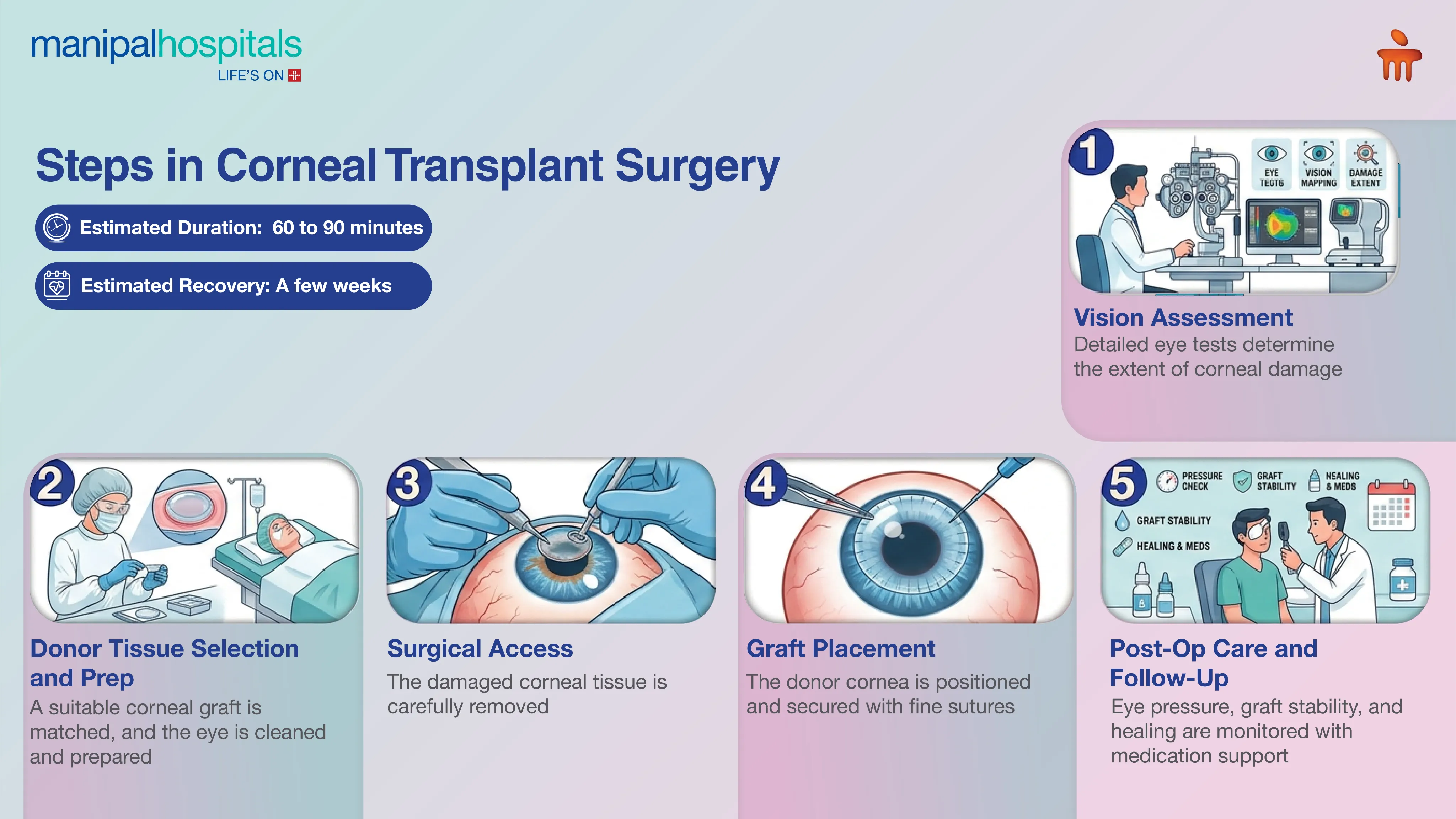
Manipal Hospitals approaches corneal transplant surgery in India through a clear, step-wise, and carefully coordinated process that prioritises patient safety, visual improvement, and overall eye health.
Before the procedure, ophthalmologists carry out a detailed assessment that includes vision testing, slit-lamp examination, corneal imaging, and evaluation of any underlying eye conditions. Donor cornea selection is planned based on medical suitability and visual requirements. Patients receive guidance on medication adjustments, eye hygiene, fasting instructions, and what to expect on the day of surgery.
During the procedure, surgeons perform either a full-thickness or partial-thickness corneal transplant depending on the extent of damage. Using microsurgical techniques, the affected corneal tissue is carefully removed and replaced with healthy donor tissue. Fine sutures are placed to secure the graft, and the eye is stabilised throughout the procedure. Anaesthetists monitor comfort and vital signs, while surgical teams maintain a sterile, controlled environment to prevent complications. After the procedure, patients are monitored in the recovery area, where eye pressure, graft position, and early healing are examined. Protective shields, prescribed eye drops, and detailed care instructions are provided to reduce inflammation and prevent infection.
Didn’t find what you were looking for?
Request a CallbackBenefits
Choosing corneal transplant surgery at Manipal Hospitals provides the following benefits:
-
Improved vision through the placement of healthy donor tissue
-
Preservation of eye structure, comfort, and optical function
-
Reduced glare, scarring, and visual distortion
-
High-precision results using modern microsurgical techniques
-
Lower rejection risk supported by tailored medication plans
-
Faster recovery with partial-thickness graft options
-
Enhanced outcomes through high-quality imaging and continuous monitoring
What to Expect
Consultation and diagnosis
The process begins with a detailed eye examination, including vision testing, slit-lamp evaluation, corneal imaging, and assessment of eye pressure.
Pre-operative preparation
Patients receive instructions regarding medication adjustments, eye hygiene, and fasting. Donor cornea selection is completed, and suitability is confirmed. The team explains the surgical steps, expected results, recovery timeline, and post-operative care requirements.
Surgery day
On the day of surgery, the eye is cleaned, and anaesthesia is administered. Surgeons remove the damaged corneal tissue and replace it with healthy donor tissue using fine microsurgical techniques.
Recovery room monitoring
Immediately after surgery, patients are observed for graft position, eye pressure, and early healing. Protective shields are placed, and initial medication is administered to control inflammation and prevent rejection.
Hospital stay
Most patients return home the same day, receiving instructions on activity restrictions, eye-drop schedules, and protective measures.
Physical therapy
Specific eye exercises are generally not required, but patients are guided on safe visual habits and protection.
Follow-up appointments
Regular visits allow monitoring of healing, suture status, graft clarity, and medication adjustments.
Long-term recovery
Vision gradually improves over weeks to months, supported by continuous guidance and structured corneal health monitoring.
Why Manipal Hospitals?
Manipal Hospitals offers specialised corneal care supported by experienced ophthalmologists, modern surgical facilities, and well-structured clinical pathways for patients requiring corneal transplants. The eye-care units are equipped with high-resolution imaging systems, advanced microscopes, and dedicated operating theatres designed for delicate microsurgical procedures.
Each patient undergoes a comprehensive evaluation to determine the most suitable transplant technique, ensuring treatment is tailored to the type and severity of corneal damage. The ophthalmology team, including corneal surgeons, optometrists, anaesthetists, and trained nursing staff, works in close coordination throughout the patient’s treatment journey.
This integrated expertise supports accurate diagnosis, safe graft handling, and effective post-operative monitoring. Strict infection-control measures, sterile environments, and continuous observation help reduce complications and promote smooth healing. Patients receive detailed counselling on the procedure, expected outcomes, and long-term care requirements. Follow-up visits are scheduled to monitor visual improvement, manage sutures if needed, and support overall recovery.
Centre of Excellence
The Ophthalmology Department at Manipal Hospitals provides comprehensive care for patients requiring advanced corneal treatments and transplant surgery. The department is led by experienced corneal surgeons, optometrists, and trained nursing teams who manage both simple and complex corneal conditions. High-resolution imaging, modern operating microscopes, and dedicated eye-care theatres support safe and precise surgical procedures.
Services Offered
Patients receive complete corneal care that supports accurate diagnosis, safe surgery, and steady visual recovery.
-
Detailed corneal evaluation and vision testing
-
Full-thickness and partial-thickness corneal transplant options
-
Donor tissue matching and preparation
-
Microsurgical corneal graft placement
-
Management of corneal scars, infections, and thinning disorders
-
Post-operative graft monitoring and medication planning
-
Suture assessment and adjustment when required
Facilities & Services
Patients benefit from state-of-the-art eyecare facilities designed to support precise corneal surgery and safe, well-monitored recovery.
-
High-resolution corneal imaging and topography systems
-
Dedicated ophthalmic operating theatres
-
Advanced surgical microscopes for microsurgery
-
Sterile environments with strict infection control
-
On-site eye bank support for donor tissue handling
-
Post-operative recovery suites for close monitoring
-
Skilled ophthalmic nursing and medication support
Frequently Asked Questions
A corneal transplant may be recommended if vision is affected by scarring, thinning, swelling, or conditions that do not respond to medication. A detailed eye examination helps determine whether surgery is necessary.
At Manipal Hospitals, patients undergoing a corneal transplant receive thorough eye evaluation, donor tissue preparation, and precise surgical graft placement. In addition, post-operative medication and regular follow-up visits help monitor healing, graft stability, and ongoing visual improvement.
The surgery is usually painless because anaesthesia is given. Patients may feel mild irritation or a foreign-body sensation after the procedure, which settles with prescribed drops and protective measures.
Initial healing usually takes a few weeks, while full visual stabilisation may require several months. Regular follow-up visits help assess graft clarity, manage suture adjustments, monitor eye pressure, and ensure steady, safe recovery.
Risks include infection, graft rejection, raised eye pressure, and delayed healing. Regular monitoring, timely medication, and scheduled follow-up visits for corneal transplants in India at Manipal Hospitals help detect early changes and manage complications promptly.
Consult our Experts



You’re on Our Indian Website
Visit the Global site for International patient services
'Click' to chat with us
