8 Min Read
One of the most common and genuinely my favourite questions patients ask me: How is it possible that recovery after robotic surgery is so quick?
For decades, surgery was almost synonymous with large scars, extensive pain, and weeks of forced rest. Traditional open surgery required large incisions, significant tissue handling, and prolonged healing time. For many, these procedures meant putting life on hold—family, responsibilities, work, everything.
Robotic surgery has transformed this landscape. It has transformed not just how we operate, but also how patients heal and return to their lives. As a surgeon who sees this transformation every day, I can confidently say the difference is truly remarkable. Recovery after robotic-assisted surgery usually takes just a few days.
In this blog, let us have a detailed look at why patients heal faster, supported by the science behind minimally invasive surgery and enhanced surgical precision.
Synopsis
Understanding Robotic Surgery
In robotic surgery, surgeons use a robotic system to perform procedures through small incisions. The robot doesn't work on its own. Rather, the surgeon operates specialised instruments via a console that provides high-definition, magnified visualisation and enhanced precision.
The robotic system turns the surgeon's hand movements into smaller, more precise movements of the surgical tools. With this technology, surgeons can operate more accurately, especially in areas of the body that are delicate or complicated.
Robotic-assisted techniques are often used for the following procedures:
-
Colorectal surgery
-
Prostate surgery
-
Gynaecological procedures
-
Kidney surgery
-
Hernia repair
-
Gastrointestinal surgery
They lead to better outcomes by improving control and limiting damage to nearby tissues.
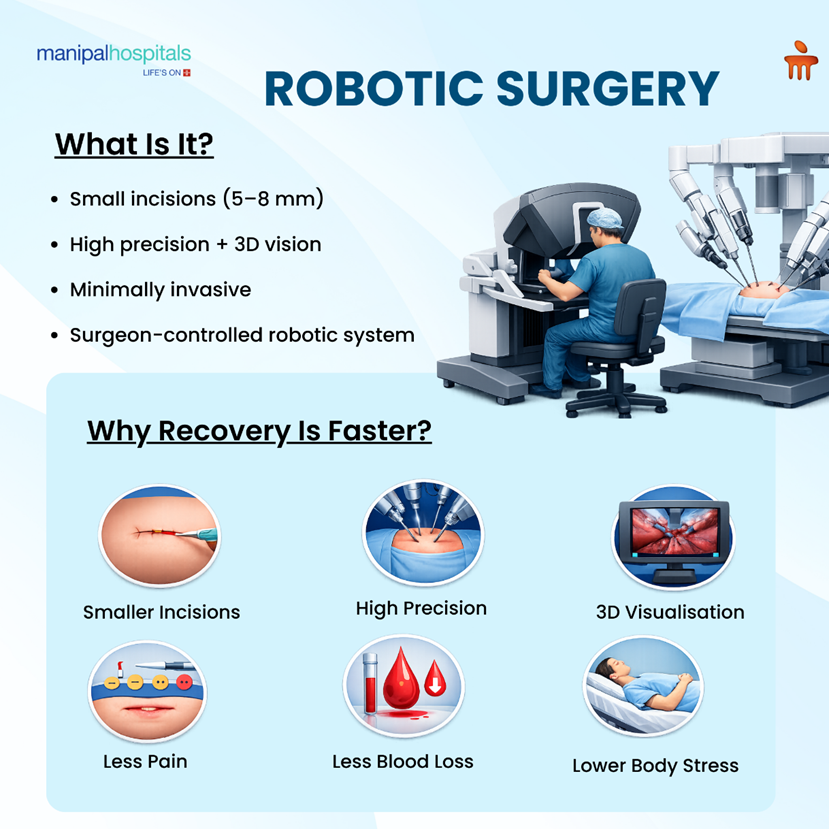
Why is Robotic Surgery Recovery Faster?
Recovery after robotic surgery is usually quicker than traditional procedures which involve larger incisions and more tissue handling. Robotic techniques are also more precise and less disruptive to the body.
Smaller Incisions Promote Faster Healing
Robotic surgery focuses on accuracy and causes minimal damage to the body. Smaller cuts help wounds heal faster. One clear difference between traditional surgery and robotic-assisted surgery is the size of the incision. In open surgery, surgeons often need to make a large cut to reach the internal organs. This can lead to a longer healing time and more pain after the operation.
Robotic surgery uses small keyhole incisions, generally 5 to 8 millimetres in size. These provide access to the surgical site while minimising damage to surrounding tissues.
Benefits of Smaller Incisions:
-
Reduced postoperative pain
-
Lower risk of infection
-
Minimal scarring
-
Shorter hospital stay
Recovery is quicker because the body heals smaller wounds more easily.
Enhanced Surgical Precision Protects Healthy Tissue
Recovery is often quicker because robotic systems allow highly precise movements. Robotic technology reduces natural hand tremors to tiny movements. This helps surgeons operate with great precision and lowers the risk of damaging nearby tissues.
After surgery, the body heals best when healthy tissue is preserved, and that brings several benefits patients often notice. There’s less damage to surrounding organs, reduced inflammation, and a lower risk of complications. Recovery also feels smoother, with a faster return to daily activities. By protecting healthy tissue, the body experiences less stress and can bounce back more quickly, making the healing journey easier and more reassuring.
Advanced 3D Vision Improves Surgical Accuracy
A high-definition three-dimensional camera gives the surgeon a close-up view of the surgical area during robotic surgery. This advanced visualisation has several benefits:
-
Greater clarity of small structures such as nerves and blood vessels
-
Better visibility in 3D
-
Better identification of delicate anatomical areas
Enhanced visualisation enables surgeons to safely perform procedures in confined or anatomically complex areas, such as the pelvis.
Reduced Pain Allows Early Mobilization
Recovery from traditional surgery often takes longer because of post-surgery pain. Larger incisions can make movement and daily activities difficult. With robotic surgery, patients usually experience less pain due to minimal tissue damage.
This means patients can start walking, eating, and resuming basic activities sooner; need fewer pain medicines; and regain their strength faster. Moving early after surgery also helps prevent blood clots and muscle weakness.
Reduced Blood Loss and Lower Complication Risk
Because robotic instruments are so precise and give surgeons a better view during surgery, robotic-assisted surgery is usually associated with less blood loss. Less bleeding can have several important benefits:
-
Lower risk of blood transfusion
-
Faster stabilisation after surgery
-
Reduced surgical complications
-
Quicker overall recovery
Smaller incisions and careful tissue handling further reduce the risk of surgical site infections and postoperative swelling.
Lower Physiological Stress on the Body
Open surgery often causes a stronger stress response because it involves larger wounds and more tissue damage. Robotic surgery usually causes less stress, which helps the body heal faster. As a result, patients often experience faster recovery of digestion, immune function, and overall energy levels. Many patients say they regain their strength sooner than they expected.
Robotic Surgery Vs Traditional Open Surgery
When patients hear about robotic surgery, one of the first questions they ask is how it actually differs from traditional open surgery. The difference is not just about technology but about how the body experiences and recovers from the procedure. The comparison below breaks down these differences clearly:
|
Feature |
Robotic-Assisted Surgery |
Traditional Open Surgery |
|
Incision size |
Small keyhole incisions (5–8 mm) |
Large surgical incision |
|
Tissue trauma |
Minimal |
Greater tissue disruption |
|
Blood loss |
Usually minimal |
Often higher |
|
Pain levels |
Generally lower |
Often higher |
|
Hospital stay |
Shorter |
Longer |
|
Recovery time |
Often, a few days |
Several weeks |
This comparison shows how robotic surgery has gained popularity recently for many procedures.
Faster Recovery in Complex Surgical Areas
Robotic systems are especially helpful for surgeries in deep or complex areas like the pelvis, where accuracy matters most. In operations such as colorectal or prostate surgery, surgeons need to protect delicate nerves and structures. Robotic technology gives them better control, which helps preserve nerves, lowers the risk of complications, and leads to a quicker recovery of bladder and bowel function. These benefits improve outcomes and help patients return to daily life sooner, making recovery smoother.
What Patients Can Expect After Robotic Surgery?
Recovery is usually quick, but everyone heals at their pace. Age, overall health, and the type of surgery can all affect how long it takes. Most patients can expect the following:
-
A shorter stay in the hospital and a quicker discharge
-
Mild discomfort that gets better quickly
-
An early return to moderate daily activities
-
Follow-up appointments to check on healing
Doctors usually advise patients to gradually increase their activity and avoid heavy work until they are fully healed.
When Robotic Surgery May Be Recommended?
If a patient needs surgery but would be better off with a less invasive method, robotic-assisted procedures may be recommended. Robotic surgery is often considered when:
-
The procedure requires high precision
-
The surgical area is difficult to access
-
Minimising recovery time is important
-
There is a need to reduce surgical complications
A thorough assessment aids in ascertaining the suitability of robotic surgery for each patient.
Conclusion
Modern surgical technology has transformed patient experiences following major surgeries. Robotic-assisted surgery enables surgeons to perform complex procedures through minimal incisions with high precision, significantly reducing bodily trauma.
As a result of these benefits, many patients recover within days rather than weeks, experiencing less pain, fewer complications, and a faster return to daily life. Robotic surgery is an important step forward in healthcare. It uses detailed imaging, precise tools, and less invasive methods.
If you are considering robotic cancer surgery, you can speak with our cancer surgeons in Kanakapura Road, Bangalore, to see if this option suits you and how it could support a quicker recovery.
FAQ's
No. The surgeon is responsible for the whole robotic system. It enhances the precision of the surgeon’s movements.
In many cases, robotic surgery may be safer and support faster recovery because it is more precise, involves smaller incisions, and has fewer complications.
Depending on the type of surgery and the patient's overall health, many people get better in a few days to a couple of weeks.
Because the procedure uses very small incisions, scars are usually minimal and often fade significantly over time.
Not every procedure needs robots. Your doctor will look at your condition and decide if robotic surgery is the best choice for you.
Share this article on: