7 Min Read
.webp "Why Choose Robotic Surgery Over Other Types of Surgical Methods")
Surgery has changed a great deal in recent years, and that change matters to you. Robotic surgery builds on the benefits of laparoscopic surgery while giving surgeons better vision, finer instrument control, and easier access to difficult anatomy. For you, this can mean smaller wounds, less pain, quicker recovery, and a faster return to daily life. This blog explains how robotic-assisted surgery works, why the Da Vinci Robotic Surgical System is widely used, the real advantages over laparoscopic surgery and open surgery, and which procedures you can expect to be offered at Manipal Hospital Kanakapura Road.
Synopsis
- Advancements in General Surgery Techniques
- How is Robotic Surgery Performed?
- 3 Components of the Robotic Surgical System
- How Robotic Surgery Enhances Surgical Precision and Patient Outcomes?
- Advantages of the Robotic Surgical System Over Laparoscopy
- Advantages for surgeons and patients
- Robotic surgery applications
- Robotic Procedures at Manipal Hospital Kanakapura Road
- What to Expect if You Choose Robotic Surgery
- Conclusion
Advancements in General Surgery Techniques
Surgical methods continue to evolve with time. The key factors determining surgical success include the surgeon’s anatomical knowledge, technical skill, quality of visualization, precision instruments, and strict maintenance of sterility. The adoption of modern technology and innovations plays a vital role in improving surgical outcomes. Today, the 3D visualization and flexible robotic arms provided by robotic systems allow surgeons to perform intricate procedures with exceptional precision and achieve optimal results.
How is Robotic Surgery Performed?
Many people mistakenly believe that in robotic surgery, the robot operates independently. This is completely false. The surgeon plays a central and active role throughout the procedure, controlling every movement of the robotic arms and making all surgical decisions.
During a typical operation, your surgeon sits at a console and uses hand controls to guide the robotic arms inside your body. The console provides a magnified, three-dimensional image so the surgeon sees the anatomy in detail. Tiny instruments at the end of the robotic arms carry out the movements you see at the console. Throughout, the operating surgeon decides every move and remains in full control.
3 Components of the Robotic Surgical System
The Da Vinci Robotic Surgical System comprises 3 key components:
|
Surgeon Console |
Patient Cart |
Vision Cart |
|
The surgeon’s workstation, where they sit and operate using magnified 3D visualization and master controls that translate hand movements into precise movements of the robotic arms. |
A movable cart positioned over the patient. It holds the robotic arms attached to surgical instruments and a camera. These arms are controlled entirely by the surgeon from the console. |
This serves as the central hub connecting the surgeon’s console and the patient cart. It houses a monitor for the surgical team and provides the necessary energy sources for cutting and coagulating tissues. |
How Robotic Surgery Enhances Surgical Precision and Patient Outcomes?
Compared to open and laparoscopic surgeries, robotic-assisted procedures offer significant advantages. While laparoscopic surgery provides magnified vision, smaller incisions, and faster recovery, robotic surgery goes a step further with:
-
3D visualization
-
Enhanced wrist articulation allows a greater range of motion
-
Improved dexterity and control
These features result in less tissue inflammation, minimal bleeding, and faster recovery, leading to superior patient outcomes.
Advantages of the Robotic Surgical System Over Laparoscopy
|
Additional Wrist-Like Joints |
|
|
3D Vision |
|
|
Reduced Pressure on the Patient’s Body |
|
Advantages for surgeons and patients
Better tools benefit both the surgical team and the person having surgery.
Robotic surgery applications
Robotic methods are now used across many specialties because the platform improves surgical control where fine dissection and suturing matter.
Common areas of application include general and gastrointestinal surgery, gynaecology, urology, thoracic surgery, endocrine surgery, and selected head and neck procedures. At centres with experienced teams, the list of suitable procedures continues to expand as surgeons gain more experience and the technology evolves.
Robotic Procedures at Manipal Hospital Kanakapura Road
At Manipal Hospital Kanakapura Road, we perform a wide range of robotic-assisted surgery using the Da Vinci Robotic Surgical System. The robotic programme covers common and complex procedures in general and gastrointestinal surgery and other specialties.
-
Robotic-assisted cholecystectomy for gallbladder disease
-
Robotic-assisted appendectomy for select cases
-
Hernia repairs, including complex and recurrent hernias
-
Robotic assisted inguinal Hernia surgery
-
Robotic assisted umbilical hernia surgery
-
Robotic assisted ventral hernia surgery
-
Robotic assisted incisional hernia surgery
-
-
Robotic fundoplication for hiatus hernia and cardiomyotomy for achalasia
-
Scarless neck surgery for selected thyroid and parathyroid conditions
-
Endoscopic and robotic assisted thoracic sympathectomy for hyperhidrosis and other thoracic procedures
Your surgical team will discuss which approach is best for your condition and whether robotic surgery offers a clear advantage in your case.
What to Expect if You Choose Robotic Surgery
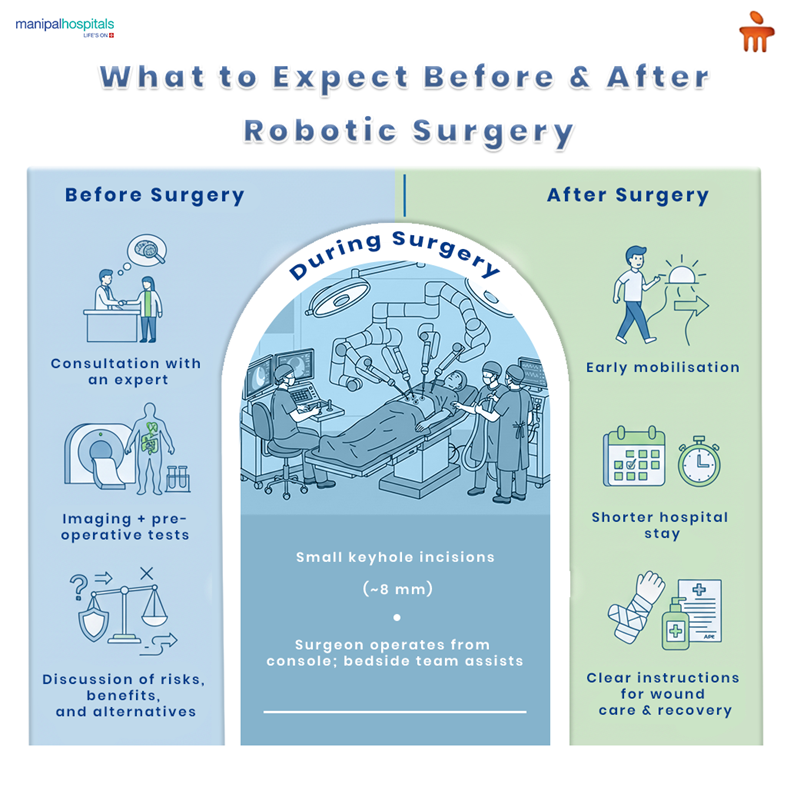
Choosing robotic surgery begins with a detailed consultation where risks and benefits are discussed for your specific condition.
-
Preoperative assessment and imaging are used to plan the operation precisely.
-
Usually, small keyhole incisions of about eight millimeters are made for instrument ports.
-
The surgeon operates from the console while a skilled operating team manages the procedure at the bedside.
-
Close postoperative monitoring and early mobilisation to speed recovery.
-
Clear follow-up instructions and rehabilitation guidance to help you return to normal activities.
Your team will explain expected recovery times and any special precautions based on the operation performed.
Conclusion
Robotic surgery represents a major step forward in minimally invasive surgery. By combining superior visualisation with articulated instruments, robotic systems such as the Da Vinci Robotic Surgical System give surgeons greater precision and patients a faster, less painful recovery compared with some traditional approaches. If you are considering surgery, discuss all available options with your surgeon and ask whether a robotic approach is appropriate for your condition.
At Manipal Hospital Kanakapura Road, experienced surgeons and a dedicated robotic program aim to deliver safe, effective care tailored to your needs.
FAQ's
Robotic surgery offers specific advantages for complex procedures and for operations in confined spaces. Safety depends on the surgeon’s experience and the procedure chosen. Discuss risks and benefits with your surgeon.
No. The surgeon controls every movement of the robotic arms from the console. The robot does not act independently.
Yes. Robotic procedures use small keyhole incisions that are similar in size to laparoscopic ports and usually heal with minimal scarring.
Recovery varies by procedure and your overall health. Many patients experience less pain and shorter hospital stays compared with open surgery. Your surgical team will give a personalised recovery plan.
Candidates are selected based on the condition being treated, anatomy, and overall health. Your surgeon will advise whether robotic-assisted surgery is the best option for you.
Share this article on: