5 Min Read
In the daily hustle of meeting deadlines and clearing backlogs, how many of us are really taking care of our health?
We often push through fatigue or ignore minor changes in our bodies to meet the demands of a busy life, but the kidneys, the silent workhorses of the body, might be struggling to keep up. As per epidemiological estimates, 1 in 6 individuals may have some kidney disease. This blog walks you through the kinds of kidney problems doctors commonly see, illustrated by real-world cases. The aim is simple. If you recognise symptoms early and act, most people will have more choices and better outcomes.
Synopsis
- Kidney Problems: What Brings Patients to a Nephrologist?
- Common Causes of Kidney Problems
- Kidney Disease Symptoms and Signs
- How Doctors Detect Kidney Problems?
- Treatment Options: From Simple Fixes to Advanced Therapies
- Common Presentations and Next Steps
- Practical Advice for Patients and Families
- Conclusion
Kidney Problems: What Brings Patients to a Nephrologist?
In our everyday practice, we often notice patients across all ages reporting to us with sudden manifestations of kidney ailments. Sometimes, there would be a mother noticing unusual puffiness around her 5-year-old child’s eyes in the morning, a young professional stunned by high blood pressure and a protein leak during a routine check-up, or a grandmother with diabetes and deteriorating kidney function.
Many fear that a nephrologist consultation may lead them to dialysis, but the reality is quite the opposite. If these problems are detected in early stages, whether through a routine urine test or a serum creatinine blood test, there are numerous treatment pathways to maintain kidney health. From targeted medications and dietary shifts to eliminating hidden toxins, these early interventions can slow or even halt the disease and preserve your quality of life for years to come.
Common Causes of Kidney Problems
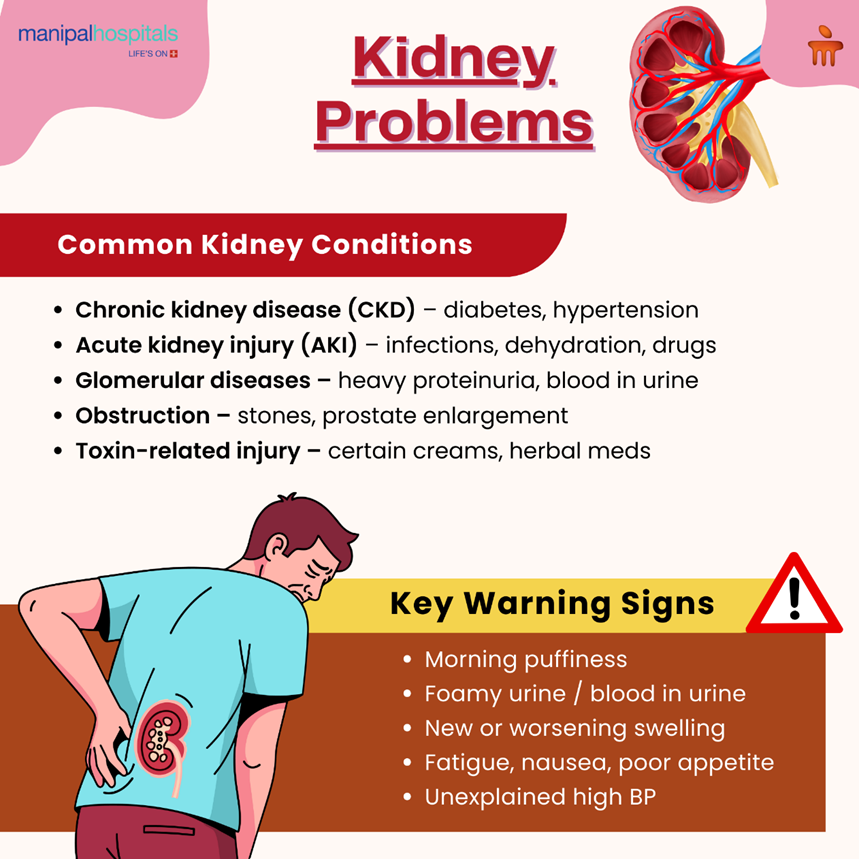
Kidney disease has many triggers. Knowing common causes helps you recognise risk and ask the right questions.
-
Diabetes mellitus and long-standing high blood pressure remain the leading causes of chronic kidney damage.
-
Infections, certain medications, and severe dehydration can cause acute kidney injury that may be reversible.
-
Autoimmune diseases and primary glomerular diseases cause proteinuria and blood in urine in children and adults.
-
Toxins and over-the-counter remedies, including some skin creams, can injure the kidneys.
-
Obstruction of urine flow due to stones, prostate enlargement, or structural problems can raise creatinine and damage the kidney.
Your doctor will use your history to narrow down the likely cause before ordering specific tests.
Kidney Disease Symptoms and Signs
These common symptoms of kidney disease should prompt you to visit a doctor.
-
New swelling of the face, eyes, or legs, especially when worse in the morning or at the end of the day.
-
Persistent fatigue, loss of appetite, nausea, or metallic taste.
-
Changes in urine, such as foamy urine, visible blood, or reduced volume.
-
Rising blood pressure that is hard to control.
-
Abnormalities found incidentally on routine tests, such as protein on dipstick or elevated serum creatinine.
If you notice these, ask for a urine test and basic kidney and blood tests.
How Doctors Detect Kidney Problems?
Start with simple tests: urine test, urine albumin to creatinine ratio, and blood tests including serum creatinine, urea, and electrolytes.
-
An ultrasound of the abdomen helps assess kidney size and look for obstruction or structural abnormalities.
-
When indicated, formal 24-hour urine protein collection or spot urine protein ratios give better quantification of proteinuria.
-
A kidney biopsy may be recommended if the cause is unclear if rapid changes in function occur or if specific glomerular diseases are suspected. Biopsy guides treatment in many diseases.
-
Additional tests may include autoimmune screens, infection tests, or imaging, depending on the suspected cause.
This rational sequence minimises delay and targets treatment.
Treatment Options: From Simple Fixes to Advanced Therapies
Treatment depends entirely on the cause and the stage of the disease. The good news is that many problems respond well when addressed promptly.
Conservative and supportive care
-
Stopping harmful medications or toxins and treating infections.
-
Controlling blood pressure and blood sugar closely to slow the progression of chronic kidney disease.
-
Dietary advice, including salt restriction and protein guidance, is based on your stage.
-
Use of medications such as ACE inhibitors or ARBs to reduce proteinuria in many conditions.
Specific treatments guided by diagnosis
-
For glomerular diseases, targeted immunosuppression may be required after biopsy confirmation.
-
For obstructive causes, relief of the blockage often restores function.
-
For drug or toxin-related injury, stopping the agent and supportive care can produce recovery.
When dialysis is needed
Some people develop severe dysfunction or acute kidney injury that requires temporary support.
-
Hemodialysis uses a machine and a filter to remove wastes and excess fluid. It is commonly done at a centre and requires vascular access such as an AV fistula or a temporary catheter.
-
Peritoneal dialysis uses the lining of the abdomen and can be done at home by trained patients or caregivers.
-
Dialysis can be short-term while the kidneys recover or long-term if the damage is irreversible.
Kidney transplantation
-
When kidney damage is permanent, and you are a suitable candidate, kidney transplantation offers the best long-term quality of life.
-
Living donation often shortens waiting time and gives excellent outcomes. Pre-emptive transplant before starting dialysis is an ideal option when possible.
-
Post-transplant, you will need lifelong immunosuppression and regular monitoring.
Common Presentations and Next Steps
|
Presentation |
Likely concern |
Typical first step |
|
A child with morning facial puffiness and frothy urine indicating proteinuria, cola-colored urine or blood in urine |
Nephrotic syndrome or glomerular disease |
Definitely needs to meet a nephrologist—if younger than 14 years, to meet Pediatric nephrologist if available, otherwise Nephrologist Urine protein quantification, start oedema control |
|
Young adult aged less than 35 yrs diagnosed with high BP will definitely need evaluation, especially if urine shows protein leak |
A renal cause for high BP is likely in more than 85% patients, with other causes also to be searched for |
Definitely needs to meet with a nephrologist. |
|
Older diabetic with intermittent leg swelling |
Diabetic kidney disease and fluid retention |
Older diabetic with intermittent leg swelling |
|
Sudden rise in creatinine after medication use |
Acute kidney injury from a nephrotoxic drug |
Stop the drug, support fluids, monitor, and get a nephrologist's opinion. |
|
Low albumin with high protein in urine |
Significant proteinuria, causing low blood protein levels |
Definitely meet with a nephrologist. |
Practical Advice for Patients and Families
You have a central role in preserving kidney health and recognising problems early.
-
Keep routine health checks as recommended, including urine tests and blood pressure measurements.
-
Tell your doctor about all medicines and creams you use, including over-the-counter and herbal products.
-
Control diabetes and blood pressure carefully. Small improvements matter.
-
Seek early nephrology referral if proteinuria, blood in urine, or rising serum creatinine are found.
-
If dialysis or transplant is likely, ask about the options early so you can plan access and evaluation.
Being proactive gives you and your clinician the best chance to protect kidney function.
Conclusion
Kidney problems present in many ways, from a child with swollen eyes to an adult with subtle protein on a health check. The common thread is that early recognition and targeted evaluation change the story. Some conditions recover completely with correct treatment, others need ongoing renal replacement therapy or kidney transplantation, but in every case, timely specialist input opens the most options.
If you have noticed swelling, persistent fatigue, changes in urine, or if a health check has shown protein in the urine or rising serum creatinine, do not wait. Book a consultation without a kidney specialist at Manipal Hospital Kanakapura Road, for a focused evaluation and a clear, practical plan tailored to you.
FAQ's
Yes, you should get it checked. Many kidney problems begin silently, and protein in the urine is often the first sign that something is not right. Even if you feel fine, this finding needs evaluation by a nephrologist. Early assessment helps identify conditions that can be treated before they cause long-term damage.
Not always. Leg swelling can happen due to heart issues, varicose veins, medications, or low protein levels. But if the swelling is new, persistent, or accompanied by foamy urine, rising blood pressure, or tiredness, it’s important to do simple urine and blood tests.
Kidney disease behaves differently in each person. Factors such as age, duration of diabetes, blood pressure control, eye changes, other medical problems, and rate of kidney decline influence treatment decisions.
Yes. Some unregulated or cosmetic products may contain harmful substances, especially heavy metals like mercury. These can damage the kidneys and cause protein leakage. If you develop swelling or abnormal urine tests after starting a new product or medicine, stop using it and talk to a doctor.
In many cases, yes. When causes such as dehydration, infections, medications, or sudden blood pressure changes are identified early, kidney function often recovers. But long-standing conditions like chronic diabetes or hypertension may cause permanent changes.
Share this article on: