9 Min Read
When someone hears the words "kidney failure," the initial reactions are usually fear and confusion. This is a moment many families find overwhelming. But what happens next doesn’t have to be frightening. Not all kidney problems are the same, and the treatment and outcome depend on the diagnosis after evaluation by the nephrologist. In this blog, we will describe a few examples of clinical presentations of severe kidney dysfunction.
Scenario 1: A Sudden Decline, When Acute Kidney Injury Becomes Serious
A middle-aged woman with diabetes and well-controlled blood pressure suddenly felt unwell. She had normal urine output, but persistent vomiting and poor appetite made her visit a doctor. She casually mentioned taking painkillers for body aches the previous week.
Her tests showed a sharp rise in creatinine, a sign of acute kidney injury. Because she had symptoms of vomiting and poor appetite, which are seen in patients with severe renal dysfunction, she needed urgent hemodialysis to stabilise her body. A kidney biopsy confirmed a reversible cause. Over the next few weeks, her kidneys slowly recovered, and dialysis was discontinued.
This scenario shows a crucial truth: Some kidney failures are temporary and can fully improve provided the underlying cause is identified early.
Scenario 2: When the Damage Has Been Happening for Years
A 35-year-old photographer visited the hospital for headaches and was surprised to learn he had high blood pressure. Blood tests showed reduced kidney function, and his ultrasound revealed small, shrunken kidneys, a classic sign of long-standing chronic kidney disease.
Because the damage was irreversible, his best chance at long-term health was kidney transplantation. His sister came forward as a donor. After a thorough evaluation, he underwent a successful transplant. He now continues his creative work, energetic and symptom-free, while his sister leads a normal life with yearly check-ups.
This case shows another reality: Some kidney damage cannot be reversed, but life can return to normal with the right treatment at the right time. The best form of renal replacement therapy is kidney transplantation, after which the patient returns to normal life and activities in the majority of cases.
Synopsis
Symptoms of Severe Kidney Dysfunction
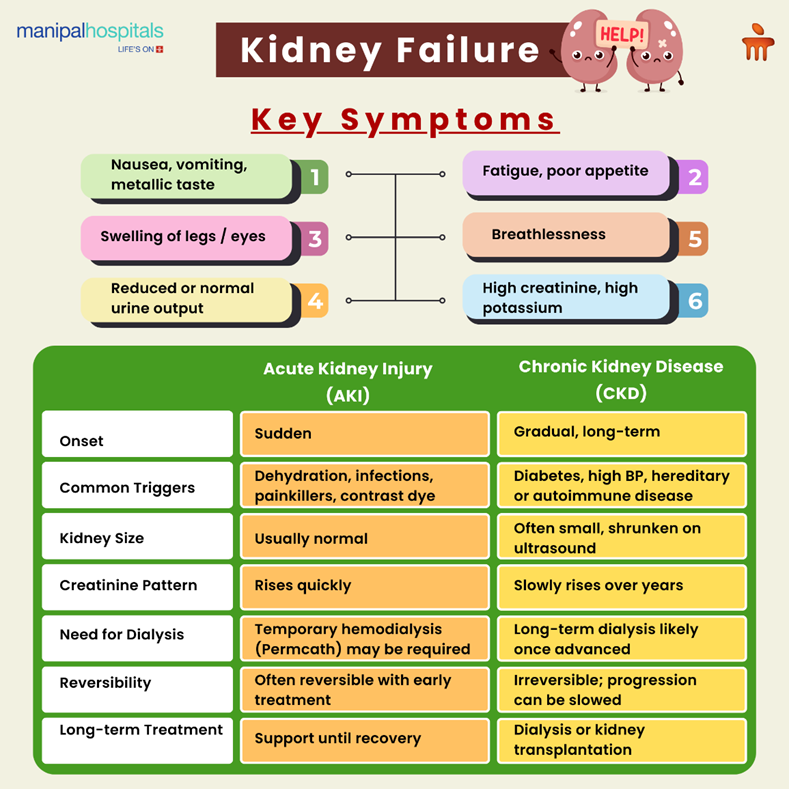
Kidney failure can produce a range of symptoms. Early signs of kidney disease are often subtle, while advanced dysfunction causes more obvious problems.
-
Fatigue, poor appetite, nausea and vomiting.
-
Reduced urine output in some cases, though urine output can be normal in others.
-
Swelling of legs or around the eyes from fluid retention.
-
Breathlessness from fluid overload or anaemia.
-
Confusion, difficulty concentrating or sleep disturbances in uremia.
-
Abnormal blood test results, such as high serum creatinine and high potassium, can be life-threatening.
If you or a loved one develops these symptoms, urgent medical review is important.
How Can Acute Kidney Injury Be Managed?
When kidney failure is sudden, the immediate aim is to identify and treat the cause and to support the body while the kidneys recover.
-
Identify and remove the trigger. Stop nephrotoxic drugs such as certain painkillers and antibiotics when appropriate. Correct dehydration or sepsis.
-
Treat reversible causes guided by tests and sometimes a kidney biopsy
-
Support renal function with temporary hemodialysis when uremic symptoms, dangerous electrolyte imbalances, or fluid overload threaten life. This often uses a temporary catheter, such as a Permcath, placed in the neck.
-
Monitor closely and provide nutrition, careful drug dosing, and infection prevention while recovery is assessed.
-
Many patients with AKI recover fully, but recovery requires timely diagnosis and correct supportive care.
When Does Chronic Kidney Disease Reach End Stage?
If kidney damage is advanced and irreversible, the choices are ongoing dialysis or kidney transplantation. Treatment selection depends on medical suitability, lifestyle, and personal preference.
|
Hemodialysis |
It is the commonest form of dialysis and is usually performed at a centre 3 times a week. Access is via an AV fistula, graft, or a central venous dialysis catheter. An AV fistula is surgically created between an artery and a vein and is the preferred long-term access because it has fewer complications. |
|
Peritoneal dialysis |
It uses the patient’s own peritoneal membrane and a permanent catheter to exchange fluid at home. It offers flexibility and is often used by patients who prefer home therapy and want to be in control of their treatment, who have satisfactory urine output, who have cardiac problems, or who have vascular access problems. It is given to motivated patients or caregivers who prefer to do the therapy at home or at work by themselves. |
|
Kidney transplantation |
Transplant is the best treatment for patients with end-stage kidney failure. A living donor transplant or a deceased donor transplant can restore normal kidney function and quality of life. Transplant requires lifelong immunosuppression and regular follow-up. But, of all the available renal replacement therapies, viz., hemodialysis, peritoneal dialysis, and kidney transplantation, the best treatment option is kidney transplantation. |
Choosing among these options involves discussing benefits, risks, and how each fits your life.
Understanding Dialysis: How It Works and What to Expect
Dialysis replaces some kidney functions. It is life-saving and allows people to live many active years, but it also requires adaptation.
-
Hemodialysis filters blood through a machine. Each session removes waste and excess fluid. It ensures a good quality of life, and the patients often return to their previous activity levels and will have a good quality of life. Some may experience tiredness after a session, which may become better once the patient and caregivers learn about fluid and diet balance in dialysis. The patients may have to visit the hospital or dialysis centre at least 3 times weekly for a 4-hour treatment duration.
-
AV fistula creation takes weeks to mature; until then a Permcath or temporary catheter can be used for urgent dialysis. Catheters have a higher infection risk and are used only when necessary.
-
Peritoneal dialysis is performed daily at home using dialysis fluid exchanged through a catheter. Automated devices can perform exchanges overnight for convenience.
-
Dialysis schedules, diet, and medications will be tailored. Regular tests monitor the adequacy of dialysis and overall health.
-
People on dialysis can work, travel, and enjoy family life with appropriate support and planning.
Kidney Transplantation: Benefits and Realities
Transplantation offers the closest return to normal kidney function but comes with lifelong responsibilities.
-
Kidney transplantation often improves energy, diet flexibility and life expectancy compared with dialysis for eligible candidates.
-
Living donor transplants usually offer the best outcomes and shorter waiting times. Pre-emptive transplant before dialysis starts is ideal when feasible.
-
After transplant, you will need lifelong immunosuppressive medications to prevent rejection and regular monitoring for complications and infection.
-
Donor safety is vital. Living donors receive a thorough evaluation and are advised to undergo term follow-up.
The goal of transplantation is durable kidney function and a restored quality of life.
Long-term Care
Kidney disease changes other aspects of health. Ongoing care aims to reduce complications and preserve remaining function.
-
Control blood pressure, blood sugar and cholesterol to slow further kidney damage.
-
Monitor for bone and mineral disorders, anaemia and cardiovascular disease. These require specific treatments.
-
Vaccinations and infection prevention are important, especially for people on dialysis or immunosuppression after a transplant.
-
Psychological and social support helps with adjustment to chronic therapy and medication regimens.
A multidisciplinary team including nephrologists, dietitians, and social workers supports long-term wellbeing.
Comparing Long-term Treatment Options
|
Category |
Hemodialysis |
Peritoneal Dialysis |
Kidney Transplantation |
|
Frequency |
3 times weekly |
Daily |
Lifelong follow-up |
|
Access needed |
AV fistula/catheter |
Peritoneal catheter |
Transplanted kidney |
|
Lifestyle impact |
Structured schedule |
Flexible |
Most normal lifestyles |
|
Risks |
Infection, fatigue after sessions |
Peritonitis risk |
Infection risk due to immunosuppression |
|
Best for |
Those who prefer supervised care |
Patients want home therapy. |
Medically fit patients |
Conclusion
Kidney failure is frightening, but there are clear, effective responses. Some conditions cause temporary acute kidney injury that recovers with timely support. Others represent chronic kidney disease that requires durable renal replacement therapy, ranging from hemodialysis and peritoneal dialysis to kidney transplantation. Early engagement with your nephrology team opens the best options, including pre-emptive transplant and planned vascular access.
If you or a family member has rising creatinine or symptoms suggesting kidney disease, book a consultation with our top nephrologists in Kanakapura Road immediately. They will review your tests, explain realistic options, and craft a personalised plan to protect your health and quality of life.
FAQ's
Yes. Many people assume that kidney failure means your urine output will stop, but that’s not always true. You can still pass a normal amount of urine and have severe kidney dysfunction. The kidneys may not be filtering toxins even though they are making urine.
The only reliable way to know is through proper evaluation. Your doctor will look at blood tests, urine tests, and an ultrasound to see whether the kidneys are acutely injured or chronically damaged. In some situations, a biopsy may be needed. Temporary causes usually improve with treatment, while long-term damage may require renal replacement therapy.
Not always. Some people need hemodialysis only for a short period while their kidneys recover from a sudden injury, as in an acute kidney injury. Once the underlying cause is treated, dialysis can be stopped. But, in other conditions when there is long-standing irreversible damage to the kidneys, dialysis treatment is for life, or until kidney transplantation.
Yes. Donor safety is always the first priority. Before anyone donates a kidney, they undergo a detailed evaluation to ensure they can live a healthy life with one. Most donors return to their normal routine within a few weeks and only need yearly check-ups to monitor their kidney function.
You can live well with the right support and a clear treatment plan. Many people continue working, travelling, and spending time with their families while on dialysis. It may take some time to adjust to the schedule, but once the body stabilises, your energy levels usually improve.
Definitely. Kidney transplantation is the best treatment option available for end-stage kidney disease, and these patients can return to a normal life and activity levels. But they will need some precautions, which include infection prevention, regular blood check-ups and follow-up, and lifelong immunosuppressive medications to prevent rejection of the transplanted kidney.
Share this article on: