7 Min Read
When it comes to aortic valve replacement, knowing the differences between traditional open-heart surgery and minimally invasive options is the first step toward making an informed decision with your healthcare team. If your aortic valve becomes very narrow or starts to leak, replacing it can be life-saving. Today, patients have more than one option for aortic valve replacement. In this blog, you will learn about minimally invasive procedures and traditional open-heart surgery. Learning about these options can help you feel more prepared and confident when discussing treatment with your doctor.
Synopsis
- Aortic Valve and Its Function
- What is Aortic Valve Replacement?
- When Do You Need to Replace Your Aortic Valve?
- Types of Aortic Valve Replacement
- Transcatheter Aortic Valve Replacement (TAVR)
- AVR Surgery (Open-heart Surgery)
- Main Differences Between Minimally Invasive and Open-Heart
- Recovery After Aortic Valve Replacement
- Risks of Replacing the Aortic Valve
- Conclusion
Aortic Valve and Its Function
The heart is a vital muscular organ responsible for pumping blood throughout the body. The aortic valve is one of the heart’s four main valves. It controls blood flow from the heart’s left ventricle into the aorta, the main artery that sends oxygen-rich blood throughout your body. If the valve doesn’t open or close as it should, the heart has to work harder to pump blood.
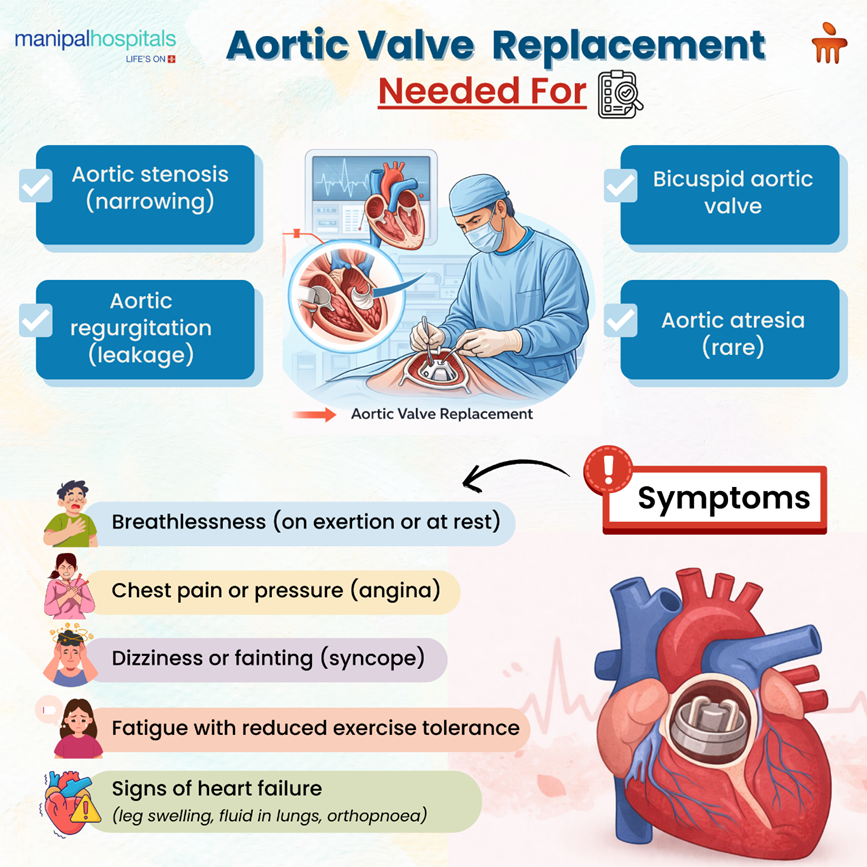
Common aortic valve problems include:
-
Aortic stenosis: The valve gradually becomes restricted, limiting blood flow
-
Aortic regurgitation: Blood leaking back into the heart
-
Bicuspid aortic valve: A bicuspid aortic valve has two leaflets instead of three
-
Aortic atresia: A rare condition with valve closure
Doctors often recommend aortic valve replacement surgery when symptoms become more severe or the valve damage increases.
What is Aortic Valve Replacement?
Aortic valve replacement is a surgery where the damaged valve is removed and replaced with a new, artificial valve. The new valve can be:
-
Mechanical valve: Lasts a long time but needs blood thinners for life.
-
Biological valve: Made from animal tissue and needs fewer medications in the long run.
The goal of aortic valve replacement is to restore normal blood flow, reduce symptoms, and improve both survival and quality of life. Minimally invasive valve replacement allows a much faster recovery and longer freedom from reinterventions.
When Do You Need to Replace Your Aortic Valve?
If you have any of the following, your doctor may suggest surgery to replace your aortic valve:
-
Breathlessness while doing things or at rest
-
Pain or pressure in the chest
-
Feeling dizzy or passing out
-
Tiredness and a reduced ability to exercise
-
Signs of heart failure
Types of Aortic Valve Replacement
There are two main ways to replace the aortic valve:
-
Minimally invasive techniques, such as transcatheter methods
-
Conventional open-heart surgery
Your age, overall health, the condition of your valve, and your surgical risk all help determine which option is best for you.
Transcatheter Aortic Valve Replacement (TAVR)
Transcatheter aortic valve replacement is a minimally invasive procedure. A thin tube called a catheter is used to deliver the new valve, usually through an artery in your leg.
How Does TAVR Work?
This approach does not require opening the chest or stopping the heart, so many patients recover more quickly.
-
There is no need for a large surgical incision in the chest.
-
The new valve is deployed within the diseased valve
-
Most of the time, the heart keeps beating during the procedure.
Who Should Get TAVR?
Surgical AVR, or surgical aortic valve replacement, is the traditional method and has been performed safely for many years. Transcatheter aortic valve replacement is often suggested for:
-
Elderly individuals
-
Patients who are at a high or moderate risk of surgery
-
People who have other health problems that make open surgery dangerous
Advances in technology have made this option more widely available, but it is not suitable for everyone.
AVR Surgery (Open-heart Surgery)
Surgical AVR, or Surgical Aortic Valve Replacement, is the traditional method and has been performed safely for many years.
How Is Surgical AVR Performed?
This method allows the surgeon to see the new valve directly and place it accurately.
-
The breastbone is used to open the chest.
-
The heart stops for a short time.
-
They take out the diseased valve and put in a new one.
Who Needs AVR Surgery?
People often recommend surgical AVR for:
-
Patients who are younger
-
People who have complicated valve disease
-
Patients who need more heart surgeries, like bypass surgery
Main Differences Between Minimally Invasive and Open-Heart
Aortic Valve Replacement: Minimally Invasive vs Open Heart
|
Cuts and Steps |
TAVI/TAVR (transcatheter aortic valve implantation/replacement) includes a small cut or hole. On the contrary, open surgery requires a bigger cut in the chest. |
|
Time to Get Better |
Minimally invasive procedures usually mean a shorter hospital stay and a faster return to your normal activities. Open-heart surgery requires a longer recovery, often several weeks. |
|
Risks and Problems |
TAVR may have the chance of needing a pacemaker. Surgical AVR involves more stress during the operation but provides better long-term results. |
|
Durability of the valve |
Surgical valves have been around for a long time. TAVR valves are improving as more long-term results become available. |
Your cardiologist will review each option to find the best balance of safety and benefit for you.
Recovery After Aortic Valve Replacement
How long it takes to recover depends on the type of aortic valve replacement you have.
Following TAVI/TAVR
-
Stay in the hospital for 2-4 days.
-
You will likely have less pain and be able to move around sooner.
-
You can start doing your normal activities again in 1-2 weeks (varies per individual)
Following Traditional Surgery
-
Stay in the hospital for 5-7 days.
-
The bone in your chest will heal gradually.
-
Full recovery may take 6 to 8 weeks.
Risks of Replacing the Aortic Valve
All medical procedures have some risks, but modern techniques have made aortic valve replacement safer than ever. Some possible risks are:
-
Infection or bleeding
-
Problems with the heart's rhythm or stroke
-
Leakage or failure of the valve
-
Clots in the blood
-
Need for another intervention
Your level of risk depends on your age, overall health, and the type of procedure you have.
Conclusion
Deciding between minimally invasive treatment and open-heart surgery can be difficult. Understanding the differences between transcatheter aortic valve replacement and surgical AVR can help you and your healthcare team make the best decision. Both methods are highly effective when used for the right patient at the right time.
If you have been diagnosed with aortic valve disease, visit Manipal Hospital Kanakapura Road to determine the best-suited aortic valve replacement surgery in Kanakapura Road, Bangalore.
FAQ's
Your doctor will consider your age, health, valve condition, and surgical risk. Some people do better with transcatheter aortic valve replacement, while others benefit more from surgical AVR. Getting a personalised evaluation is important.
Yes, the goal of aortic valve replacement is to provide long-term relief. Biological valves can last 10 to 20 years, depending on your age and lifestyle. Mechanical valves may last a lifetime.
When performed at experienced centres, both procedures are safe. Minimally invasive techniques usually allow for a faster recovery, while open-heart surgery may offer longer-lasting results for some patients. The safest option depends on your individual health.
Some patients, especially those with mechanical valves, need to take blood-thinning medicine for life. Others may only need standard or short-term heart medications. Your doctor will explain your treatment clearly.
About a week after transcatheter aortic valve replacement, many people can begin light activities. Full recovery after open-heart surgery to replace the aortic valve may take several weeks.
Share this article on: