7 Min Read
Heart disease remains a major health concern worldwide, but advances in medical technology have made treatments safer and more effective. Angioplasty ihearts one such life-saving procedure. If you or someone you care about needs this treatment, it's natural to have questions or concerns. This guide explains angioplasty, how it works, what to expect during recovery, and possible risks, all in clear and simple language to help you feel more comfortable and informed.
Synopsis
What is Angioplasty?
Many people are curious about angioplasty meaning, and how it benefits the heart. Angioplasty is a minimally invasive procedure that opens blood vessels that are too narrow or blocked. It is most often used on the coronary arteries, which supply blood to the heart muscle.
The word ‘angioplasty’ means the widening of a blood vessel (angio) to bring back healthy blood flow. When plaque builds up in arteries, it can block blood flow to the heart, which can cause chest pain (angina) or even a heart attack.
Angioplasty is a quick and effective way to get rid of this blockage. Patients sometimes also use the term 'angiosurgery' for this procedure. Unlike bypass surgery, angioplasty doesn’t require opening the chest. Instead, it uses thin tubes and special equipment, making it less invasive and allowing for a quicker recovery.
Why One May Need Angioplasty?
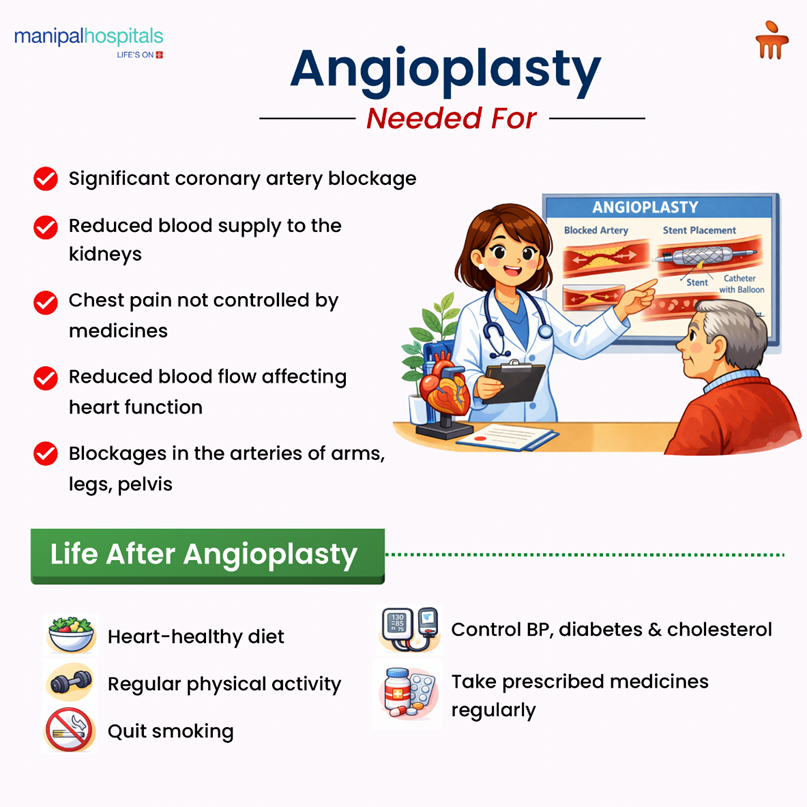
Coronary angioplasty is especially effective at quickly relieving symptoms and preventing further heart damage. If you have any of the following, your doctor may suggest angioplasty:
-
A lot of blockage in the coronary arteries
-
Pain in the chest that medicine can't help with
-
A heart attack or at high risk of having one
-
Less blood flow affects how the heart works.
Preparation Before Angioplasty
Preparing for angioplasty helps reduce risks and ensures a smoother procedure. Your doctor will review your medical history, medications, and test reports. You may be asked to fast for several hours before the procedure and temporarily stop certain medicines if required. Consulting an experienced cardiologist in Kanakapura Road, Bangalore can help you understand the procedure clearly and prepare confidently.
Basic tests such as blood tests, ECG, or imaging may be done before treatment. Wearing comfortable clothing and arranging transport after discharge can also make the process easier. Following your doctor’s instructions helps support safe treatment and faster recovery.
What Happens in an Angioplasty Procedure?
Angioplasty is usually performed in a specialised cardiac catheterisation laboratory, or cath lab. The procedure typically takes 30 minutes to 2 hours, depending on its complexity.
Step-by-Step Angioplasty Process:
-
Getting ready: Local anaesthesia is given at the entry site, usually the wrist or groin. You remain awake but comfortable during the procedure.
-
Putting in the catheter: A thin tube called a catheter is carefully put into a blood vessel and led to the heart.
-
Angioplasty with a Balloon: A small balloon at the end of the catheter is inflated in the narrowed area. This step, called balloon angioplasty, pushes plaque aside and widens the artery.
-
Putting in an angioplasty stent: A small metal mesh tube, called an angioplasty stent, is usually placed to keep the artery open. The stent remains in place to support the vessel.
-
Finished: The balloon is deflated and removed, while the stent stays in place to keep blood flowing. Some people refer to the procedure as ‘balloon heart surgery,’ but it is not a traditional surgery.
Different Types of Angioplasty
Your cardiologist will recommend the best option for you based on your health. The following are some of the common types of angioplasty:
|
Type of Angioplasty |
What It Means |
Use Cases |
|
Balloon Angioplasty |
A small balloon attached to a thin tube is guided into the blocked artery and gently inflated. |
Often used when arteries are narrowed due to plaque build-up in the heart or other parts of the body. |
|
Stent Angioplasty |
A tiny mesh tube called a stent is placed inside the artery after balloon expansion. The stent stays in place permanently. |
Commonly used in heart artery blockages and in patients who need long-term support to keep the artery open. |
|
Drug-Eluting Stent Angioplasty |
Similar to regular stent placement, but the stent is coated with medication that is slowly released into the artery. |
Used in patients with a higher risk of artery re-narrowing or those with complex blockages. |
|
Rotational Angioplasty |
A tiny rotating device is used to break down very hard or calcified plaque before placing a balloon or stent. |
Used when plaque is extremely hard and cannot be treated with a balloon alone. |
|
Laser Angioplasty |
A laser attached to a catheter is used to break down plaque inside the artery. |
Used in selected cases when other methods are not suitable or when blockages are complex. |
Does Angioplasty Carry Any Risks?
Angioplasty is considered safe, but like any medical procedure, it does carry some risks. These risks are usually ‘low and easily manageable,’ especially when experienced cardiologists perform the procedure.
-
Some common risks of the procedure can be:
-
Bleeding or infection at the site of the catheter
-
Damage to blood vessels or kidneys
-
Re-narrowing of the artery (restenosis)
-
Blood clots forming inside the stent
-
An allergic reaction to anaesthesia or contrast dye
-
Reduced blood pressure
Your doctor will carefully look at your condition to lower the risks and make sure the treatment is safe.
Recovery After Angioplasty
After an angioplasty procedure, recovery is usually quick, especially when compared to open-heart surgery.
-
Most patients stay in the hospital for one to two days. In some simple cases, you may be able to go home the next day.
-
A little pain or bruising at the catheter site, and feeling drained for a few days.
-
Slowly getting back to normal activities
-
Light activities are usually doable within one to two weeks.
Lifestyle Changes After Angioplasty
Angioplasty can treat blocked arteries, but it does not cure heart disease. Making healthy lifestyle choices is important for long-term success:
-
A diet that is beneficial for your heart
-
Regular exercise
-
Giving up smoking
-
Taking care of diabetes, high blood pressure, and high cholesterol
-
Taking your medications as directed
These steps help protect your heart and prevent future blockages.
Conclusion
Heart problems can be frightening, but getting prompt care can save lives and improve your quality of life. Understanding angioplasty and the recovery process can help reduce anxiety and give you the information you need to make informed decisions.
If you or a loved one needs coronary angioplasty, seeking help and advice early at our centre for angioplasty surgery in Kanakapura Road can make a big difference.
FAQ's
People don't consider angioplasty to be a major surgery. A thin catheter is put in through the wrist or groin for this procedure, which is not very invasive. Because there isn't a big cut or opening in the chest, recovery is much faster than after open-heart surgery.
No, during angioplasty, most people don't feel much pain. When the balloon is blown up, you might feel a little pressure, but it usually only lasts a few seconds. You stay awake and comfortable during the procedure with the use of local anaesthesia.
Most people recover quickly after angioplasty. You can usually walk within a few hours and return to normal activities within a week. Full recovery may take one to two weeks, depending on your health and whether a stent was placed.
Yes, it is possible to return to normalcy after an angioplasty. With healthy eating habits, moderate exercise, stress management, and regular check-ups, angioplasty can greatly improve heart health and quality of life.
Share this article on: