6 Min Read
Epilepsy is a brain condition that affects millions worldwide. Over 50 million people globally live with epilepsy. While modern medicine offers significant hope for epilepsy management, awareness, knowledge and proper care can help individuals lead healthy and active lives. This guide aims to provide clear and vital information on epilepsy symptoms, causes and treatment modalities to help manage the condition more effectively.
Synopsis
Epilepsy is more than just seizures
Epilepsy is a chronic brain disorder marked by recurrent, unprovoked seizures. A seizure is defined as a ‘sudden, uncontrolled electrical disturbance in the brain’. The key difference between seizure and epilepsy is that a single seizure can occur due to various triggers (like fever), while epilepsy is diagnosed after two or more unprovoked seizures, or one with a high risk of recurrence due to an underlying brain condition.
What causes epilepsy?
Epilepsy causes remain unspecified to date (idiopathic epilepsy). However, several factors can contribute or trigger this condition, such as:
-
Genetics- Some epilepsy types have a hereditary connection
-
Brain injury- Head trauma can lead to epilepsy, even years later
-
Strokes and vascular issues- Very common, especially in older adults
-
Brain infections- Meningitis or encephalitis can damage brain tissue
-
Brain tumours- Both benign and malignant tumours can disrupt brain activity
-
Prenatal injuries- Brain damage before birth due to various factors
-
Developmental conditions- Certain conditions, such as autism, may be associated
Identifying the symptoms of epilepsy
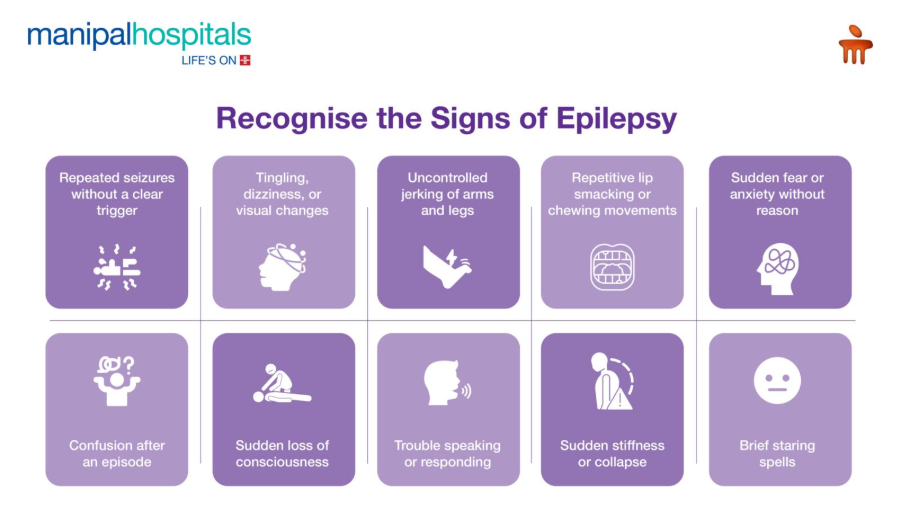
Epilepsy symptoms depend largely on the affected area of the brain. According to this, seizures are broadly categorised into ‘generalised’ and ‘focal’ seizures, with their specific sets of symptoms.
Generalised seizure symptoms (affects both sides of the brain)
-
Tonic-Clonic (Grand Mal)- Body stiffens, then jerks; loss of awareness, potential for tongue biting or loss of bladder control
-
Absence (Petit Mal)- Brief staring spells that are often mistaken for daydreaming, with minimal movement
-
Atonic (Drop Attacks)- Sudden loss of muscle tone causing a fall
-
Myoclonic: Brief, sudden muscle jerks, often in arms or shoulders
Focal Seizure Symptoms (starting in one part of the brain)
-
Focal Aware (Simple Partial)- Awareness is maintained; may involve jerking, sensory changes (tingling, odd smells), or sudden emotions
-
Focal Impaired Awareness (Complex Partial)- Awareness is altered or lost; confusion, blank stares, repetitive movements (lip-smacking), and no memory of the event
Types of epilepsy
Understanding the different types of epilepsy is crucial for accurate diagnosis and treatment planning:
-
Generalised Epilepsy- Seizures affect both sides of the brain from onset, like Childhood Absence Epilepsy
-
Focal Epilepsy- Seizures start in a specific area of the brain, such as Temporal Lobe Epilepsy
-
Combined Generalised and Focal Epilepsy- Individuals experience both types of seizures
-
Unknown Onset Epilepsy- The origin of seizure (focal or generalised) cannot be determined at diagnosis
How is epilepsy treated?
Significant advancements in epilepsy treatments now allow most people to manage their condition effectively. The primary goal is seizure control with minimal side effects. The various approaches for managing or treating epilepsy include:
Medical Management
-
Anti-seizure medications (ASMs): This is the first line of treatment and can help up to 70% of people to enjoy a seizure-free life. For the rest, it can significantly reduce seizure frequency
-
Dietary Therapies: Diets like the Ketogenic Diet can help some, particularly children, whose epilepsy doesn't respond well to medication
Surgical Interventions
Surgery may be an option for drug-resistant epilepsy/seizures that originate from a clearly defined and safely removable brain area. This can lead to a significant reduction in seizures or even freedom from seizure in 50-70% of suitable patients.
Other Therapies
-
Vagus Nerve Stimulation (VNS)- Electrical signals are sent to the brain using a device
-
Responsive Neurostimulation (RNS)- Abnormal brain activity is detected to deliver pulses
-
Deep Brain Stimulation (DBS)- Electrodes are placed in the brain to modulate activity
Conclusion
Living with epilepsy requires patience and professional guidance. The bottom line of effective epilepsy management involves proactive self-care and informed decisions. Remember to maintain a seizure diary, take medications consistently, ensure adequate sleep, inform close contacts about your condition, and consult your neurologist on a regular basis.
If you or someone you know exhibits epilepsy symptoms or requires expert management, do not wait; seek prompt medical advice at Manipal Hospitals EM Bypass. Our expert neurologists ensure advanced treatment options through comprehensive and personalised care.
FAQ's
Epilepsy is a neurological disorder that affects the brain’s electrical activity and causes recurrent seizures. It is not a mental illness. Although people with epilepsy may experience emotional or psychological difficulties, the condition itself is a physical brain disorder.
Although there is no universal cure for epilepsy, many individuals can become seizure-free with appropriate medications, and some may outgrow the condition. In certain cases, options like surgery or advanced therapies can greatly reduce the frequency and severity of seizures.
Yes, in some cases, epilepsy can be linked to genetics. Certain types of epilepsy have hereditary components, increasing a person’s susceptibility. However, many people diagnosed with epilepsy have no known family history, indicating the involvement of other non-genetic factors.
Carefully help the person to the floor. Remove nearby hazards, cushion their head, and turn them onto their side. Do not restrain movements or place objects in the mouth. Seek medical help if it lasts more than 5 minutes.
Call emergency services if a seizure lasts longer than five minutes, repeats without recovery, causes injury, occurs in water, happens for the first time, or if the person has breathing difficulties afterwards.
Share this article on: