


Book An Appointment
Why Choose Manipal?
Experience cutting-edge medical treatments and compassionate care at Manipal Hospital Miller's Road. Your health is our top priority.
Our Strengths:
Best Orthopaedic Hospital
in
Bangalore
At Manipal Hospital Miller's Road, Bangalore, our Orthopaedics Department specializes in the comprehensive care of the musculoskeletal system. Led by a team of highly experienced orthopaedic doctors in Bangalore, we are dedicated to providing both surgical and non-surgical treatments for a wide range of orthopedic issues, ensuring that our patients receive the highest quality care. Common orthopedic conditions we treat include fractures, arthritis, and sports-related injuries. Our expertise includes advanced procedures like arthroscopy (a minimally invasive technique for joint issues) and joint replacement (replacing worn-out portions of an injured joint with state-of-the-art prosthetics).
Treatments and Procedures
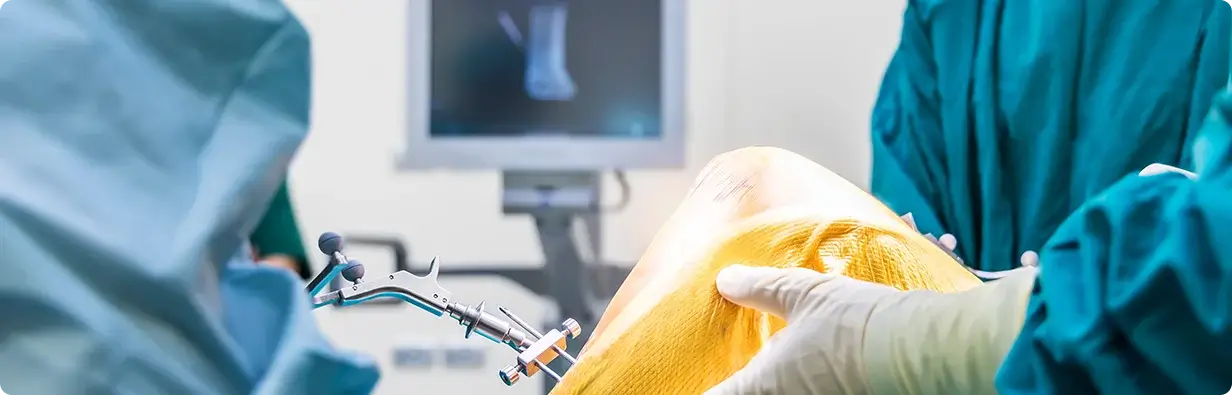
If your knee joint becomes significantly damaged or the pain is severe, your
orthopaedics specialist
may suggest a total knee replacement. This robotic knee surgery procedure
involves removing the
damaged knee joint and replacing it with a prosthetic implant. The knee joint
consists of three
separate compartments: the medial, lateral, and patellofemoral. In some patients,
only one
compartment, typically the medial, is affected by osteoarthritis, leaving the
other compartments
intact. In a total knee replacement, the medial and lateral compartments are removed
and replaced
with an artificial joint, including the patellofemoral compartment, when
necessary.
During the robotic total knee replacement procedure, the orthopaedic surgeon
makes an incision in
the knee with the help of robotic arms and shifts the patella (kneecap) aside. Any
bone spurs, which
can develop in osteoarthritis, are removed if present. Then, the surgeon removes the
two menisci
between the femur and tibia, as well as the anterior cruciate ligament (ACL) and, in
some cases, the
posterior cruciate ligament (PCL).
Depending on the type of knee replacement, the PCL might be preserved. In the main
phase of the
procedure, the surgeon removes cartilage and some bone from the upper part of the
tibia and the
lower sections of the femur. The femoral sections removed are the two knobby
protrusions known
as the femoral condyles. Metal implants are then placed on the tibia and femur to
create new
surfaces for the joint. The femoral component's surface is shaped to replicate
the original femoral
condyles. If the kneecap is also damaged, its underside may be resurfaced with a
polyethene
implant.
Lastly, the surgeon repairs the tissue layers with dissolvable sutures and closes
the skin incision with
sutures or surgical staples. A bandage is applied around the knee, and the patient
is moved to
recovery.
Facilities and Services
The facilities and services available at Manipal Hospital Miller's Road for your best possible care include the following:

Advanced technology & diagnostic services

State-of-the-art
operation theatres

Stringent infection prevention measures

ICU & post-operative
care

Physiotherapy & rehabilitation services

Easy access to medicines & lab reports

Comprehensive preoperative assessments

Patient education and support
Dedicated recovery rooms
Patient Experiences
Combining the best specialists and equipment to provide you nothing short of the best in healthcare.
Patient Experiences
Combining the best specialists and equipment to provide you nothing short of the best in healthcare.
FAQ's
● Fractures
● Arthritis
● ACL tear
● Rotator cuff tear
● Tendonitis
● Osteoporosis.
● Severe pain
● Persistent swelling in a joint
● Limited mobility
● Injury causing pain or swelling
● Long-standing (chronic) pain that interferes with your daily activities
● Always warm up before a match. It reduces the risks of injury.
● Make sure you're dressed appropriately, including footwear and padding.
● Drink enough water to keep your muscles and joints working properly.
● Allow your body to rest in between games and workouts.