Best Heart Care - Manipal Hospital Jayanagar

Book An Appointment

Why Choose Manipal?

At Manipal Hospital Jayanagar, we recognize the importance of entrusting your health to a reliable hospital. Our Cardiology Department is dedicated to providing exceptional care for individuals with heart conditions. Our expert team includes Cardiologists, Echo Cardiologists, Interventional Cardiologists, Electrophysiologists, Radiologists, and Cardiovascular Surgeons, ensuring your heart receives the specialized care it deserves. Our Heart Surgeons tailor personalized treatment plans, leveraging empathy, knowledge, innovation, and patient-centred care to support you through every step of your heart health journey—from screenings to complex surgeries and on-going care.

Choosing Manipal Hospitals is choosing health in many ways:
Decades of expertise
Leading cardiologists and cardiovascular surgeons
State-of-the-art technology for diagnosis and procedures
Personalized Care
Support services & Rehabilitation
Strict infection control protocols
8
+
million patients annually
49
Hospitals
11000
+
doctors
12600
Licensed beds
24
serving cities
34000
+
Employee strength

Advanced Cardiac Care
in Bangalore

Heart disease continues to be a major health issue and a leading cause of death around the world – this highlights the crucial need for specialised heart care. Cholesterol, high blood pressure, diabetes, smoking, unhealthy diet, obesity, and physical inactivity can have a negative impact on your heart.

Treatments and Procedures

Echocardiogram (Echo)
TMT
Coronary Angiogram
Angioplasty
Pacemaker Implantation
An Echocardiogram or Echo is a pain-free imaging test to diagnose your heart condition. The procedure takes about 30-60 minutes and no special preparation is needed. An Echo can identify structural heart defects including Cardiomyopathies, Congenital heart defects, Pericardial disease, Heart failure, and Valvular heart disease.

Our cardiologists in Jayanagar may recommend undergoing an Echo to:
• Find out the cause behind your chest pain, shortness of breath, or heart murmurs
• Monitor an existing heart disease for progression
• Assess heart function before surgery
• Evaluate for congenital heart defects in new-borns or unborn babies

The patient is examined while lying on their back on an examination table. An ultrasound device is placed in your chest wall which transmits sound waves to the heart and its supporting structures through the chest wall. These sound waves are used to create detailed pictures of the structure and functions of your heart valves, muscles, and heart chambers.
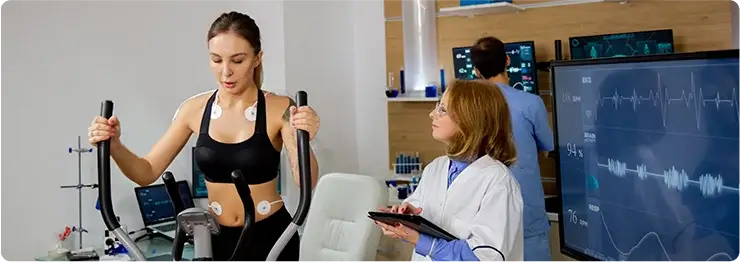
A TMT is a treadmill test. This non-invasive diagnostic process is also known as an Exercise Stress Test and takes about 20-45 minutes. It is used to evaluate your heart's response to physical exertion. Doctors can also identify potential issues with blood flow to your heart.

The test starts with you walking or jogging on a treadmill. This requires you to wear comfortable clothing and shoes. The doctor will attach electrodes to your chest that monitor your heart rhythm (ECG) and blood pressure throughout the test. Our healthcare professionals also record your baseline heart rate and blood pressure before beginning the exercise.
A Coronary Angiogram, also called Cardiac Catheterisation, is a minimally invasive procedure that captures continuous X-rays to visualize your coronary arteries. These arteries supply oxygen-rich blood to your heart muscle. The procedure helps diagnose and assess abnormalities like blockages or narrowing (stenosis) within these arteries, and evaluate blood flow to the heart muscle.

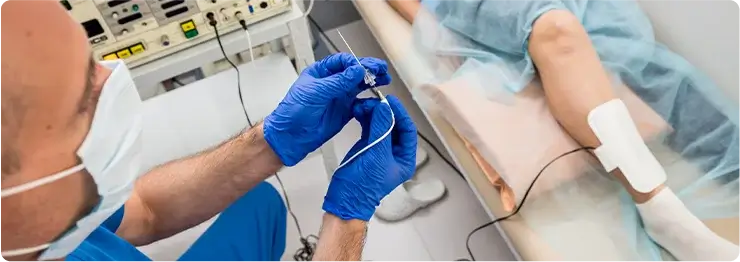
During the angiogram, a thin, flexible tube called a catheter is inserted into an artery in your groin or arm following local anaesthesia. A contrast dye is then injected through the catheter into your coronary arteries which highlights blood flow and revealing any blockages present in the arteries. After capturing the images, the catheter is carefully removed. Recovery is typically quick, and you can usually go home the same day or the next day.
Angioplasty, a minimally invasive procedure, widens blocked or narrowed arteries or veins to improve blood flow. It is often performed in conjunction with angiography and can take from 30 minutes to several hours. The timeline depends on the complexity of the procedure and your condition.

Angioplasty involves inserting a small, deflated balloon catheter into the narrowed artery. Once the catheter is positioned within the narrowed artery, the balloon is inflated to push against the plaque build-up. This eventually widens the vessel and improves blood flow. In some patients, doctors may also place a stent within your artery. After everything is done, the catheter will be carefully removed and you will be monitored for a while to ensure no complications. There might be some soreness or bruising, which resolves within a few days.
A pacemaker is a small, battery-powered medical device that is implanted in the chest to regulate your heartbeat. It can be used as a treatment for various heart rhythm issues like bradycardia (slow heart rate) or arrhythmias (irregular heartbeats). The pacemaker monitors your heart rhythm and can deliver electrical pulses when necessary to ensure your regular heartbeats.

There are two main types of pacemakers:
Single-chamber pacemaker: This stimulates one chamber of your heart. It is generally suitable for certain types of bradycardia.
Dual-chamber pacemaker: Stimulating both the ventricles, dual-chamber pacemakers help in a coordinated contraction of your heart chambers and improve blood flow. It is more suitable for complex arrhythmias.

This simple procedure involves the administration of local anaesthetic and making a small incision on your chest below your collarbone. The pacemaker will be implanted under the skin. Thin and insulated wires (leads) will be inserted into one or both heart chambers which transmit electrical signals between the heart and the pacemaker generator. Our skilled cardiologists will monitor you for a few hours after the day-care procedure.

Visit Manipal Hospital Jayanagar for all your heart-related ailments.

Want to meet a Doctor for checkup?

Facilities and Services

Manipal Hospital Jayanagar, Bangalore, offers excellent surgical facilities and support services, including:

Advanced technology

State-of-the-art
operation theatres

Easy access to Medicines
& Lab reports

Minimally-invasive
approaches

ICU care &
post-op monitoring

Physiotherapy & Rehabilitation
services

Comprehensive heart care

>

Patient Experiences

Combining the best specialists and equipment to provide you nothing short of the best in healthcare.

Patient Experiences

Combining the best specialists and equipment to provide you nothing short of the best in healthcare.

FAQ's

Our team of expert cardiologists in Jayanagar is experienced in diagnosing and treating several heart conditions. This includes:

● Coronary artery disease (CAD)
● Heart failure
● Myocarditis (heart muscle inflammation of the heart muscle)
● Valve Disease
● Arrhythmias (irregular heartbeats)
● Pericardial disease (inflammation of the sac surrounding the heart)
● Congenital heart defects

To perfectly assess your heart condition, we utilise several diagnostic methods. Some are done alone; some are done in combination. The best judge of this is our highly skilled doctors. Some of these procedures are:

● Echocardiogram (echo)
● Treadmill test (TMT)
● Holter monitor (continuous ECG recording)
● Angiography
● Cardiac MRI or CT scan, etc.

At Manipal Hospital Jayanagar, our cardiologists are skilled in performing minimally invasive procedures, such as Angioplasty with stent placement, Catheter ablation, Pacemaker insertion, etc.

Cardiac rehabilitation is a personalised program offered by Manipal Hospital Jayanagar, Bangalore. This can assist you in recovering from surgery or other heart conditions. You may need to follow all or some of the following steps to ensure complete rehabilitation.

● Education about heart-healthy living
● Stress management techniques
● Nutritional counselling
● Exercise training

We can connect you with several support groups to make you feel included in the process.

Chest pain does not always mean that you are facing some heart issue. However, whenever you feel discomfort in your chest, do not hesitate to book an appointment with our experienced team of cardiologists at Manipal Hospital Jayanagar. They can diagnose the cause behind your chest pain and help you with the following treatment plan.